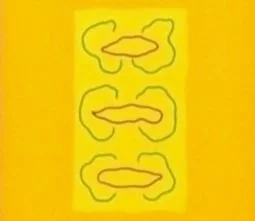
1972 - Roxy Bias Screenprints
KEVIN HARRIS & ANTHONY BENJAMIN WORKING WITH COOPERATIVE CREATIVITY
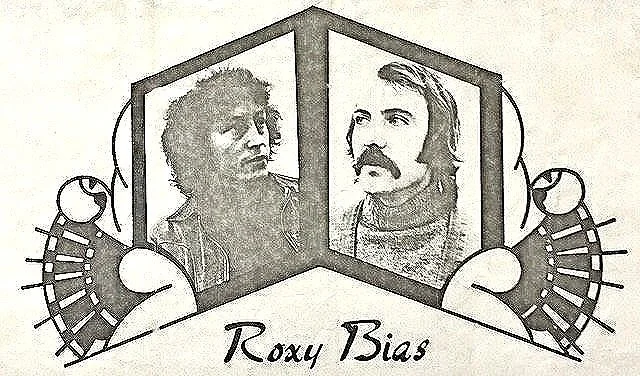
Benjamin had formed an excellent creative partnership with Master Screenprinter, Kevin Harris when he was commuting back and forth between Canada and London when they were working together to produce the TransAtlantic suite of images. His prints were selling well and winning prizes at international exhibitions; he enjoyed the whole business of printmaking and was keen to do more. He also was good at working cooperatively with skilled technicians, because he was very skilled himself, and partly because he knew what he wanted to achieve and realised that having the best people to work with would help him to achieve the the challenging goals he set for himself. He wanted to do more screen printing because it was a good way of working with the intense colours he loved.
When he finally finished with Canada and was again living in London, he resumed personal contact with Brian Eno who was fully involved in his music career, enjoying the fun of being a ‘Pop Star’, even tho he was not a musician in the conventional way. He was brimming with enthusiasm about the endless possibilities in the relatively new field of electronic music. During their lively wide-ranging, conversations, Benjamin evolved the concept of making prints that had a vibrating, visual impact within each image, as well as with other images in a set, that related to the aural impact of electronic music. Eno invited him and Nancy to a Roxy rehearsal at the Hammersmith, Odeon; they watched a few numbers from the back row of the huge cinema enjoying the sounds’ then during a pause in the music, Bryan Ferry noticed them sitting there in the dark, and threw a tempermental wobbler, so they had to leave. This was disappointing, but it did nothing to dampen Benjamin’s enthusiasm about making a suite of prints to be named - the Roxy Bias Suite.
Benjamin was delighted that Kevin Harris shared his enthusiasm for the project and agreed to work with him again at Calvert Studios. The procedure was collaborative; Harris set everything up and Benjamin cut the stencils by drawing directly on the film with a sharp scalpel, not by tracing over a drawing. After the stencils were mounted, they dove into the proofing using a ide range of vibrant intense colour, intending to produce six images by using an experimental proofing process, not by following any preconceived designs. They printed the various stencils in many different colour combinations, searching for the maximum colour impact. “Let’s try this one … darker?… more blue? … a bit more? …That’s it, Let’s print!”…
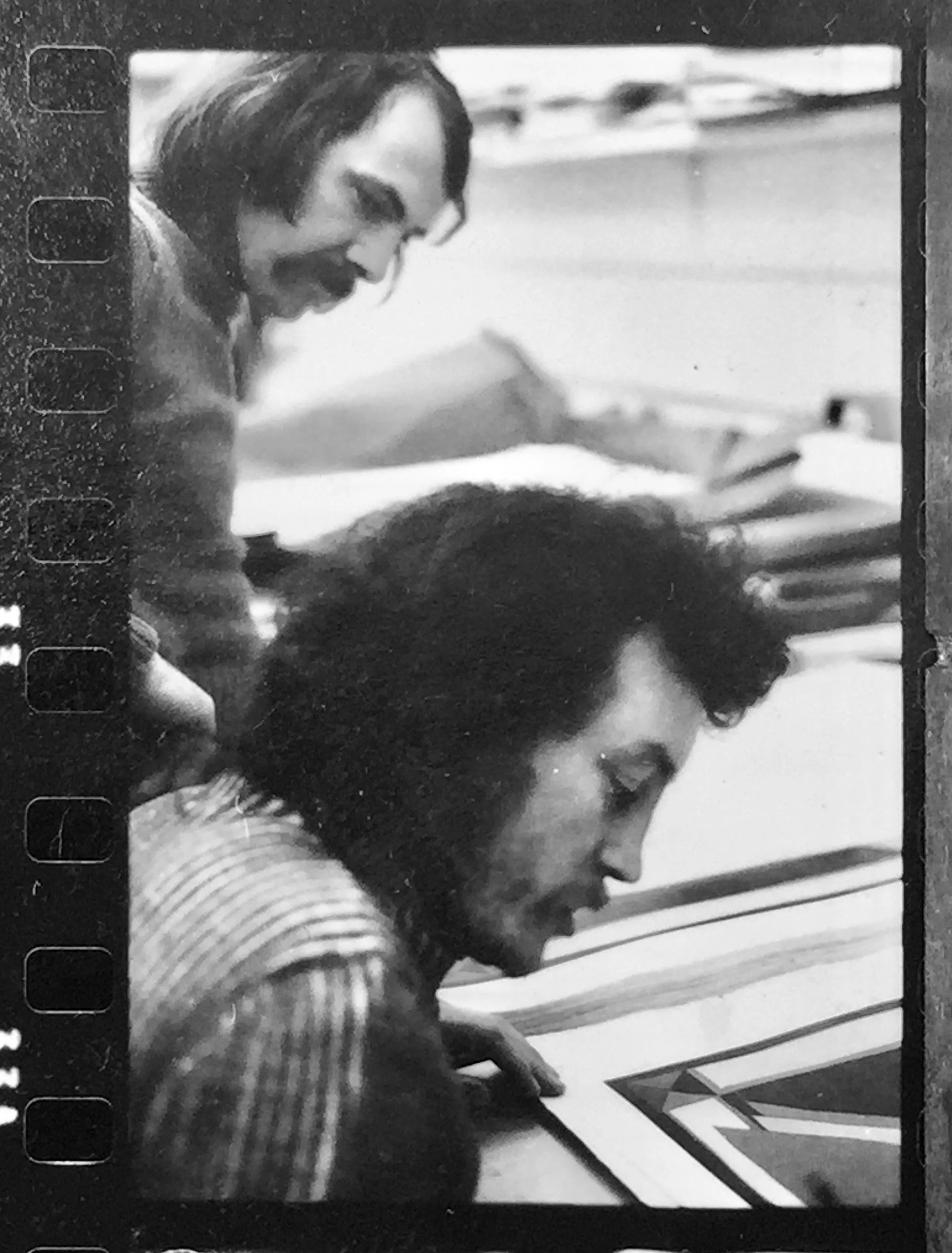
Benjamin and Harris
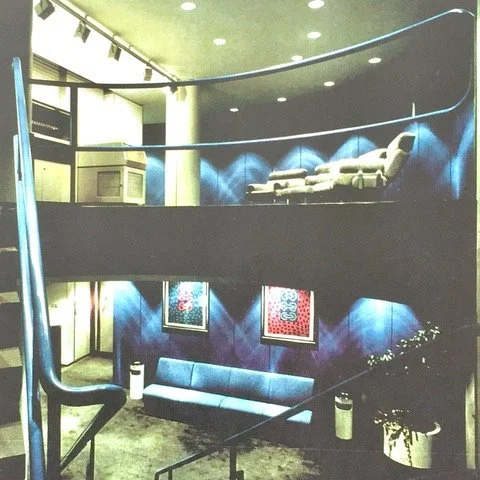
Rank Xerox Headquarters
“His prints can be read like maps. Some beings might actually choose to build something here or there. To each an appropriate beach, for they sparkle and delight and sometimes sheets are arranged like window panes. You must study them. They are like glass and you dropped them. One became a sort of whirl and spun off the edge… ”
Oliver Bradbury
Then the proofs were pinned on the studio wall for them, and anyone else who was around to compare and offer opinions over a cup of tea, or a bottle of wine. Eventually six images in three pairs that had the most dynamic impact together, as well as with the other images, were selected. The titles for the Roxy Bias Suite were terms for electronic music functions that Benjamin picked up in conversations with Eno - Butterfly Echo, Erase Function, Ringing Filter, Inverse Echo, Multi-Mode Jitter, and ‘O’Factor. Harris then undertook the exacting task of printing the six selected proofs in editions of 95, with A/Ps, on BFK Rives,105 x 76 cm., handmade paper, signed, and numbered by Benjamin; the unselected, but equally beautiful images were also signed as- ‘Unique Proof’s.
The Suite was an immediate success, winning several prizes at International exhibitions, including the Cracow Biennale, as well as in the corporate market on both side of the Atlantic. Rank Xerox had several sets for their headquarters and private clients sually purchased them them in pairs. The prints were published by Clarendon Graphics, distributed by Gorner and Millard in the UK, and Marlborough Goddard in Canada. Erase Function won a prize in a juried exhibition of more than 1200 prints, sponsored by the Ontario Arts Council. The mainly blue image almost sold out in the show that was marketed as - “Art for people with more taste than money”.

“ Benjamin’ work is emphatically visual yet conceptual elements play leading roles in it. He is among the most articulate and philosophical of British artists and for many years his painting has been predominately concerned with giving pictorial form to thought” - Norbert Lynton, Studio International
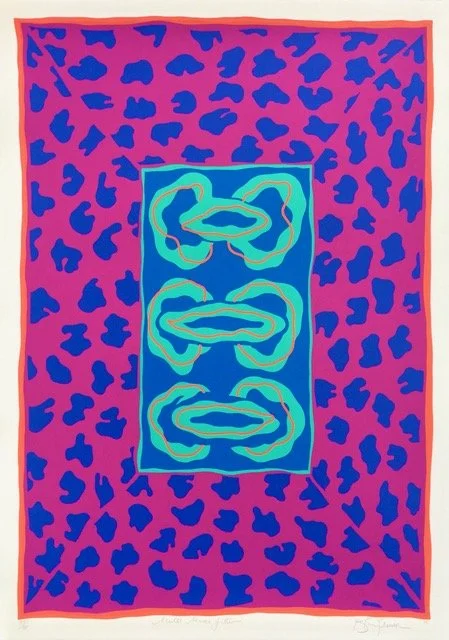
Multi- Mode Jitter
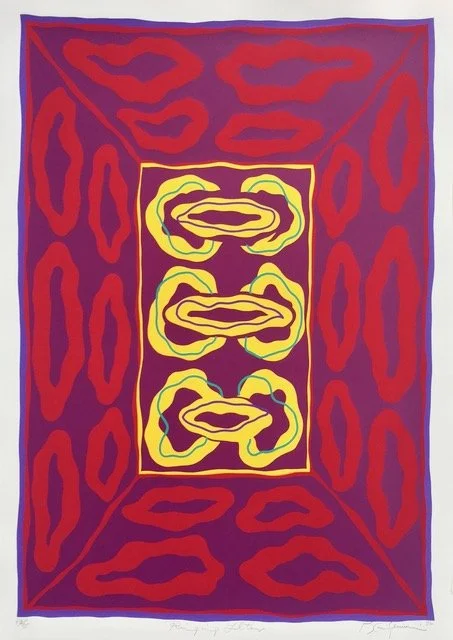
Ringing Filter
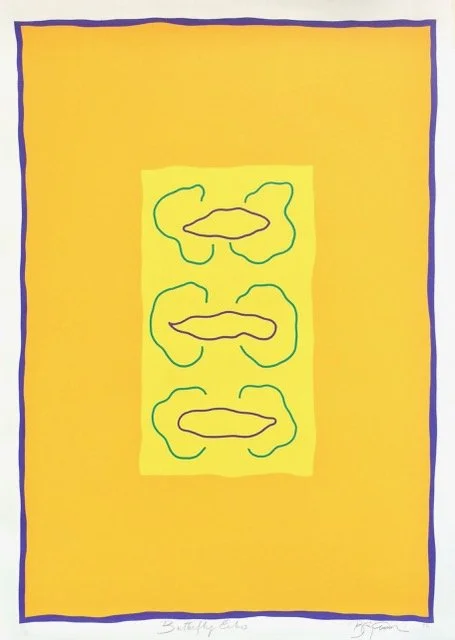
Butterfly Echo
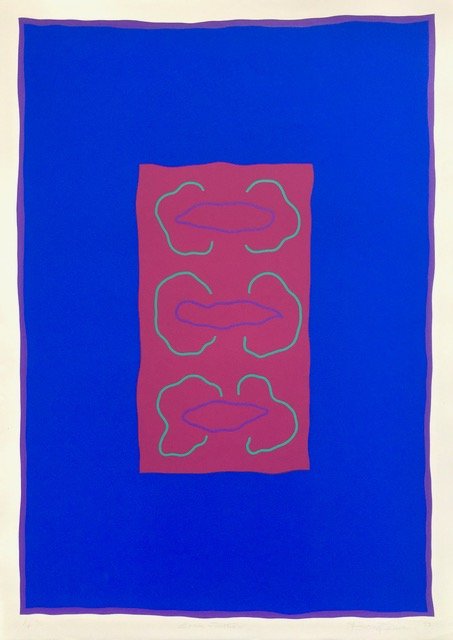
Erase Function
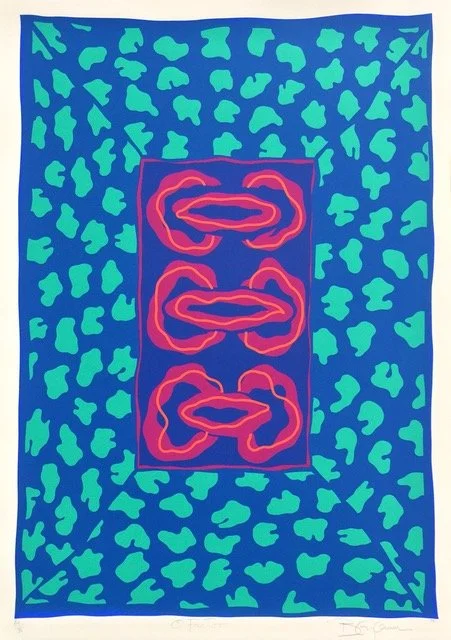
‘O’ Factor
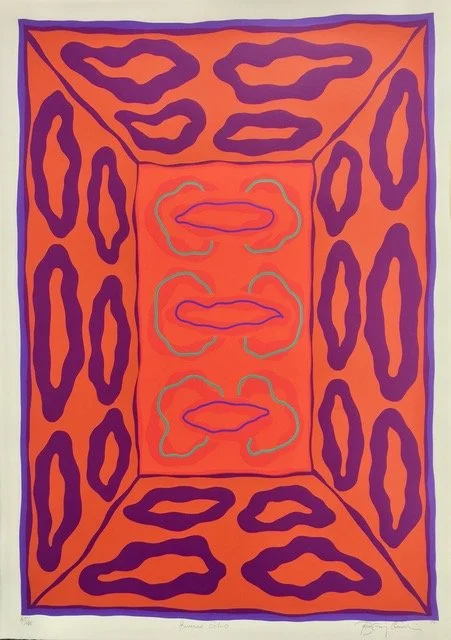
Inverse Echo
REVISITING ROXY - In the late 1990s, inspired partly by his visual and musical experiences during frequent visits to Morocco, Benjamin returned to painting on large canvases in full vibrant colour. When working out the colour combinations and compositions of the large works, he revisited the process he first explored when proofing the Roxy images in 1972. He retrieved from the bottom drawer of a plan chest, some full size paper sheets of single flat colours that Harris had printed at Benjamin’s request, while editioning the Roxy Suite. Benjamin cut the coloured sheets up into the geometric shapes, squares and half-circles, he proposed to use in the paintings … temporarily fixing them with double sided tape to the canvas he had spray painted with flickering close toned colours. He then took his time contemplating the colour and rhythmic impact of the cutout forms, adjusting the positions of the cutouts to work out the most active and visually compelling composition. When eventually satisfied, the cutout forms were outlined with masking tape and removed; the designated area was then under-painted with opaque white, then overpainted with a vibrant colour similar to the colour on the cutout.
The finished paintings had vbrant and visually active surfaces, with similar dazzling impact as the Roxy screen prints of thirty years previous; it seems possible that Benjamin had the idea of taking the procedure developed in screen printing in the 1970s into painting, but did not actually get around to trying it out until thirty years later, during the last three years of his life.
(ADD A PHOTO OF A LATE PAINTING … AND/OR ONE OF HIM WORKING ON A PAINTING, and re-use the decorative image of AB & BE on the Mail Art Page )