1980s-1990s Painting in Pencil
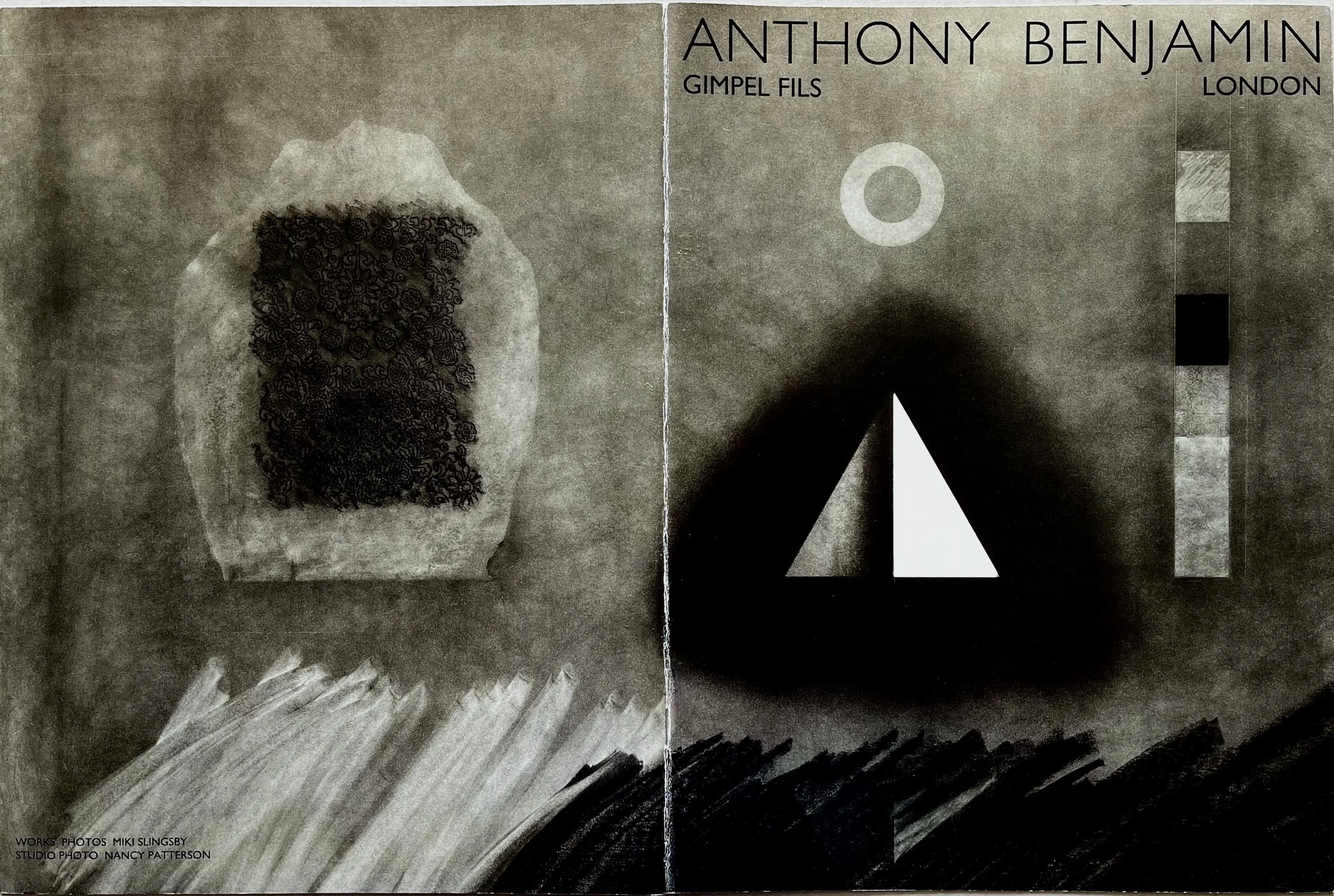
The Textures of Contemplation
The most startling aspect of this collection of new pictures is their magnificent tranquility. Benjamin has sculpted, stroked, and forged shapes, space and light to challenge the eye and coax the mind to float beyond the surface patina into a territory between night and light, sleep and wakefulness. Technique, form, and function have been harnessed in a satisfying, understated, yet immensely consummate fashion to present windows to a world which is both intensely personal—belonging to the artist—but at the same time beckons participation. This achievement should not be underestimated and neither should its intention. This exhibition is subversive …
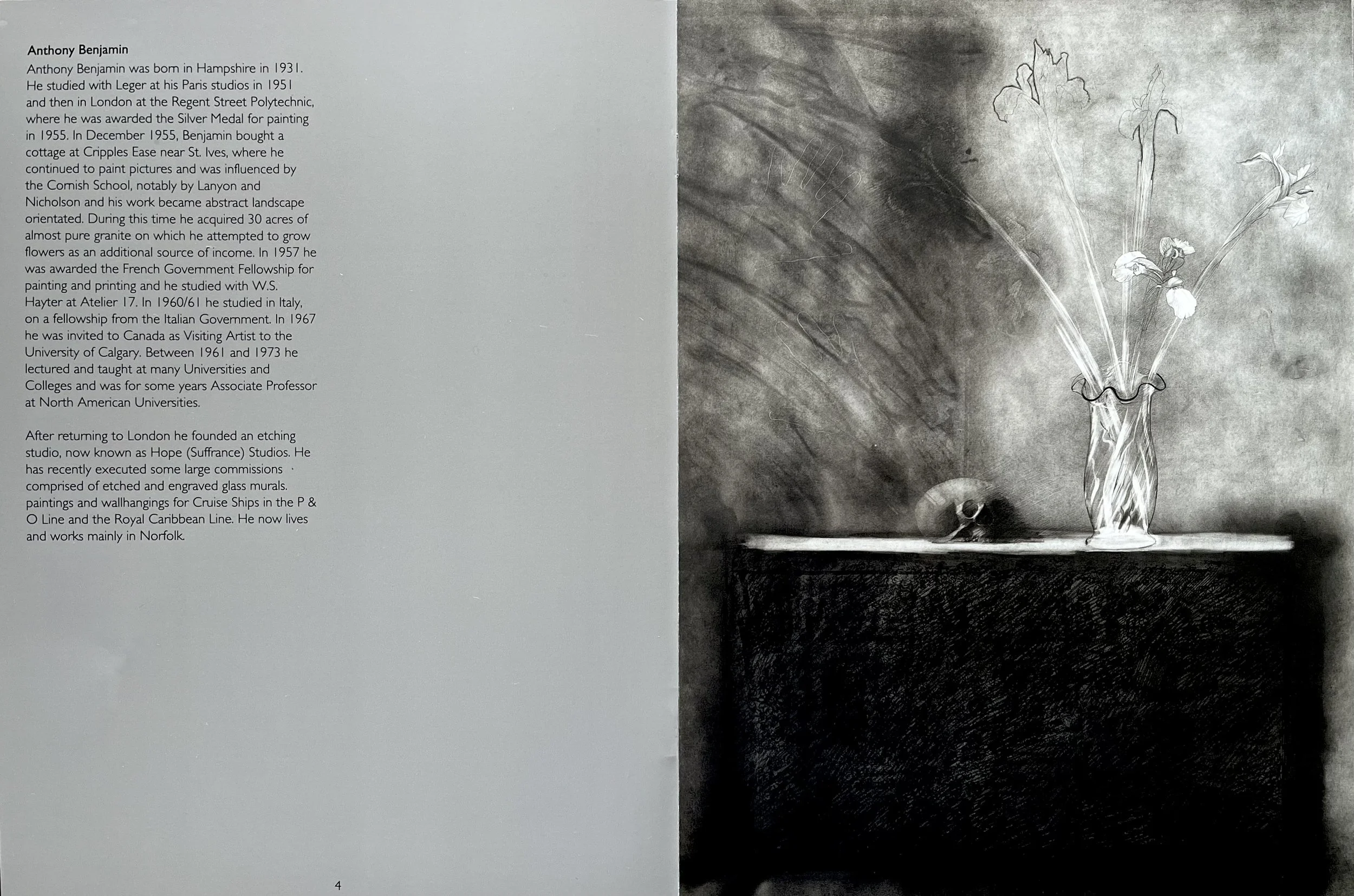
… Describing the textures of contemplation, Benjamin has chosen to use the grey scale as a metaphor and visual reference. Working with soft pencils on fine linen paper, he uses geometry, recurring figurative images and the gradation between not-quite-black and not-quite-white to circumscribe a world which is not necessarily there. A Navajo ghost crow balances in the sheen which the light throws on burnished graphic. A granite sarcophagus suspended in perfect twilight, is not more than a slab of light against a grey wash. The lily, skull, and catafalque all allude to the transient of life, but the death in life, which these pictures suggest, implies no menace, no decay.
John Kelly, Anthony Benjamin, Gimpel Fils catalogue, April/May 1990
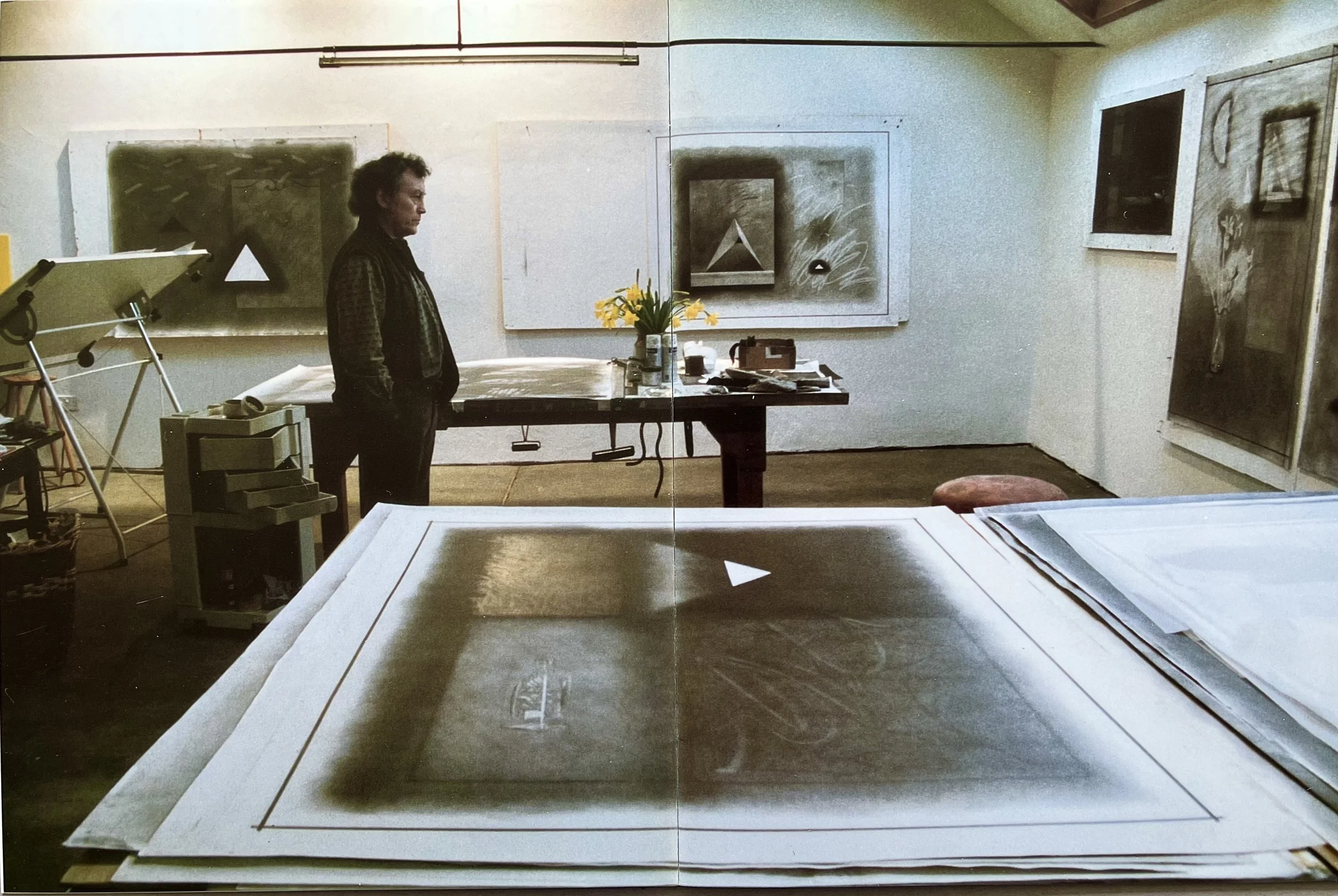
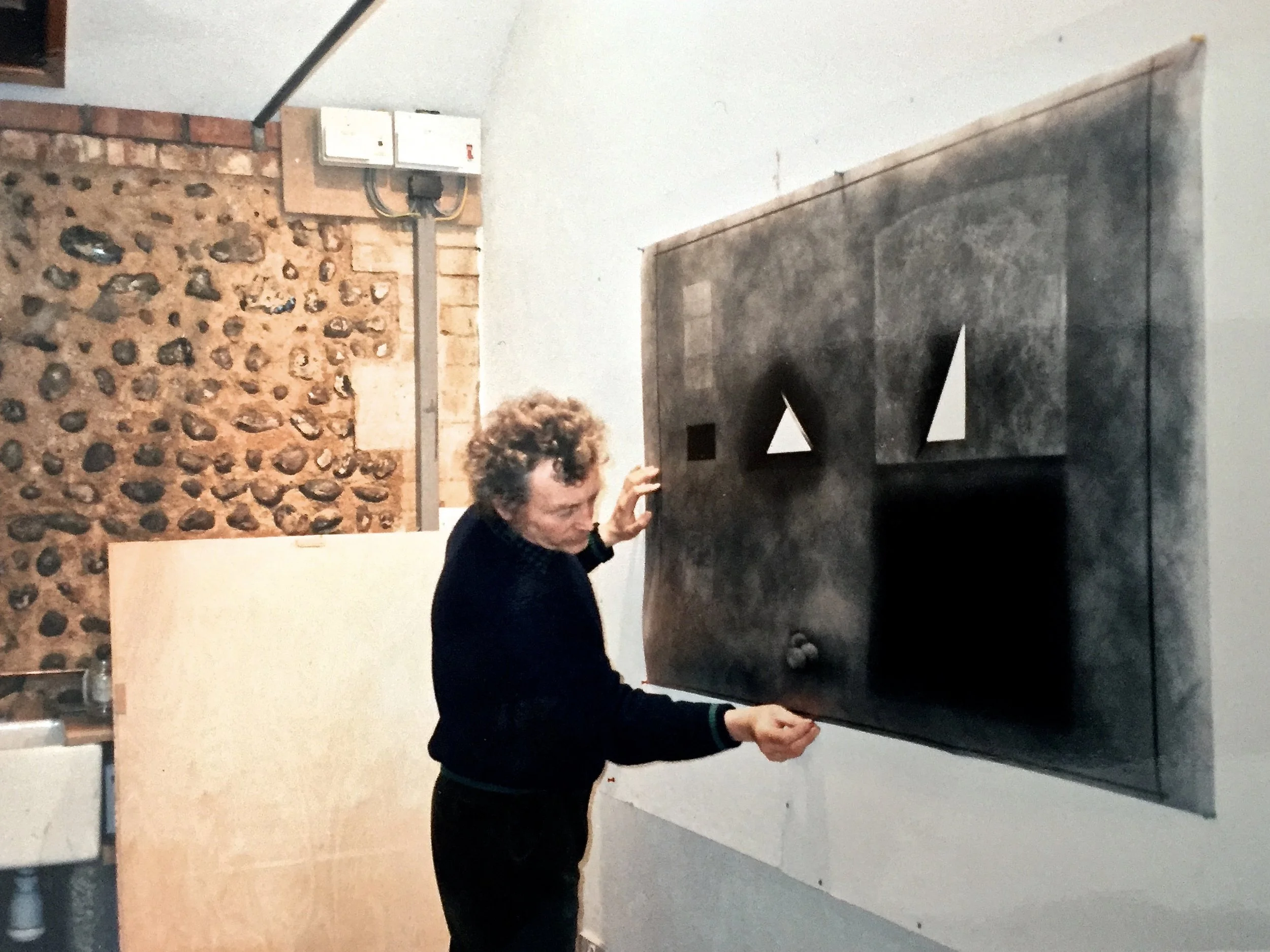
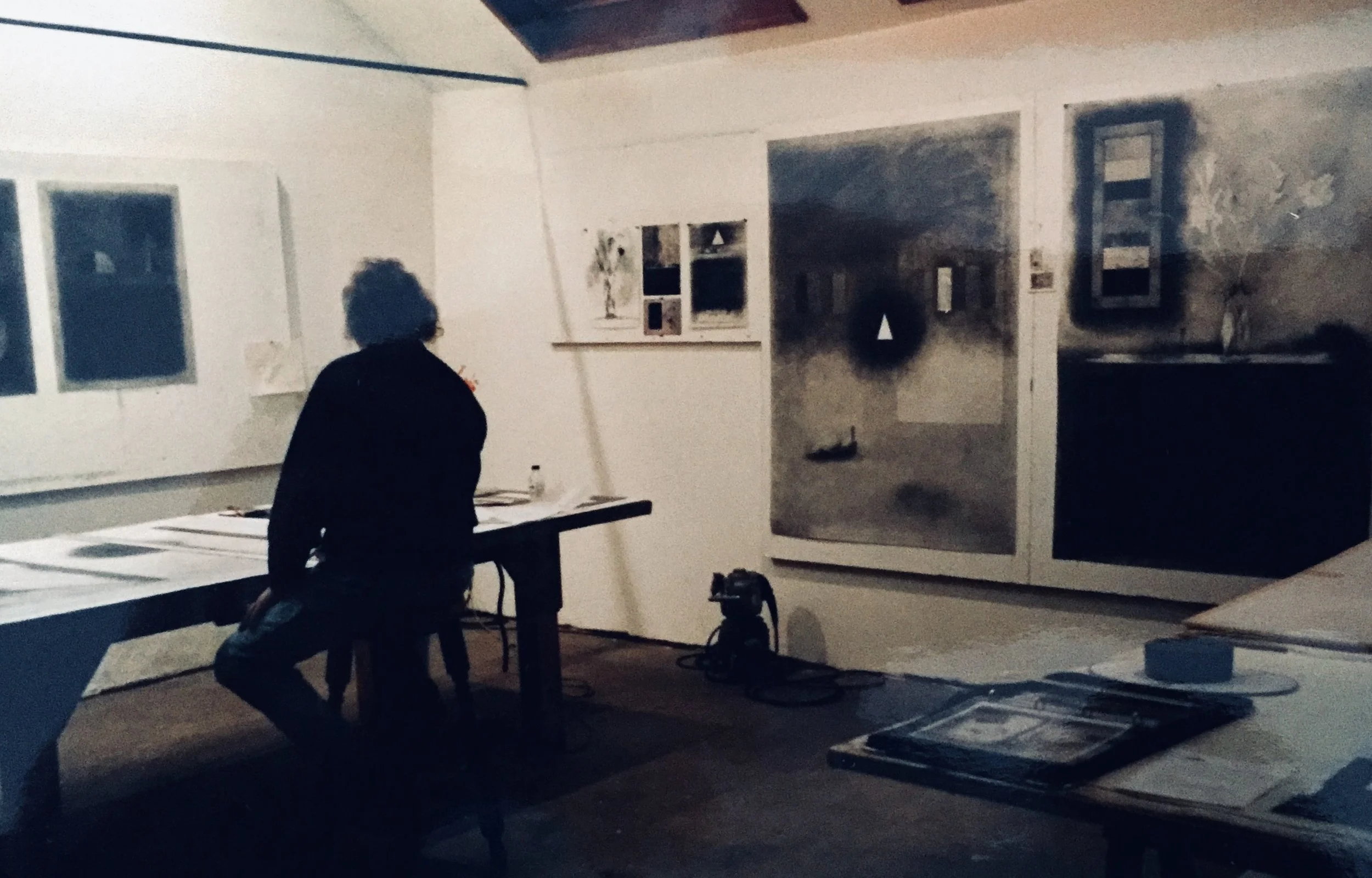
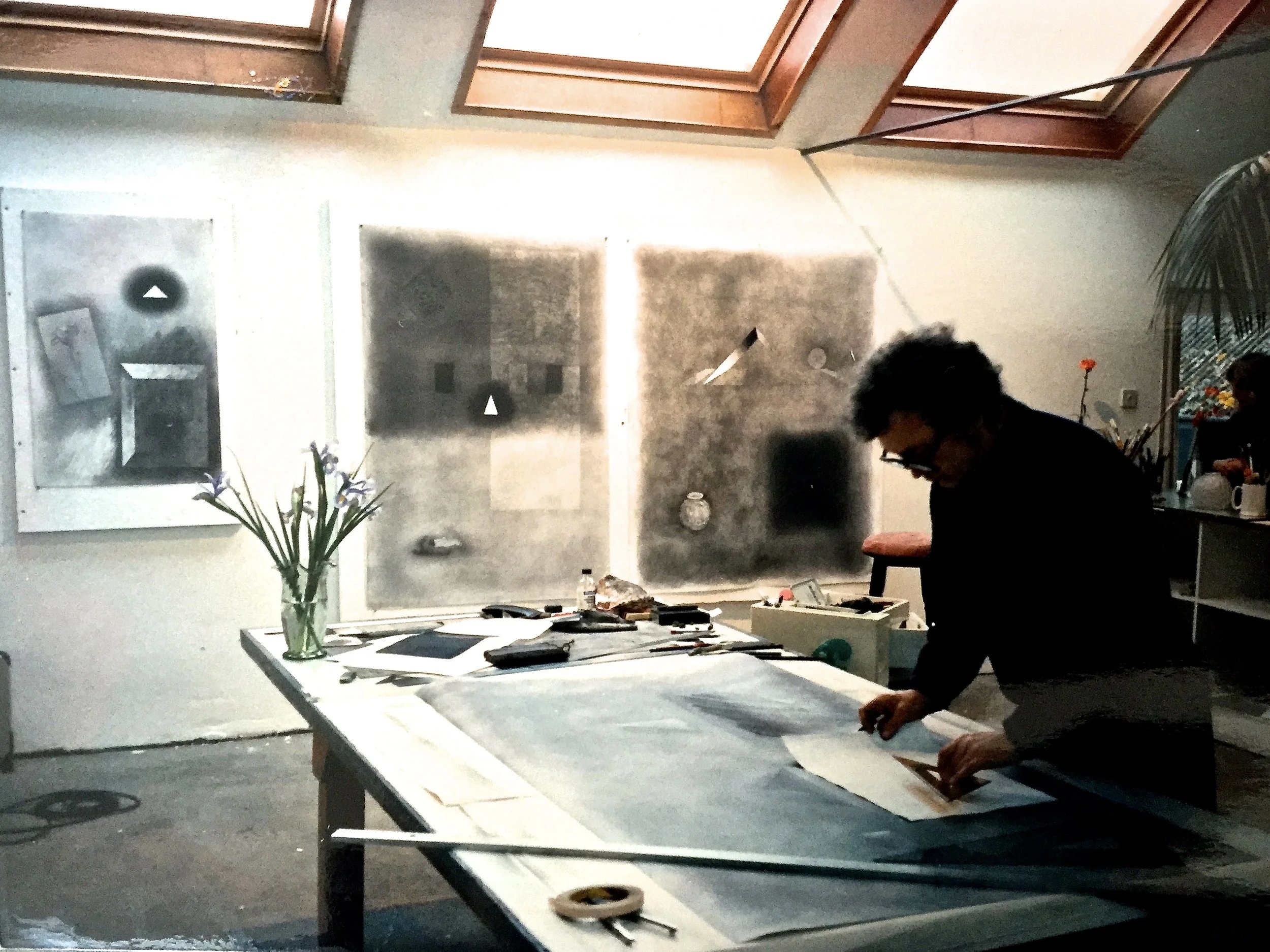
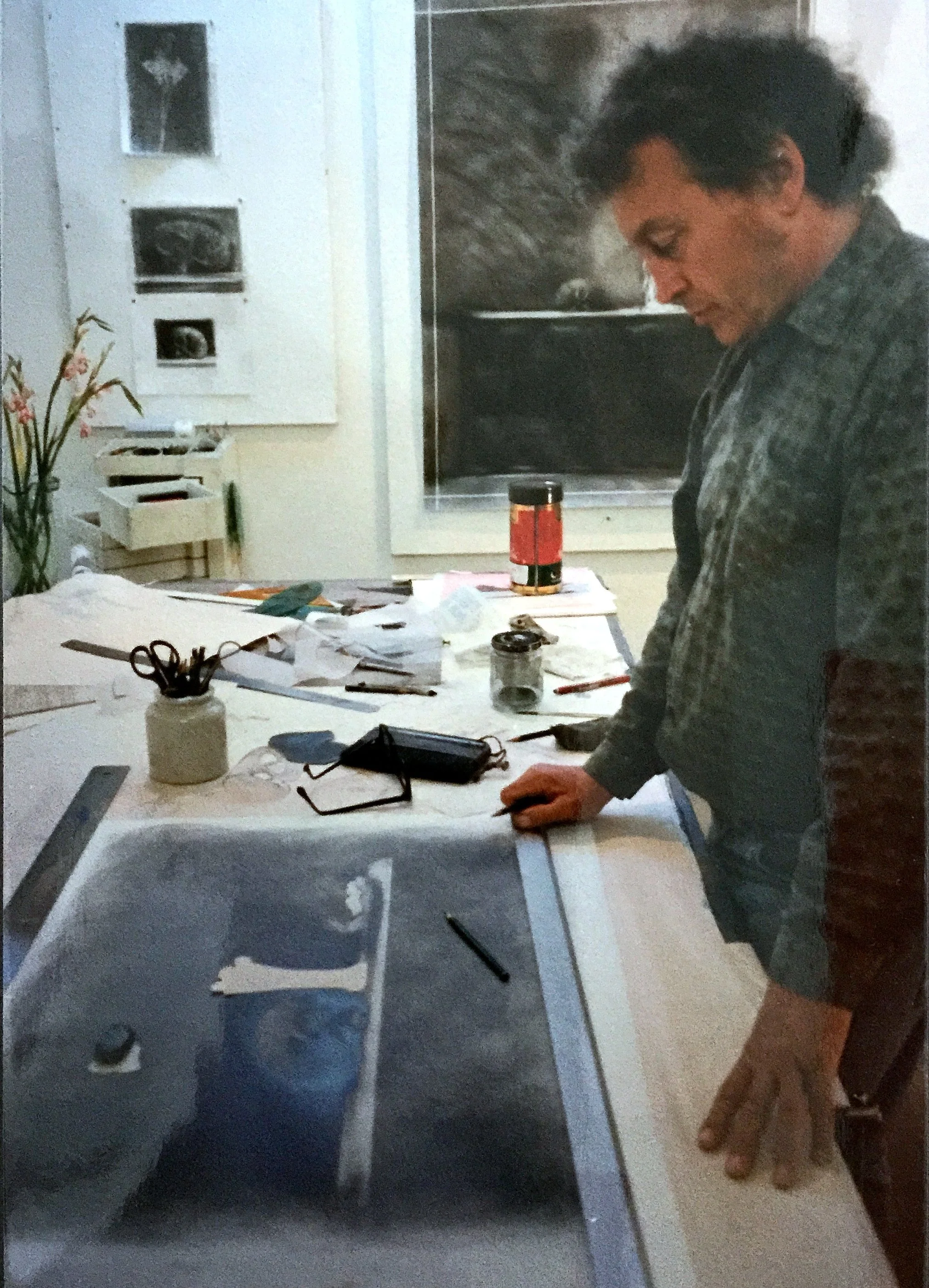
Benjamin in his Kelling studio, 1989. (The above images and two below are from the Gimpel’s catalogue.)
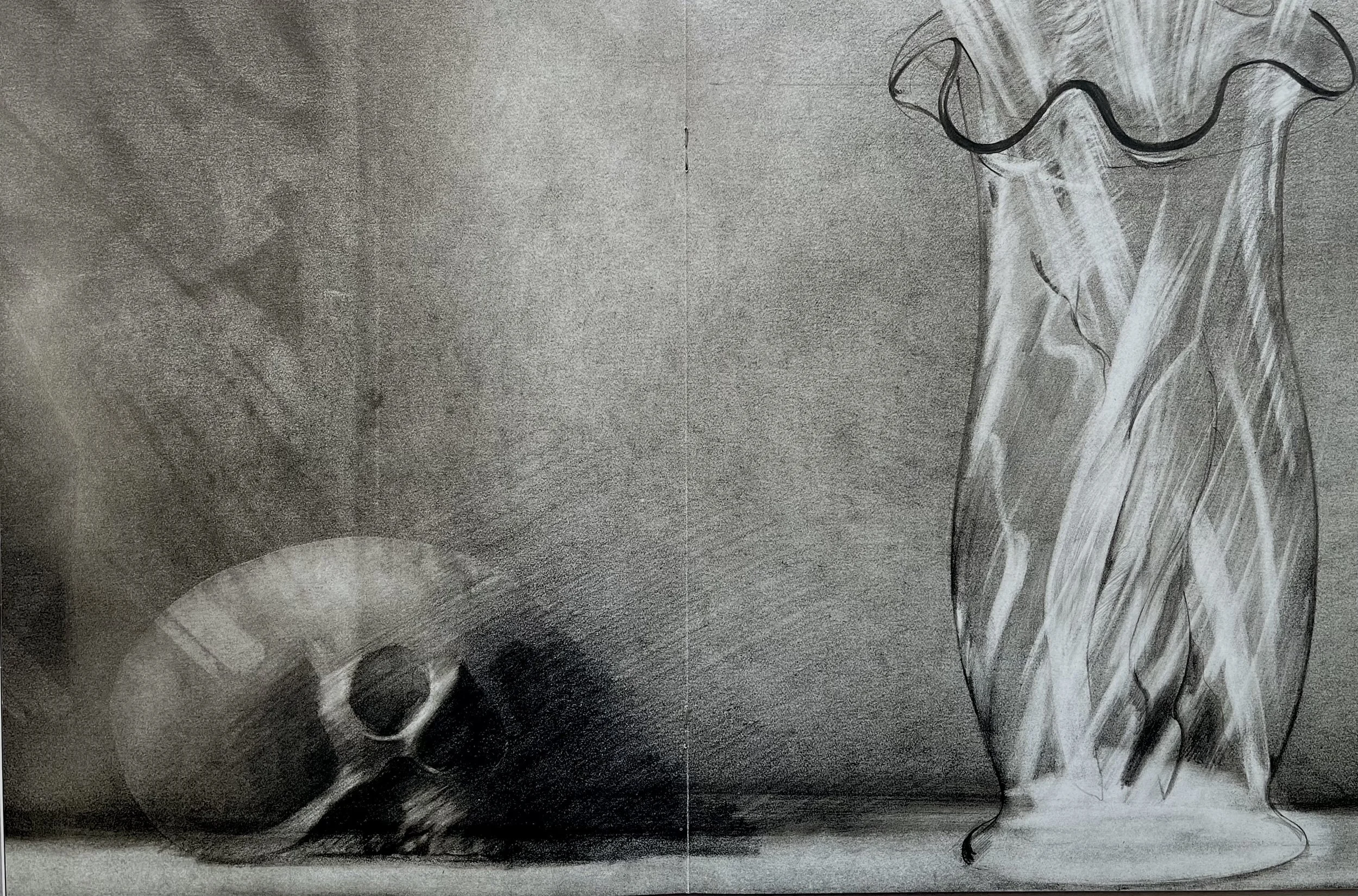
A detail of Nexus, 1989 (below)
Nexus, 1989, pencil on paper (145 cm x 109 cm). Private Collection
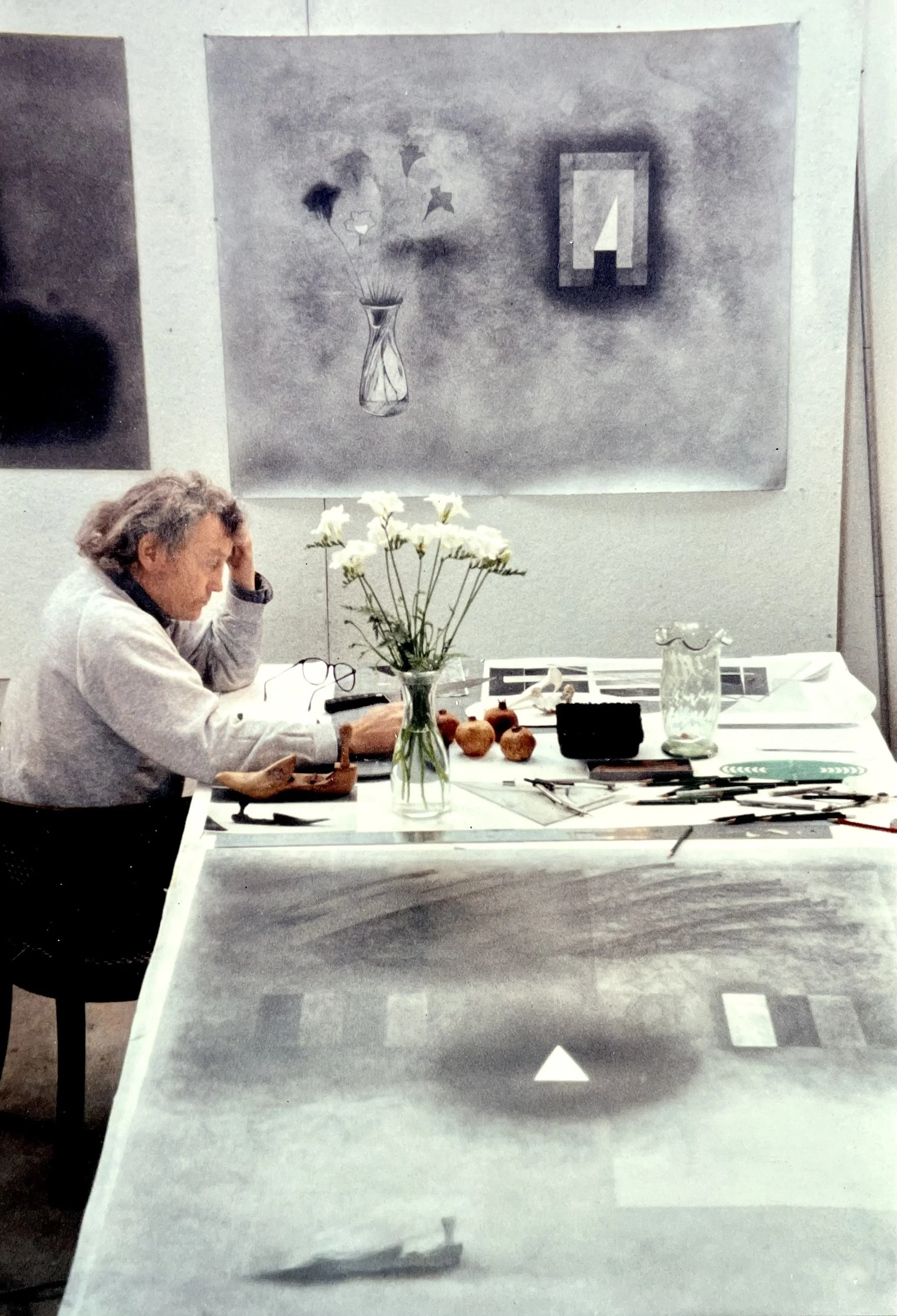
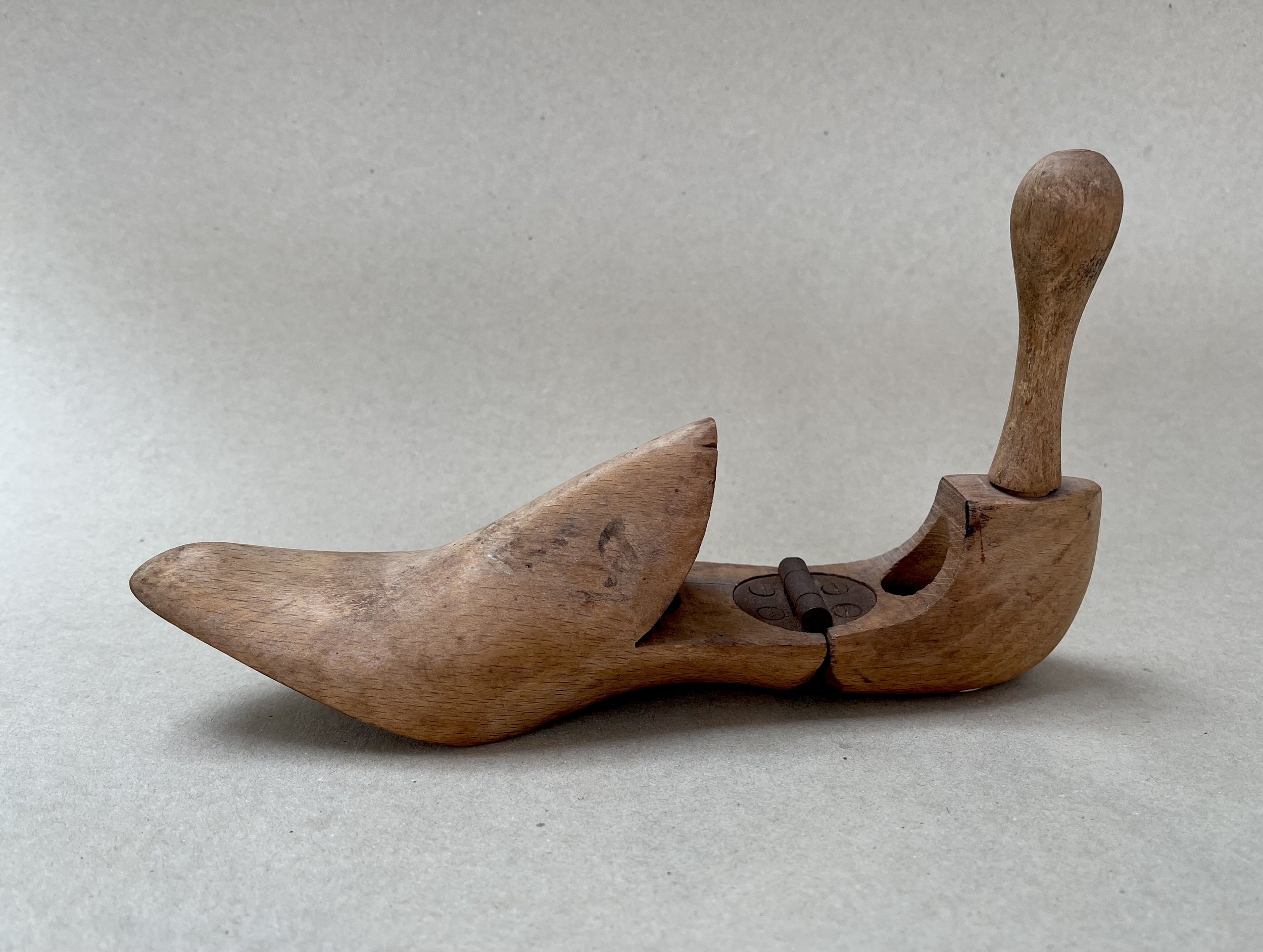
The actual shoe last.
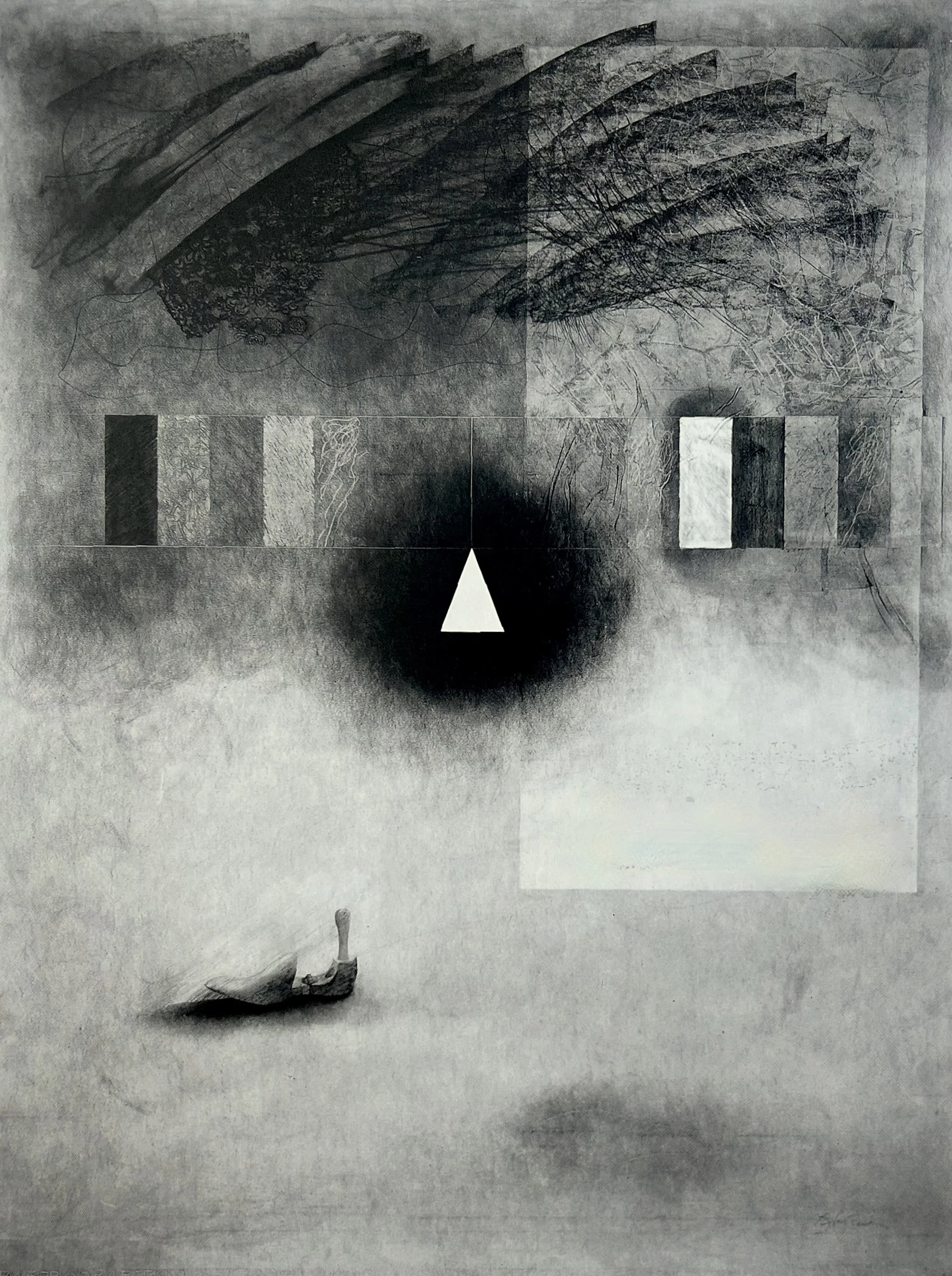
Footprint, 1989, pencil on paper (150 cm x 112.5 cm)
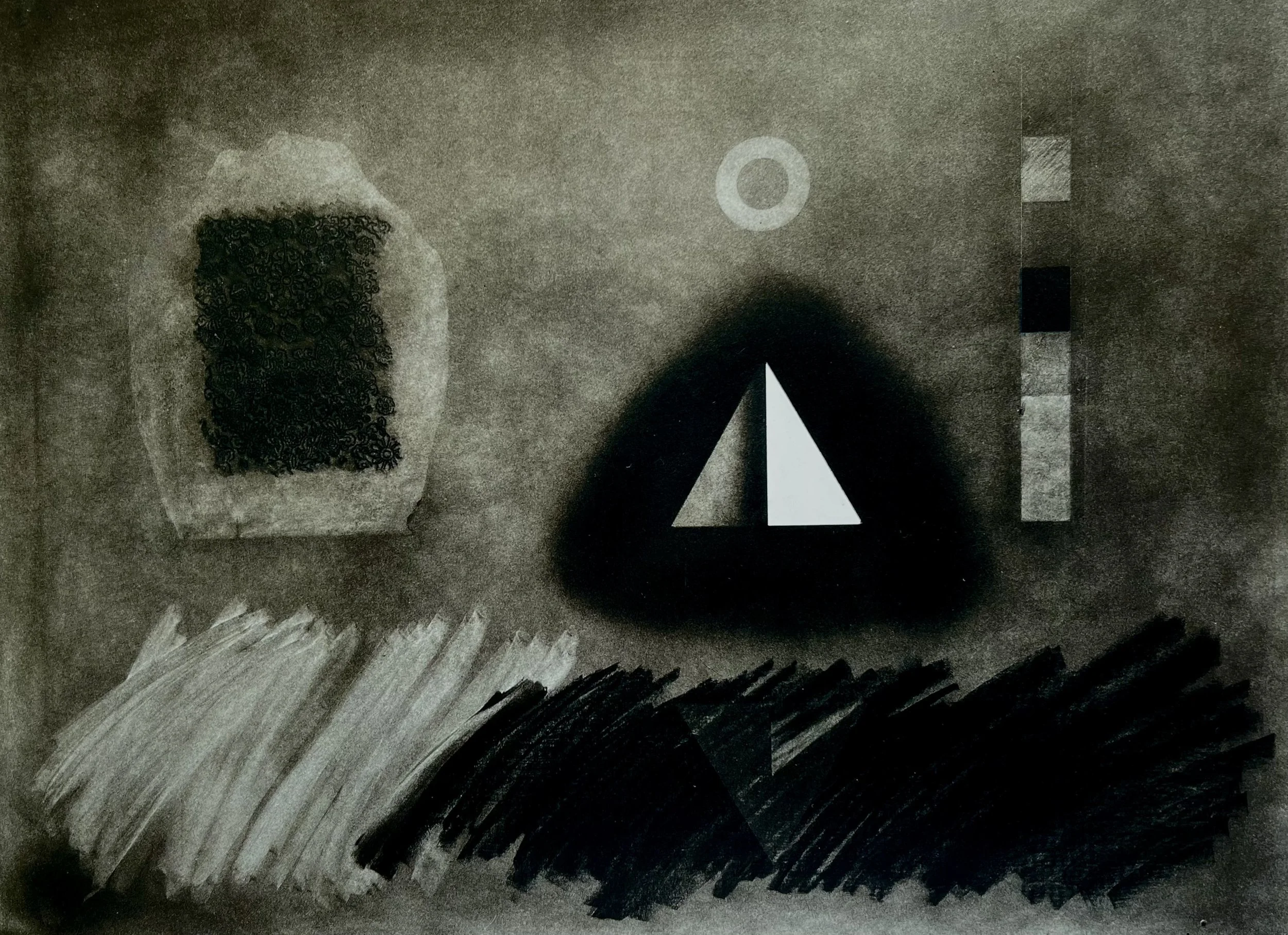
Ad Ovo II, 1989 (116 cm x 158 cm). Private Collection
Elegiac meditation is a new aspect of Benjamin’s work, as is working in the grey scale. Past work has been notable for the use of vibrant colours, but the restraint, calmness, economy and technical proficiency are a common feature of both sculptures and painting. Paradoxically, the absence of colour in this latest, and most challenging series serves to put his earlier work into clear perspective. For Anthony Benjamin, the artist’s muse is the colours and textures of the mind. The interaction of object and sensibility is both the beginning and the ending of art. This extraordinary series takes us a step farther towards charting that intangible territory, halfway between light and night, between definition and abstract, quick and dead.
John Kelly, Anthony Benjamin, Gimpel Fils catalogue, April/May 1990.
These works were also shown in 1993 at 3 Norfolk Artists, Arts Centre, King’s Lynn and the Castle Museum, Norwich, who purchased one for the permanent collection, with Derek Greaves and Roger Ackling; in 1994, a one-man show at the RHoK Institut, Brussels, Belgium, at Grisaille, held by Gimpel Fils, Olympia in London; in a three-man exhibition in the Isis Gallery, Leigh on Sea, with Trevor Bell and Brian Wall; in 1999 at the Chagford Arts Festival, Chagford, with Terry Frost; in 1999, the Far Horizon exhibition at the Tate Gallery, St. Ives; and in 2000, at the Elm Hill Contemporary Art in Norwich, and the School House Gallery in Wighton.
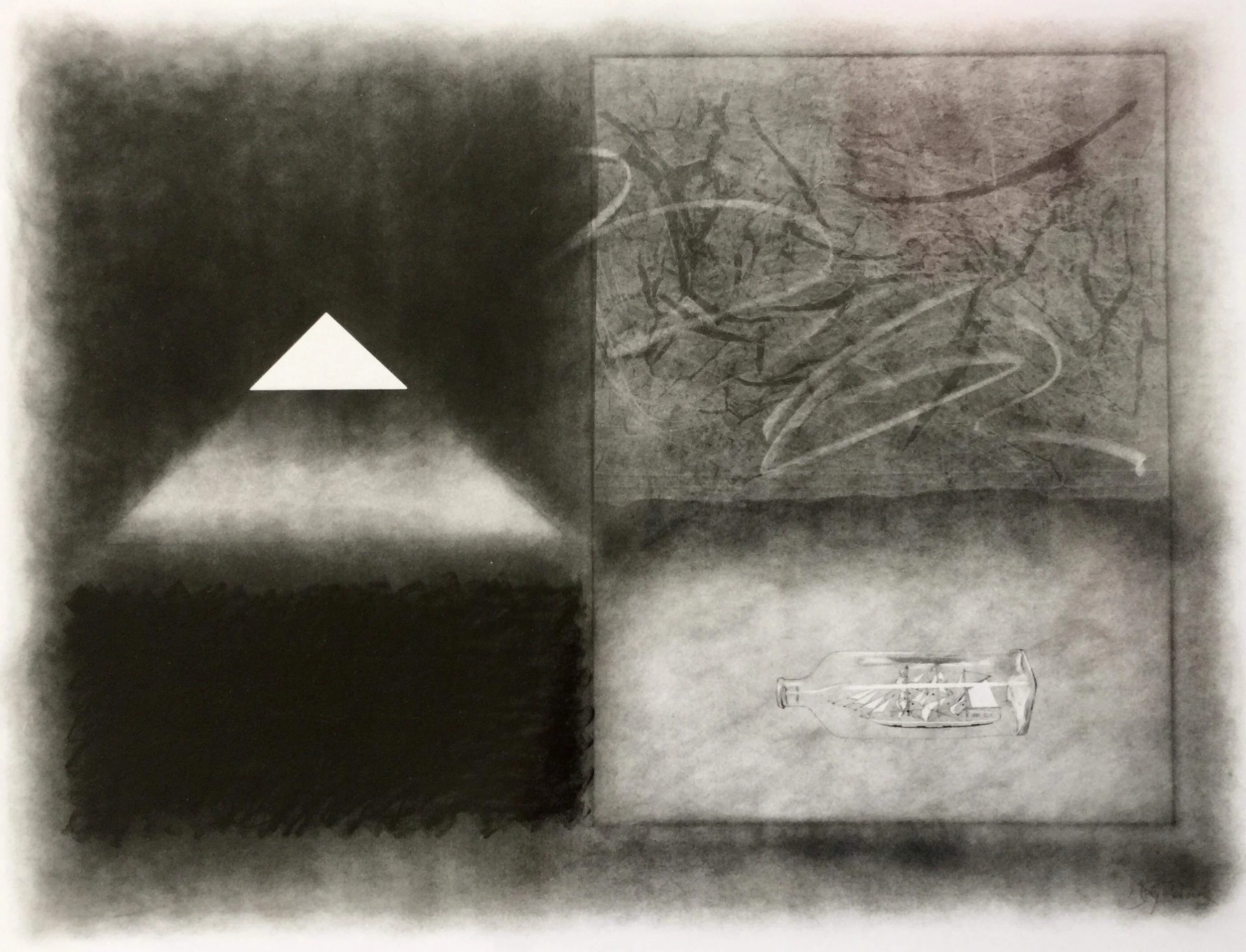
Take Me On a Trip Upon your Magic Swirlin’ Ship, 1989, pencil on paper (113 cm x 143 cm)
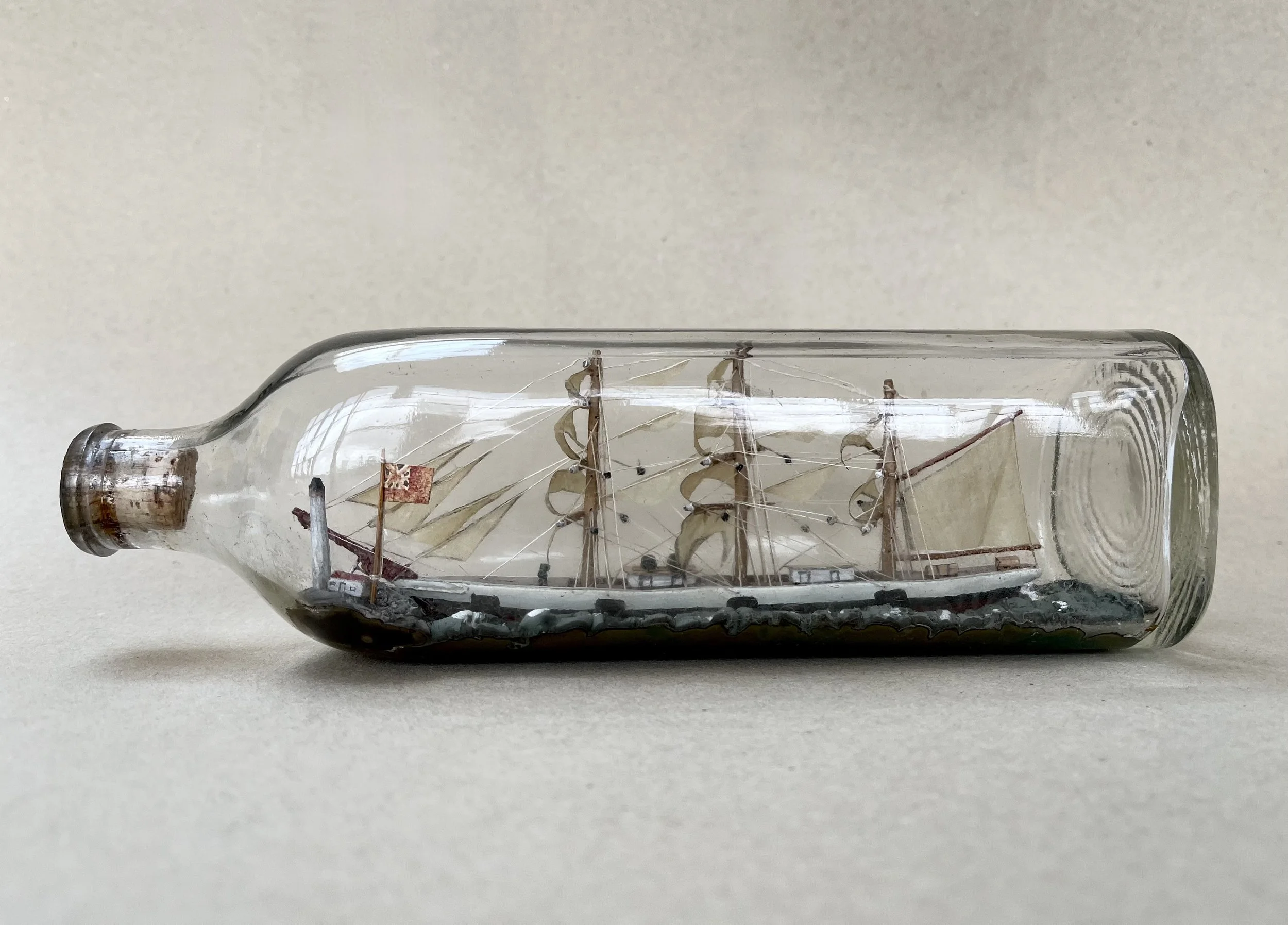
The actual ship in a bottle, made by a bosun in 1957.
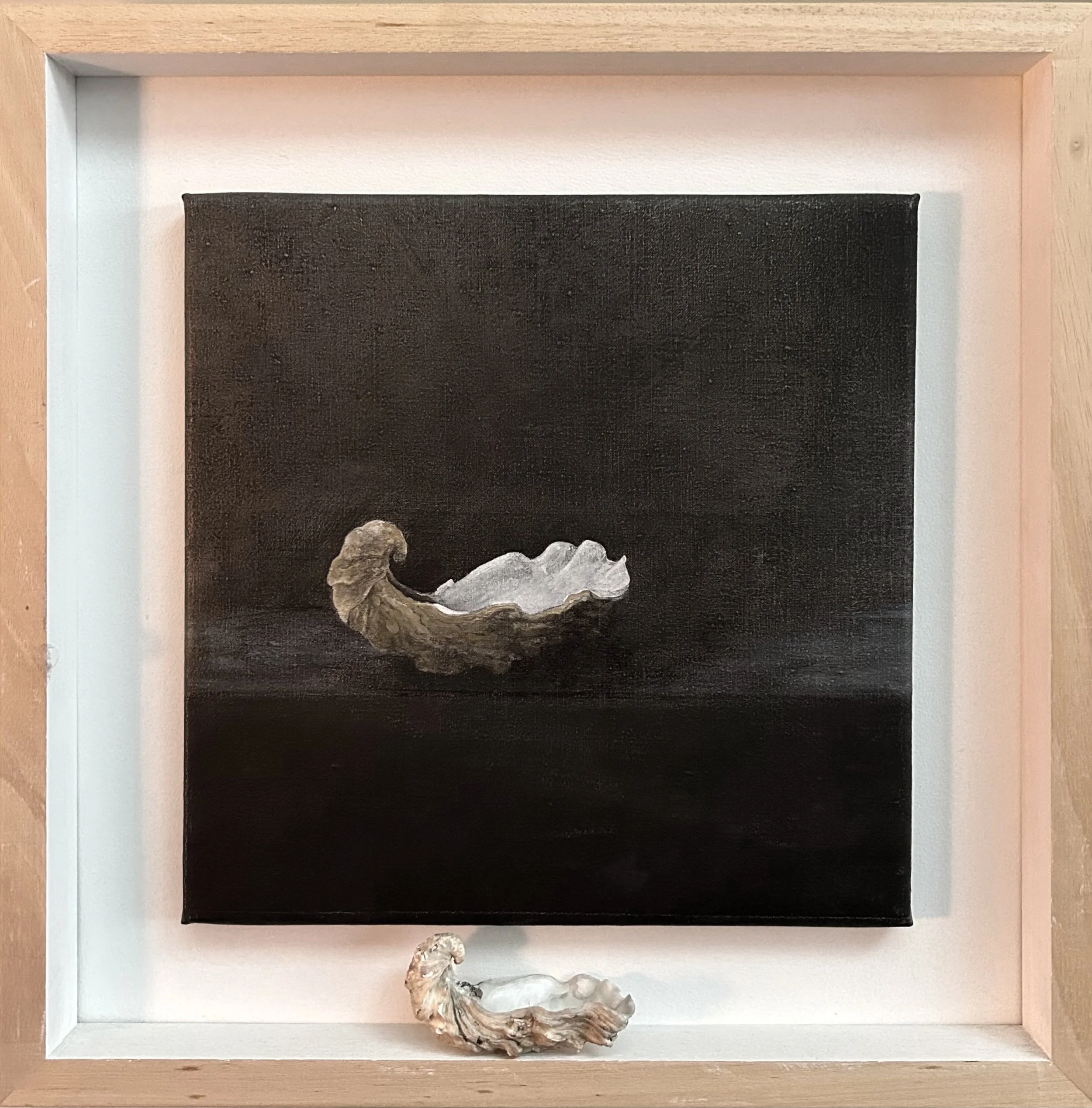
Shell painting with the actual shell, 1989 (45 cm square)
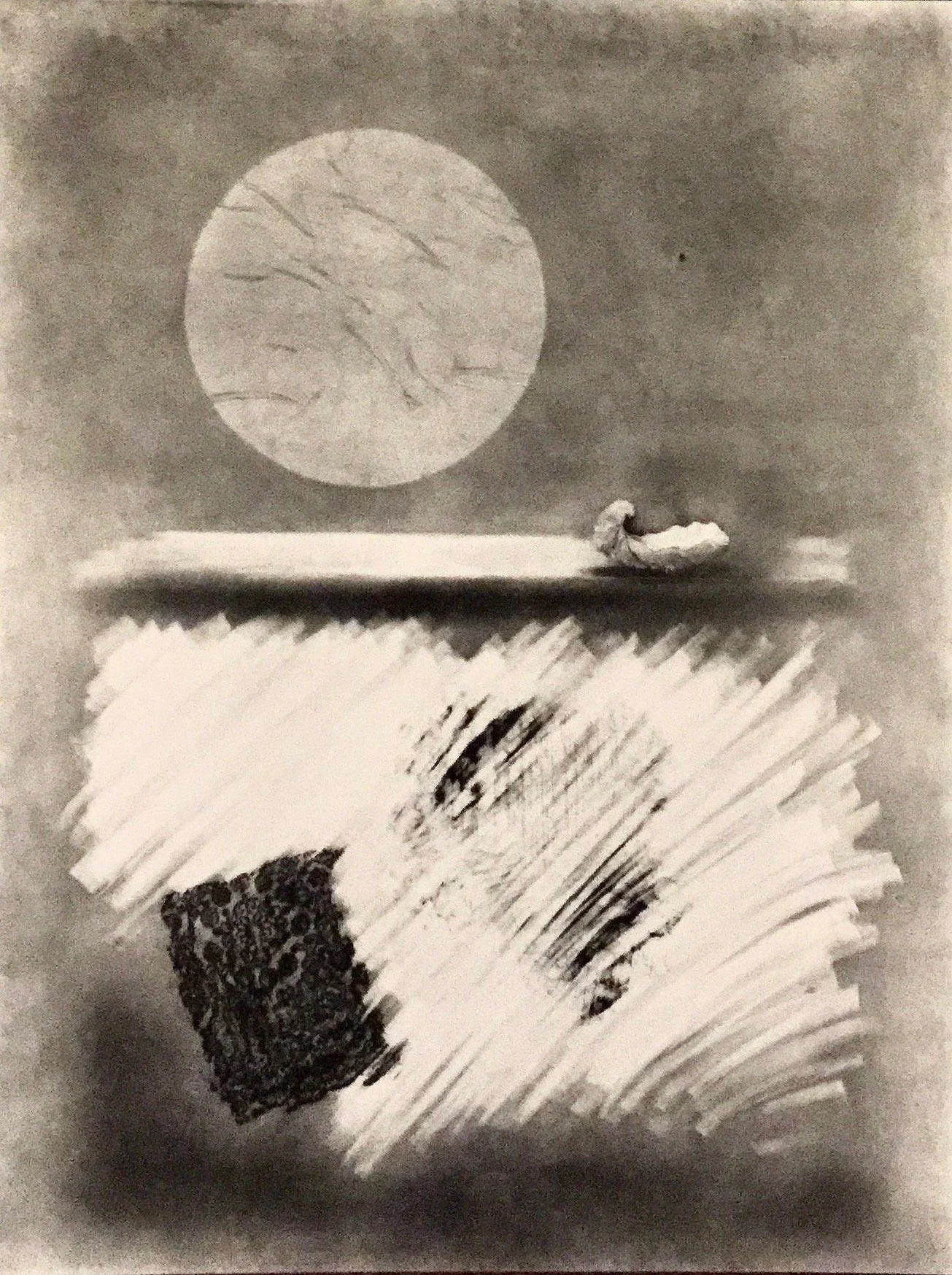
Shell, 1989, pencil on paper, (150 cm x 80 cm)
An oyster shell picked up at Moreston Key reminded him of forms found in Baroque art. It was used in several works, as well as other spiralling seashells collected from local beaches. He used Indian wooden printing blocks for frottage textures and very complex masking techniques to make the starkly white triangles which sometimes refer to engineering processes, and other times to pyramids. The mysterious Blackbird Singing image is defined by an elusive, deeply inscribed pencil line that is barely visible until the viewer takes time to look more closely into the Dead of Night.
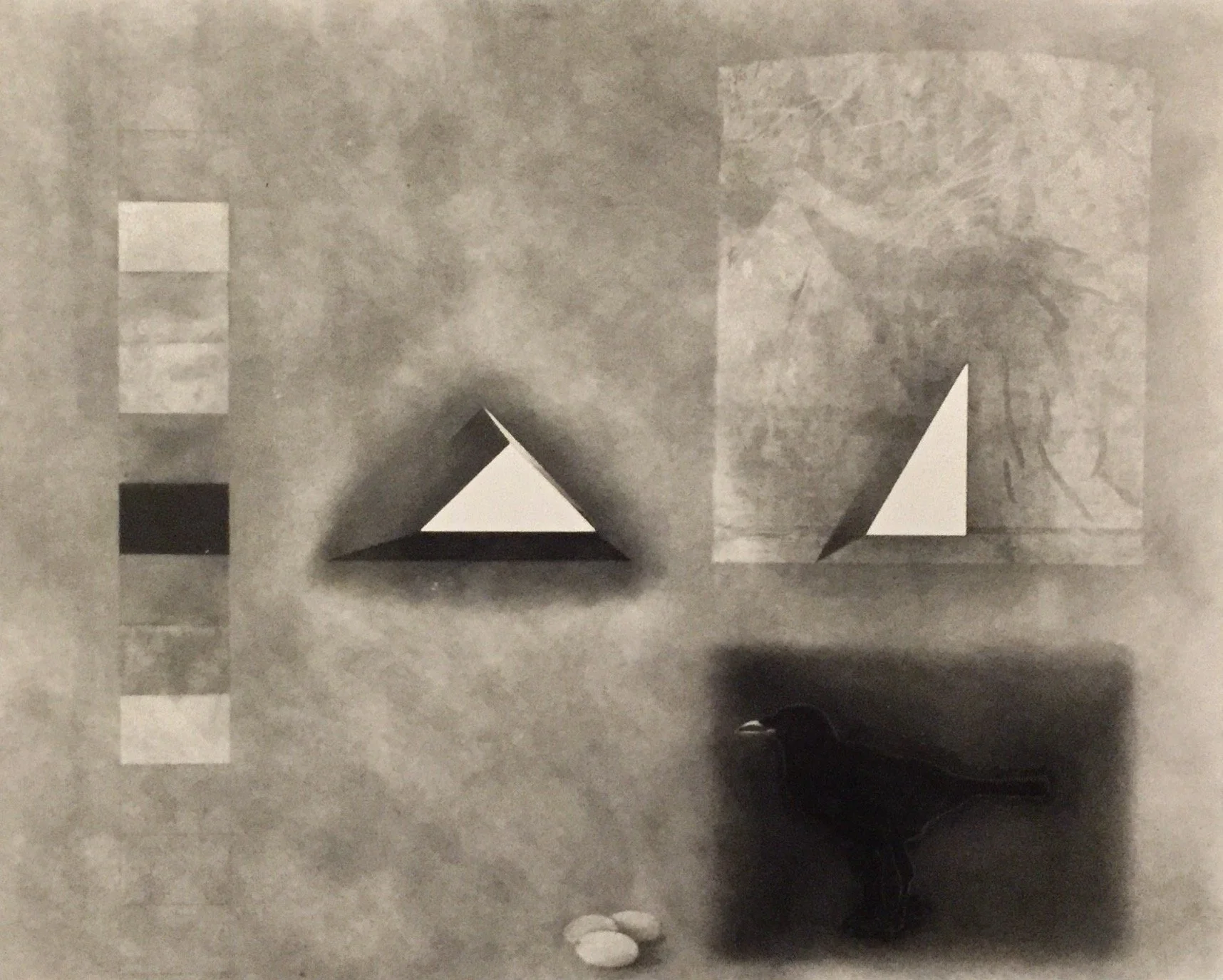
Blackbird Singing in the Dead of Night, 1988, pencil on paper (108 cm x 135 cm)
Reincarnation and life-cycles were central to Benjamin’s practise. He was obsessed with certain objects, some which he used time and again; as a true recycler, nothing was wasted and everything had a future life. In these works, the sensuous and just-there images of his family of objects, dance with energetic swathes of lines. He also used the process which we now understand was to lead him straight to his next series of paintings; at first glance the large scale drawings, and the paintings could not be more different, but the pointers are there - in the line, the colour, the understanding of his obsession with surface pattern, form and mostly, process.
Angus Stewart wrote the introduction to the RHoK Gallery Exhibition, Belgium, 1994
Anthony Benjamin, thwarted by his wish to go to art school, was apprenticed as an engineer. So his hands were taught to move with precision. His brain learnt to conceptualise. He began to manoeuvre ideas and images; and so he engineered his entry into the world of art. Sent to start a fourth year, instructed to sign on again for engineering science and mathematics, he substituted life drawing, perspective and composition. Not for the last time, Benjamin went his own way. Shortly thereafter he entered art school … It is Benjamin’s habit to use a simple fluid line, or a coruscating mix of sharp colour, or a clash of textures to make a point. The point may be simple, or complex. These drawings, so simply conceived and explained—they are only pencil on paper—are deceptive. Here he has packed in so much thought and detail that the onlooker has to pause, examine and reflect. These are not images for those in a hurry. This man is in agreement with Poussin who wrote, ‘Things which partake of perfection should not be looked at in haste, but call for time, judgement and intelligence. The means employed in their appraisal must be the same as those used in their making’. …
He is an artist whose pencil can snake and curl a line as wondrously as Tiepolo, as fluid as Matisse … His tools are simple. His material mundane. It is not what he uses, but how he uses it. His output depends on his hand and eye, not on mechanical aids. But his hand is directed with a merciless discipline, over long periods of time, so while some works are discarded because they fail to measure against his criteria, others are destroyed by his working and reworking, which can be so fierce the paper is exhausted.
The paper comes from Italy, from Fabriano. It is sharp white, with a tough surface that accepts incised lines and tolerates the laying and removing of graphite. The pencils are English, made by Berol, and have a quality of lead that Benjamin finds sympathetic with his way of working. He also uses pencil crayons and massages some areas of the paper with graphite crayon. To expand his range of chiaroscuro, he ‘paints’ graphite dust onto the surface. Within the ranges of black, white and grey, he searches for the nuance that adds one more speck of variety to a drawing which as a whole consists of numberless such minute records. The intensity of his inward vision forces him to invent and borrow ways of reaching his target. He describes this tonal variation as turning up or down the light, his slight and intricate pencil movements as adding sparse activity to force the onlooker to roam within the picture. Benjamin wants the eyes of his audience to move about, to see the differences, to react to the wit, the jokes and the ironic souvenirs. As he draws, Benjamin enters into a dialogue with each mark, so the final picture is consequent on those discussions.
… It could be said that he is an artist’s artist. That is so. It is also true that he is a thinker’s artist. He offers strange and fascinating pictures which can captivate the viewer and evoke the pleasure that grows out of the pain of twentieth century confusion.
The Beginning of a Return to Colour
This painting is a continuity of the imagery he was using in his graphite Painting in Pencil works; however, the limited, but effective use of colour reminded him that he missed using the full spectrum. Although he was still engrossed in the endless possibilities of the sublime world of Black and White, and his obsession with simple geometric forms and the significant objectshe had collected… he started experimenting with colour again…this painting was a bridge into the vibrant Rainbow World that waited just over the studio horizon.
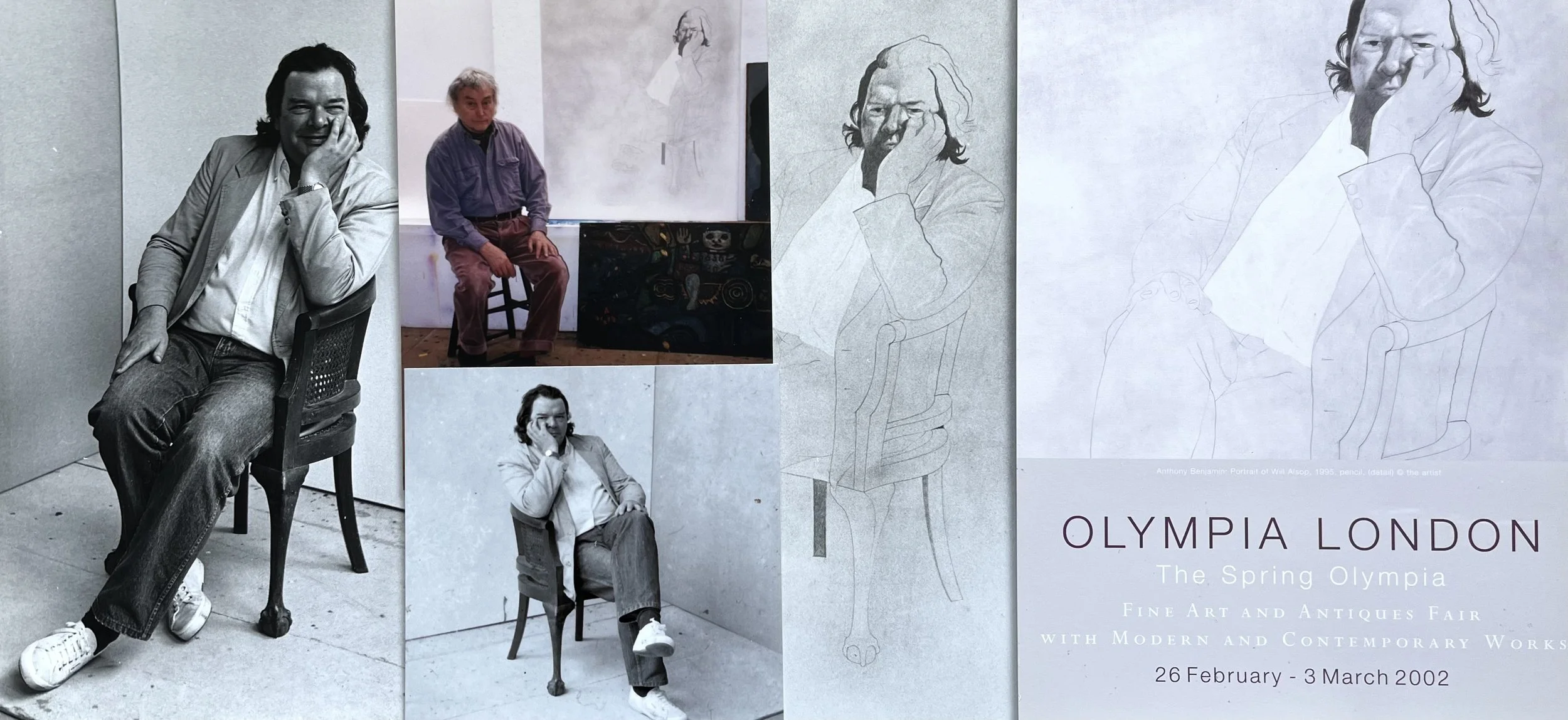
Benjamin also made a series of full-figure portraits of friends, including architect Will Alsop and Michael Bellis.
Will Alsop, avant-garde architect, 1999. Alsop designed Peckham Library, which was named the best building in 2000 and won the Stirling Prize.
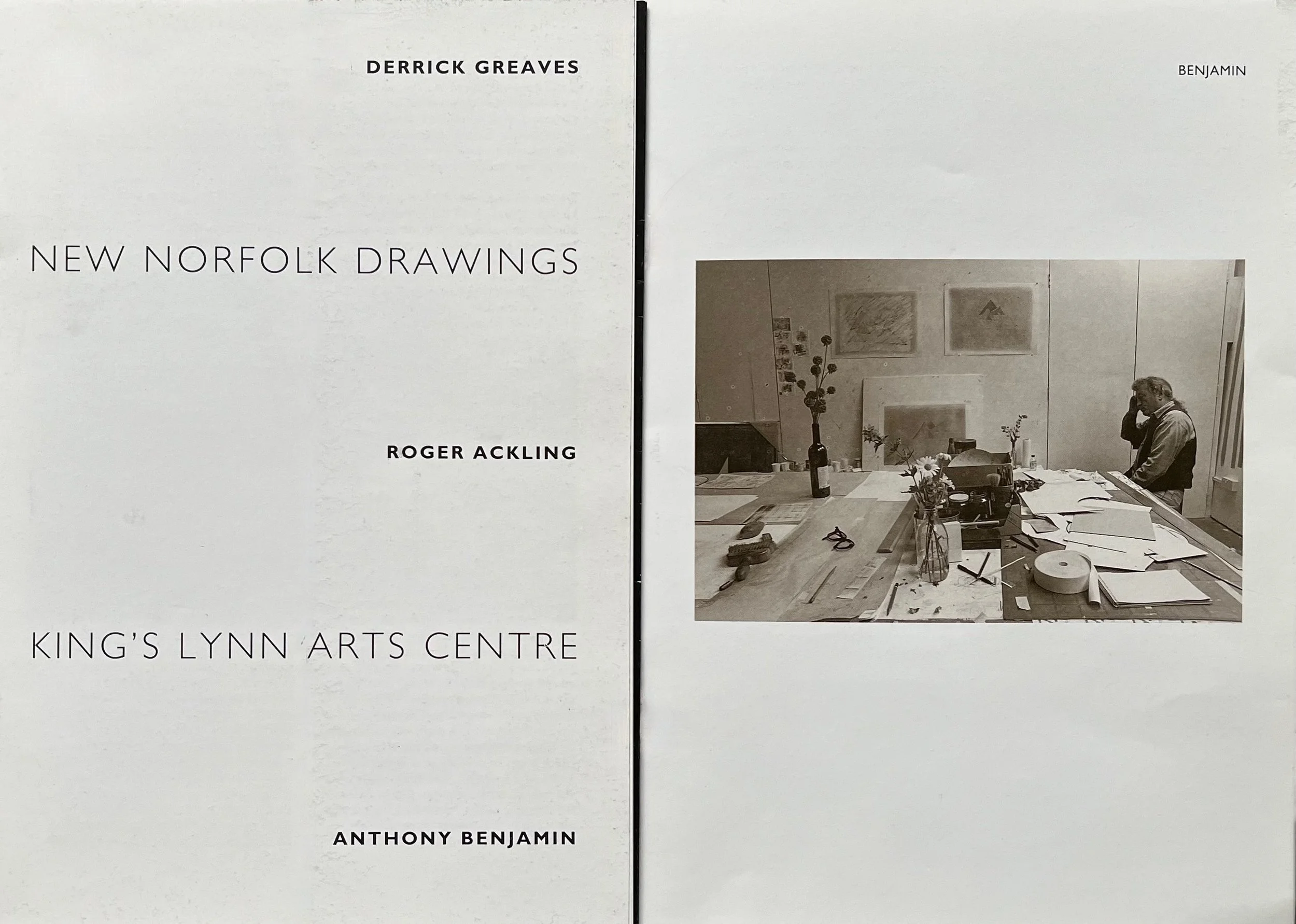
Three-man exhibition, New Norfolk Drawings, Roger Ackling, Anthony Benjamin, Derrick Greaves, King’s Lynn Arts Centre, Norwich Castle Museum, 1993
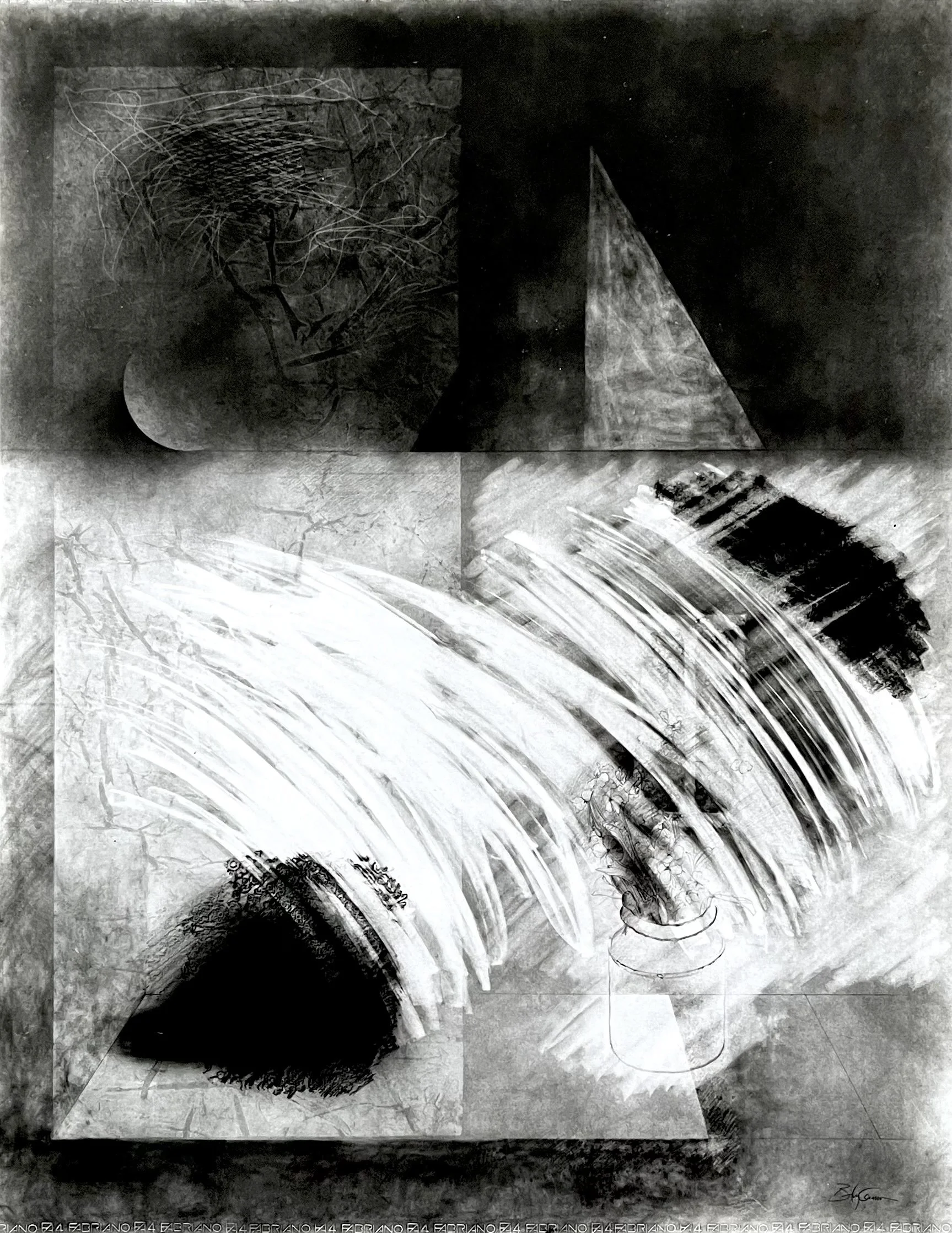
Hourglass, pencil on paper, 1990 (150 cm x 116 cm). In the collection of the Norwich Castle Museum
Anthony Benjamin is breathtaking in the control of the humble pencil. On huge sheets of paper, he conjures up tunnels of vision which intersect at unexpected points of space. He insists on a flexibility of vision, forcing us to read his objects as being in deep space despite contradictory evidence. Both abstract and geometric elements are present, accorded the same ‘reality’ as common objects such as vases, shells, and flowers. Indeed, the latter can be more ephemeral, their transparency insisted upon until their presence is merely iconic. Even when perspective is cancelled or denied by vigorous use of the rubber, Benjamin still keeps dragging us unwillingly back to the Renaissance view of the world.
Tony Warner, Arts Review, October 1993
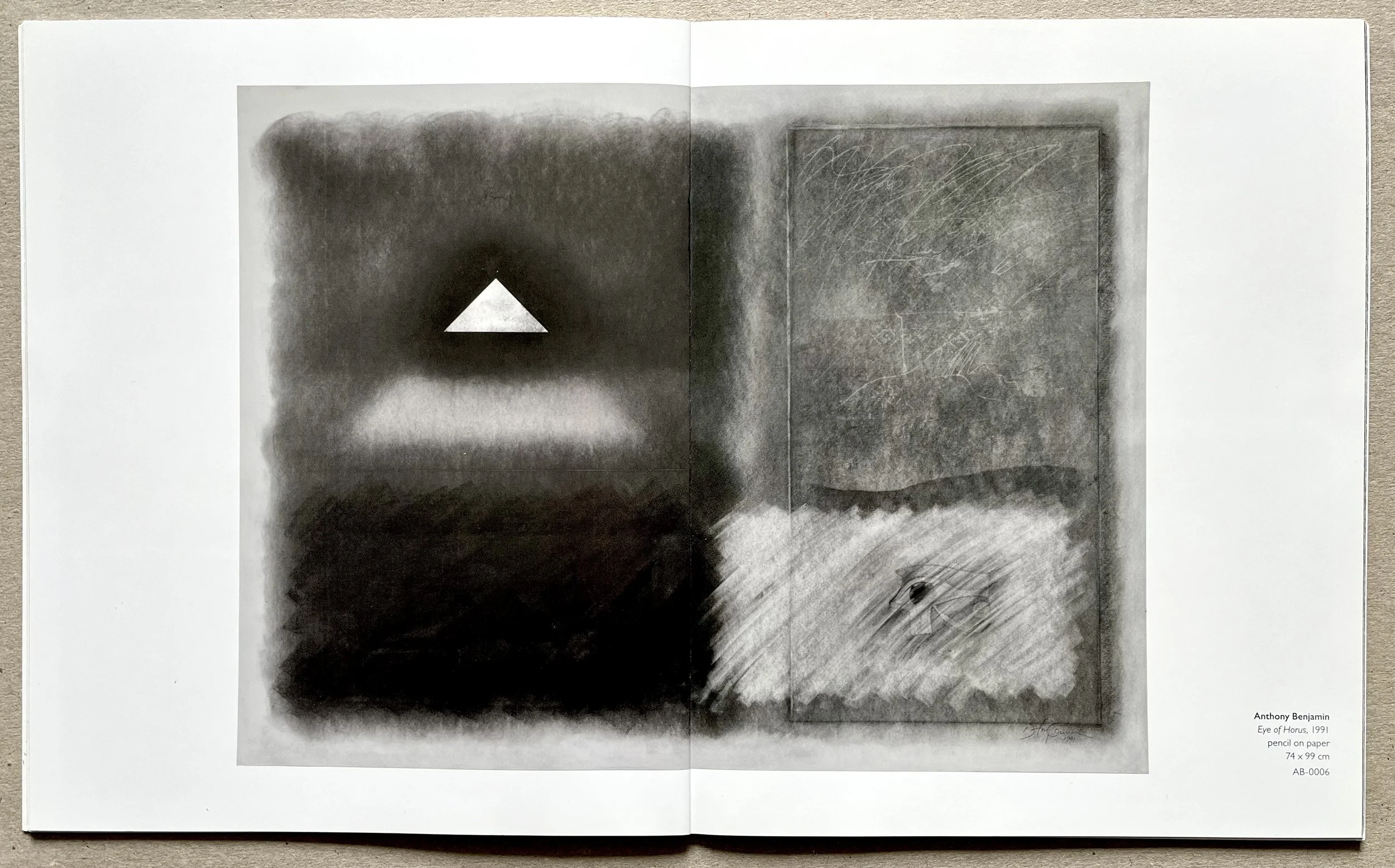
Page from catalogue for posthumous works on paper exhibition at Erskine, Hall & Coe, London, September 2014
All photos of artwork are by Miki Slingsby; all other photos are by Nancy Patterson. The term ‘Painting in Pencil’ was suggested by photographer Miki Slingsby.
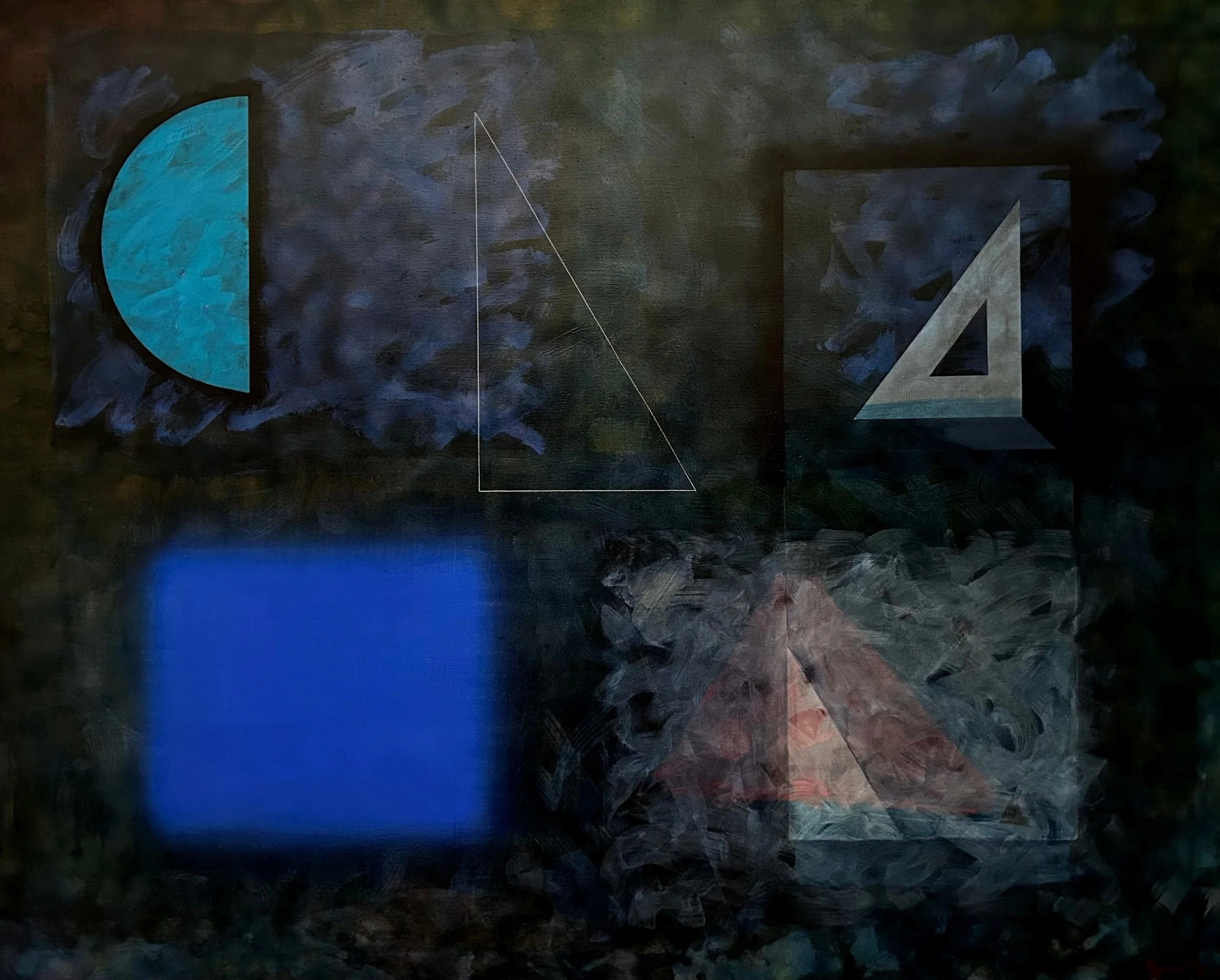
Untitled, 1987, acrylic on canvas (122 cm x 152 cm)
One work in colour that he completed shortly after an exhibition used a strong ultramarine blue that hovered over a mysterious dark indigo background. It had a luminous vibrancy that some of the earlier works had lacked. Compositionally, it related to the Painting in Pencil series and forms a bridge between the two periods of work. And he kept searching for the way back to using full, vibrant colour in a new way.