1967 Oxford and Nagaoka: Sculpture
In October 1967, he was invited to show his recent work in the inaugural exhibition of the new Oxford Museum of Modern Art by Director, Trevor Green, who he knew from their time together on the Groundcourse staff at Ealing College in the early 1960s.
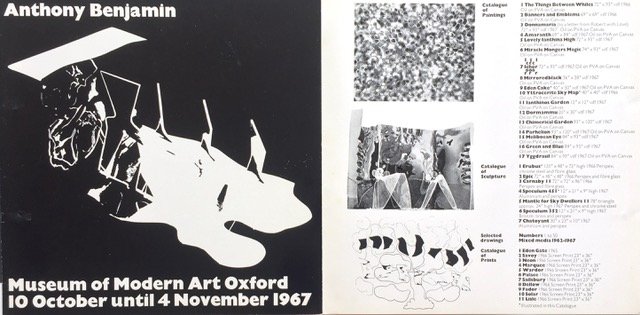
Anthony Fawcett had been the Editor of Isis, the Oxford University Arts Magazine when Benjamin had an exhibition of painting at St. Catherine’s College in 1964. In 1967 he wrote about the Benjamin Exhibition at the newly opened Museum of Modern Art. He wrote in Sculpture International:
Anthony Benjamin is exploring fresh ground in a new material, Perspex, a relatively recent discovery, and his reputation as a sculptor is growing rapidly. As a painter and printmaker he has been known for many years in London galleries and at his last exhibition titled, On the Gentle Edge, at the vast new museum of modern art in Oxford, all three mediums were shown together. Perspex is a slow but expansive material to work in. The large sculptures take about four months to complete and Benjamin sometimes employs two part-time assistants.
Vol. 2, No.1, 1967
Yttrocerite Sky Map, 1966, acrylic painting on canvas
Benjamin was slightly ambivalent about titles for his work, particularly in the early years. Often he did not bother to title or date them. This was partly because he believed ‘to name something could limit its meaning and impact’, but also because of his mischievous attitudes to basic practicalities. Fortunately, he later recognized that this cavalier approach could cause difficulties with regard to keeping track of his works. Sometimes the titles for pieces were obvious choices, but at other times he made the naming process into a game … he would ask Nancy to pick up a dictionary and let it open, then take a pencil and let it drop down at random on the page … whatever word it landed on would be the title. This was how he found the strange, but appropriate term Yttrocite, (an isometric crystal, mineral flourite, bluish/red in colour) to describe the Sky Map as a title for the above work.
Benjamin was involved in painting, drawing, and printmaking at the same time as he was making the Perspex sculptures, searching for new directions in all of his artwork. He wanted to lead viewers directly into the heart of the work, with the intention of facilitating a visual experience that would go beyond the mere physical presence of the piece, like a deep puff of magic smoke might do.
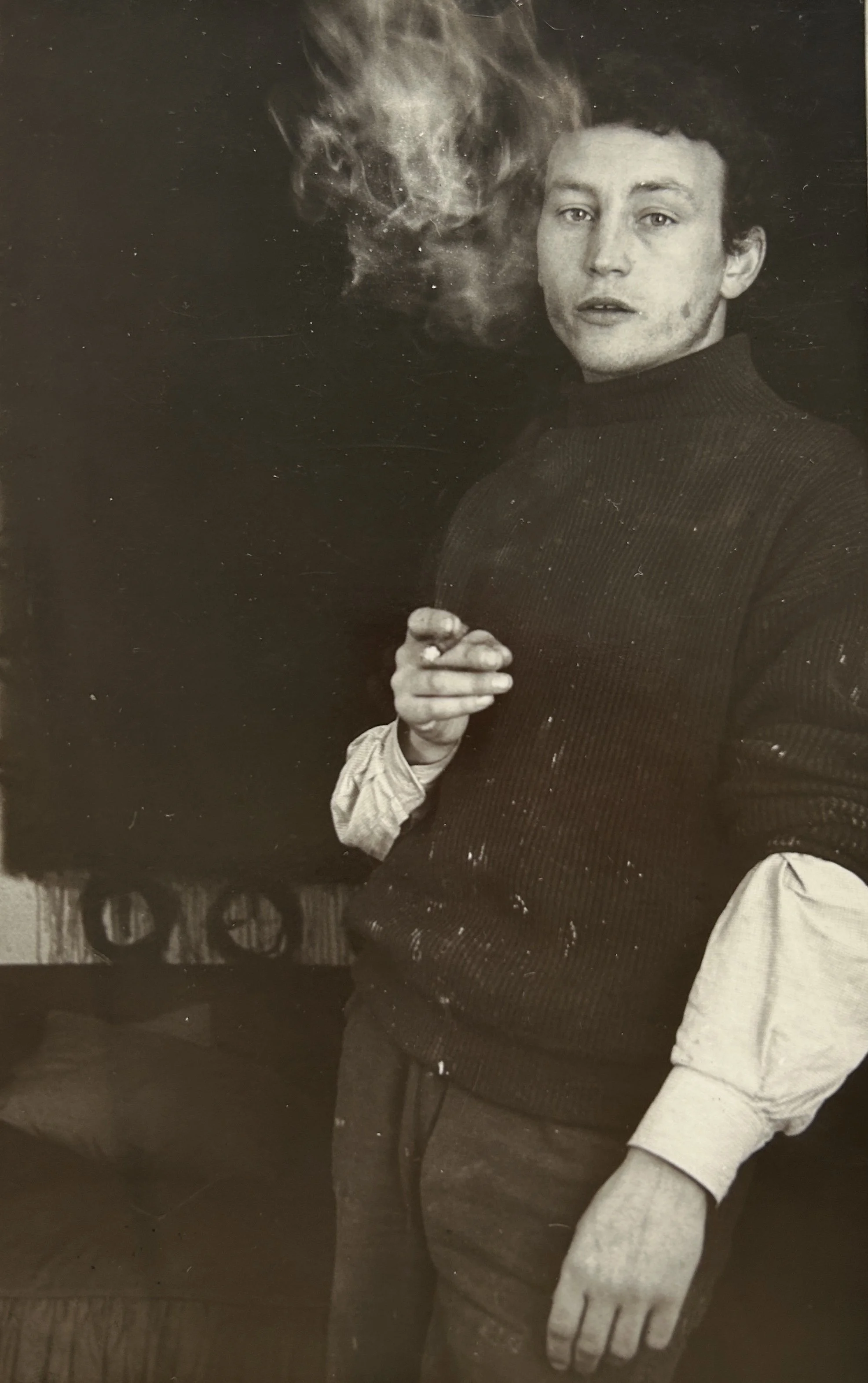
Pretending to smoke. Photo: Dennis Mitchell, 1960
… Anthony is one of the most philosophical artists in Britain today and both his painting and sculpture are concerned with giving pictorial form to thought. His art is beautiful and poetic. Although it has been continually changing for the last six years, it has kept a coherence within its variety which is undoubtably the mark of a great artist.
Anthony Fawcett, Sculpture International (Vol. 2, No.1), 1967
In a letter to the critic/curator Anthony Fawcett, about his piece of sculpture in the 1968 Coventry Cathedral Exhibition, Benjamin wrote, I find it uncomfortable to talk about my sculpture, as ‘Sculpture’ as many of the concerns involved are equally to do with painting or kinetics. I really don’t think of myself as a Sculptor, or as a Painter or Printmaker, but as an Artist, and these categories are simply the necessary, or available medium in which I happen to be working.
A visual work of art remains outside words, as does music, and some profound experiences are only diminished, it seems to me, by being wordily reduced to a relative and comprehensible level. To define a thing is to an extent to limit it to the merely rational.
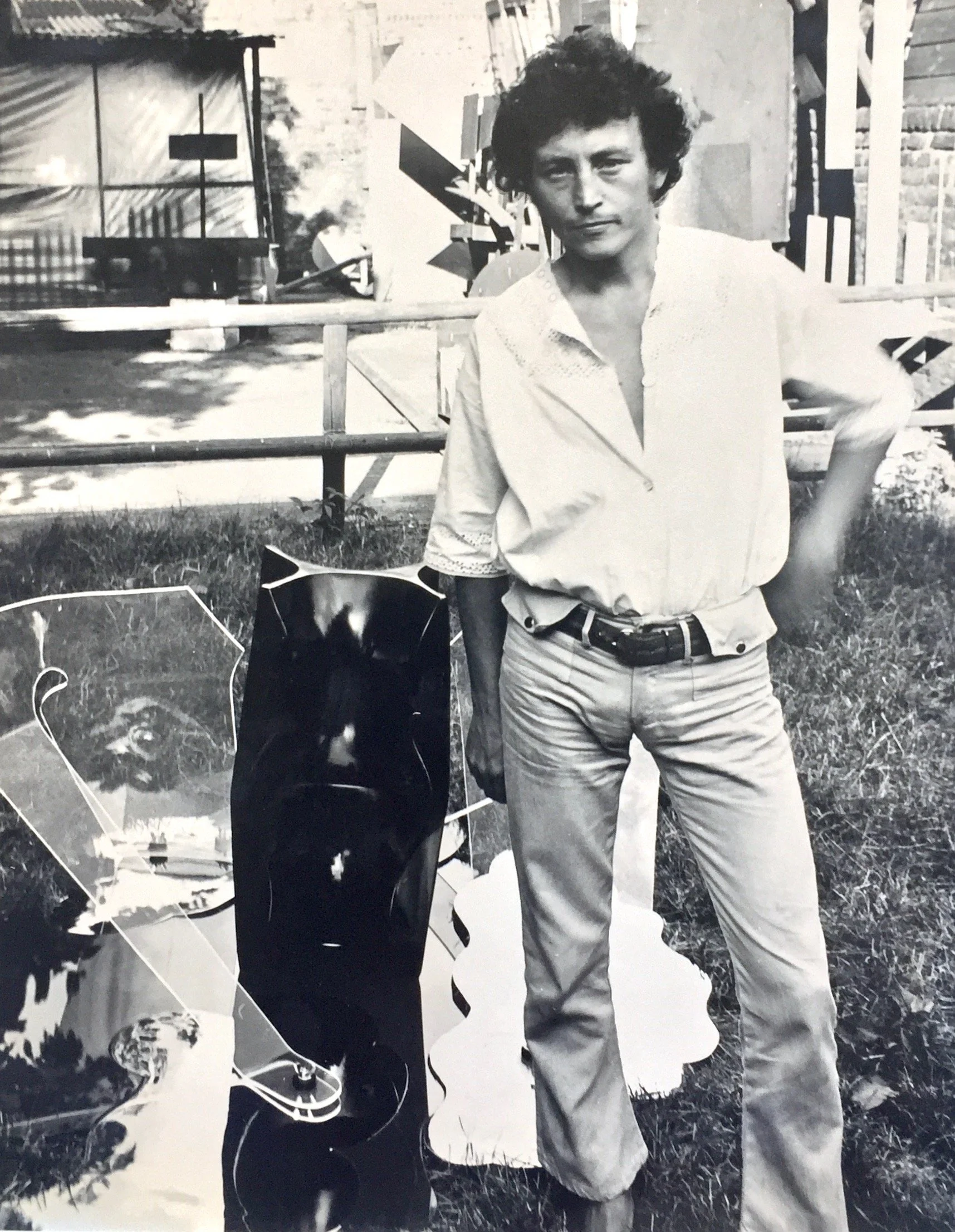
Benjamin in the garden with the sculpture and Brian Wall’s studio in the background, 1967
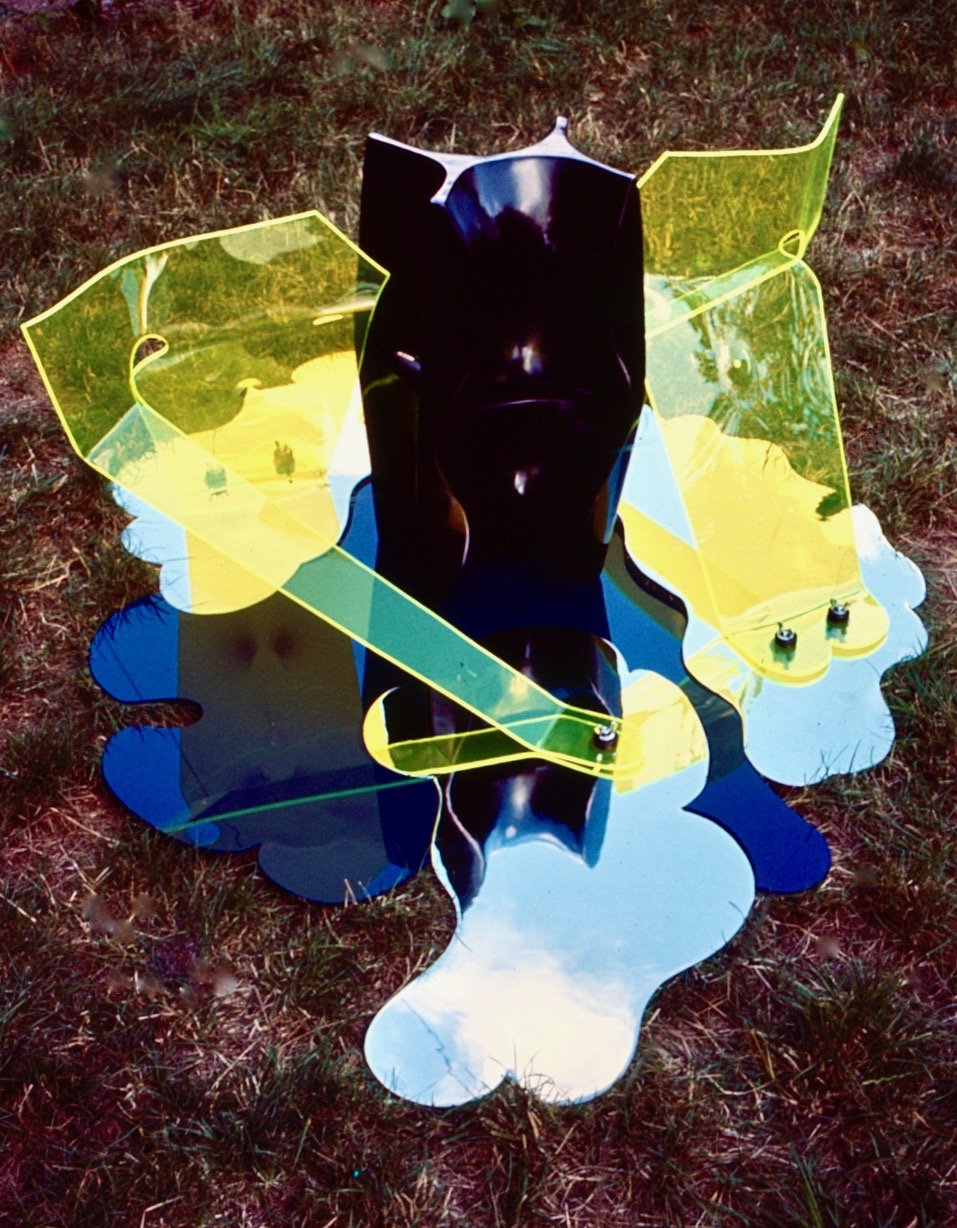
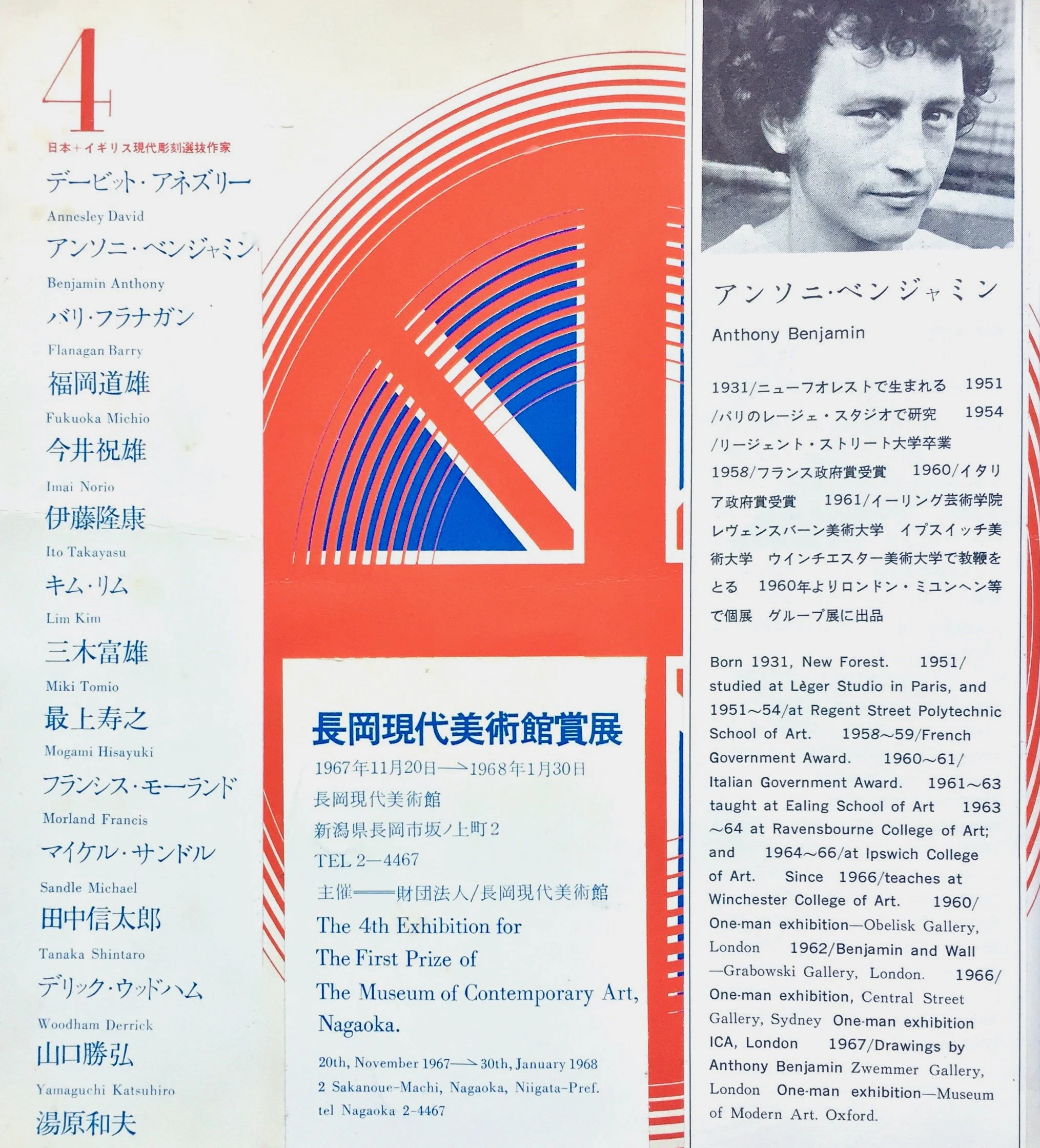
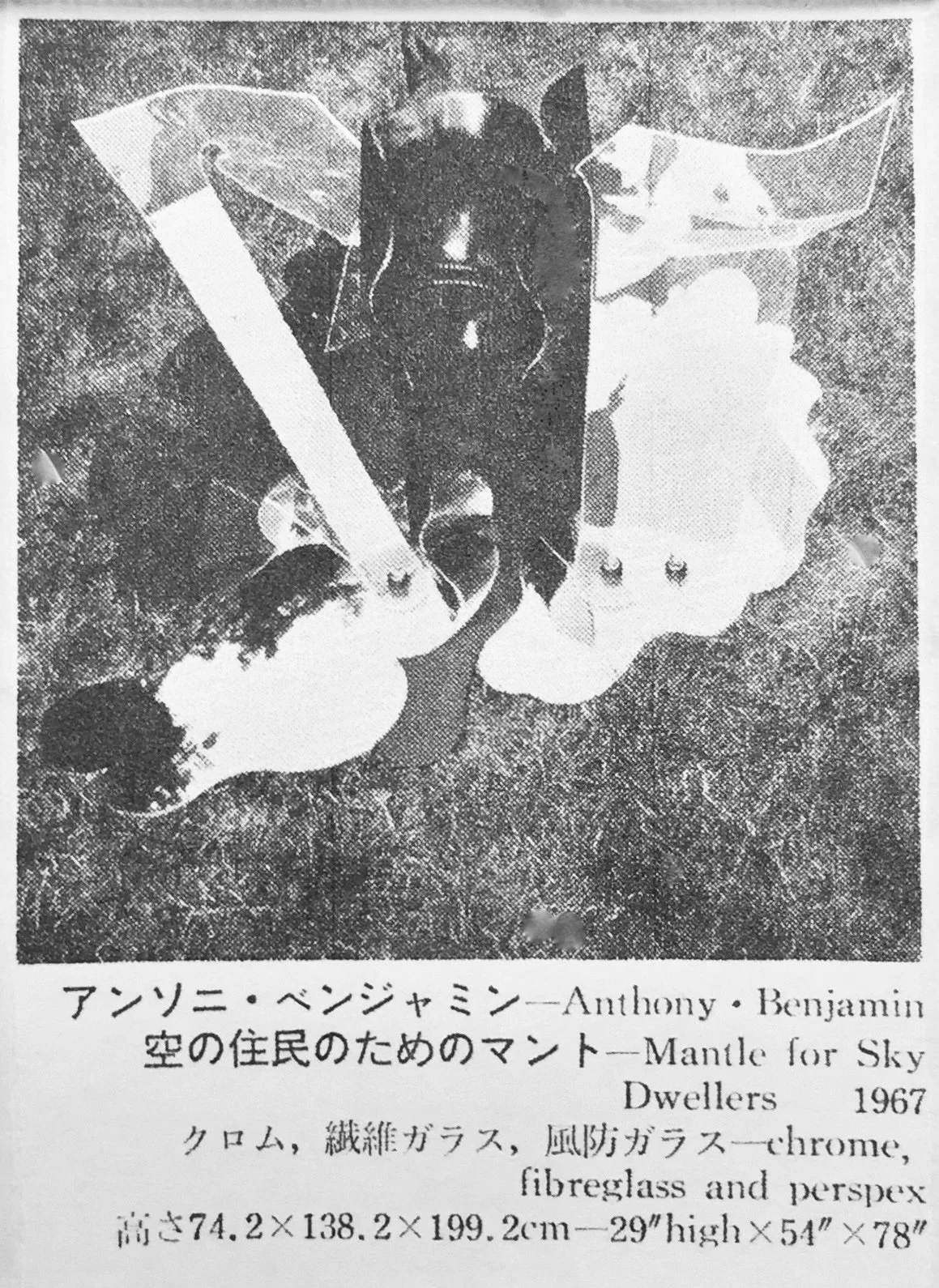
Mantle for Sky Dwellers, purchased by the Museum of Contemporary Art at the 4th Exhibition for the First Prize of the Museum of Contemporary Art, Nagaoka, 1968
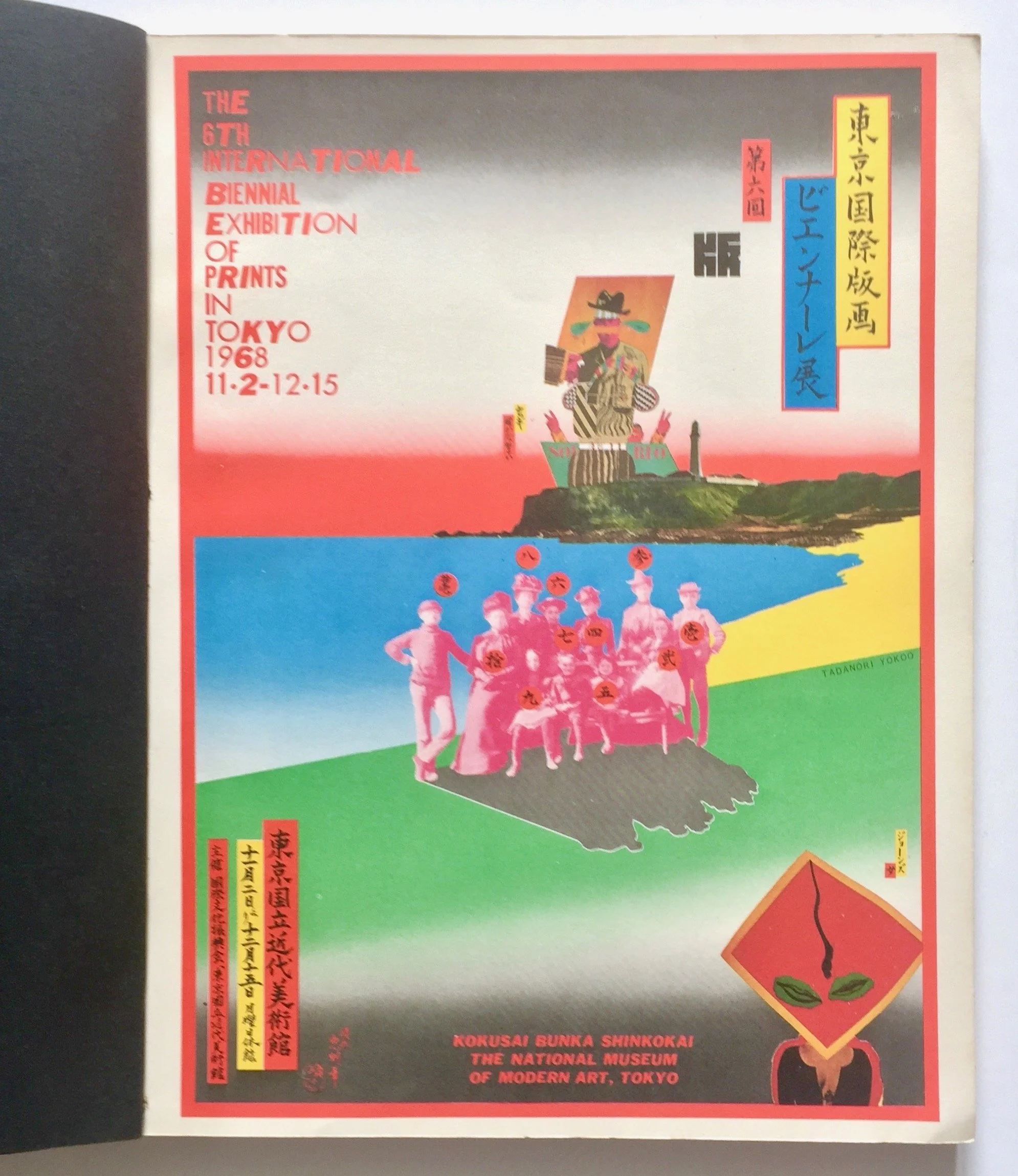
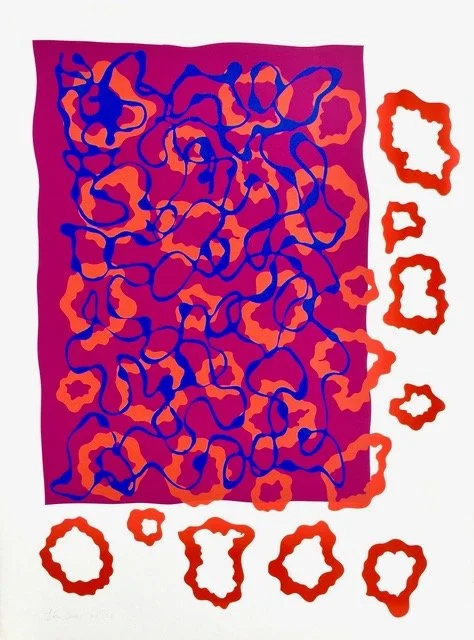
Overlayers 2. Prize winner at the 6th International Biennial, Tokyo National Museum of Modern Art, 1968.
Gentle Edge, detail, Oxford Museum of Modern Art, 1967. (Centre left: Anthony Fawcett with Benjamin). Photo: Anthony McCall
The attraction of Perspex for Benjamin was very strong—its marvellous reflective sheen and the luxurious depth of coloured light which filters through the surfaces or catches the edges. It is not possible at first to see the subtle relationship between his plastic sculptures and his painting, but in fact there is a strong link—they are both connected with actual visual events …
… His first Perspex sculpture came from an interest in popular music and in creative music, and from a situation which we call ‘Carnaby Street.’ Benjamin told us: “I’ve made a synthesis of ideas that come out of my reactions to Carnaby Street. In 1964 I made the first maquette for this, and at that time the material was fantastically seductive in itself, seemed to me like something that belonged to this sort of communication, and I wanted to make the material work for me.”
Anthony Fawcett, Sculpture International (Vol. 2, No.1), 1967
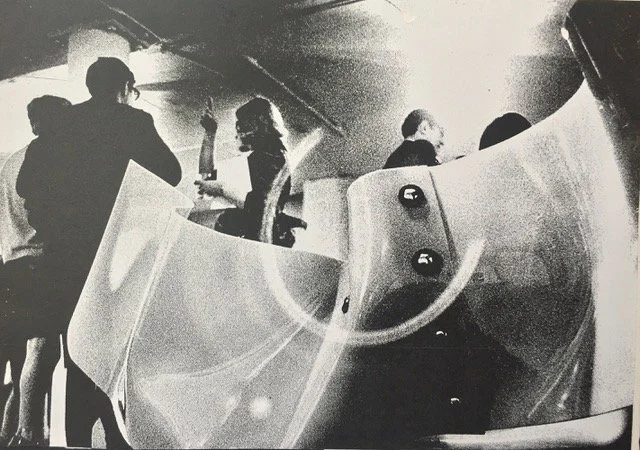
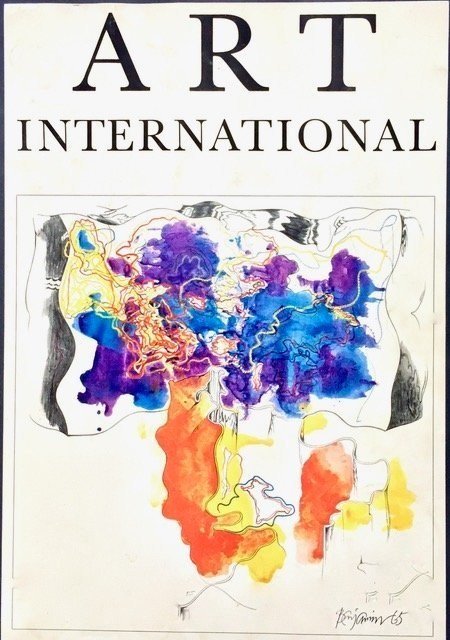
Carnaby II, mixed media drawing, Art International, 1968
As well as making drawings in preparation for a piece of Perspex sculpture, Benjamin made other works on paper that evoked the experience of looking into the surface reflections rather than just focusing on the physical shape of the piece. He used all manner of liquid colours and a Magic Eraser Rotating Device ingeniously loaded with a coloured pencil, producing wobbly and slightly uncontrolled lines. When Art International featured his work, a drawing of Carnaby II was used on the cover, and the article mentioned the materials used in making the piece: Perspex, blue 744, orange 363, fibreglass, coach bolts, rubber washers, and chrome plated nuts. The inventive drawing was purchased by Jay Shears, an American documentary filmmaker living in upstate New York.
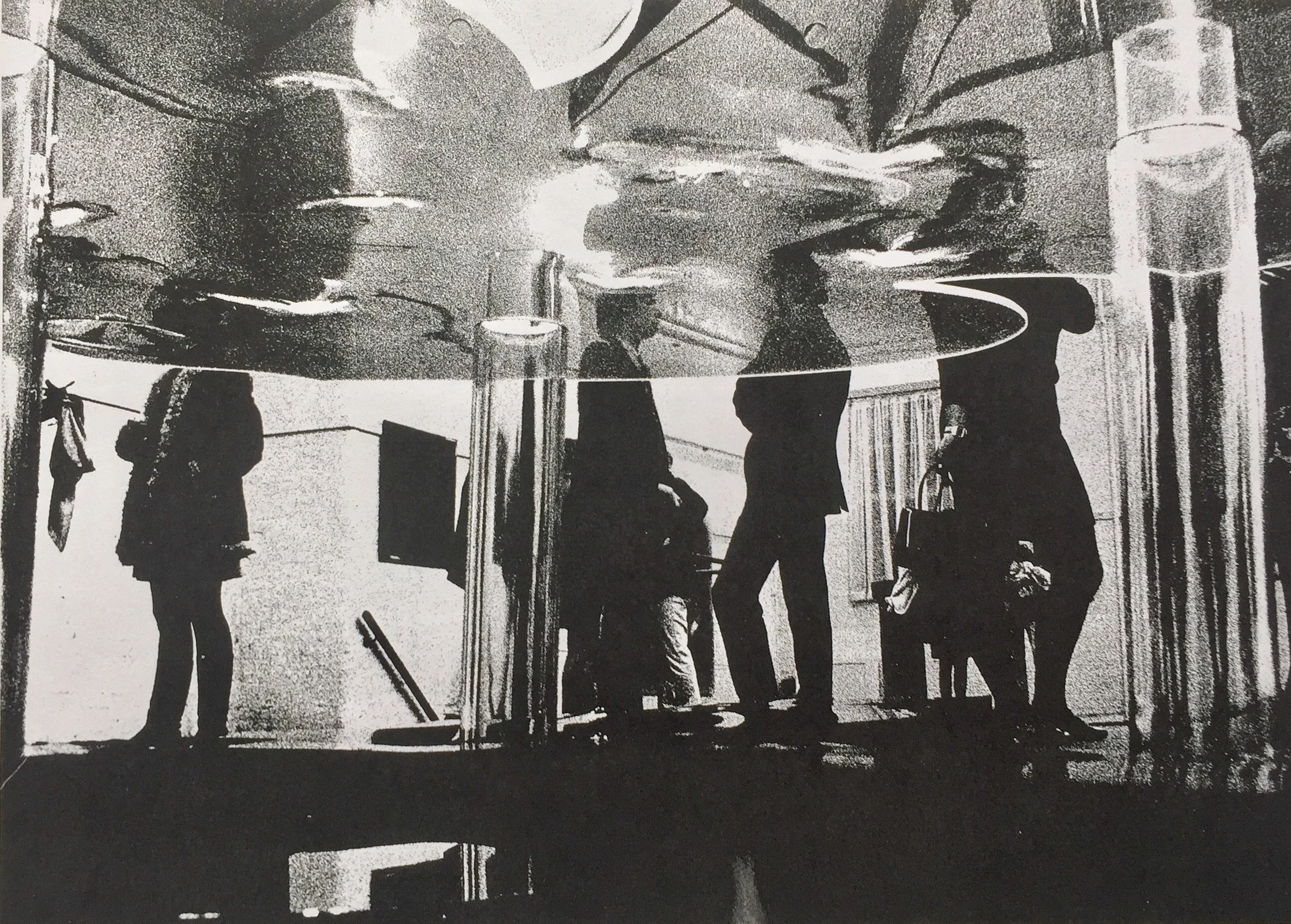
Carnaby II. Photo: Anthony McCAll
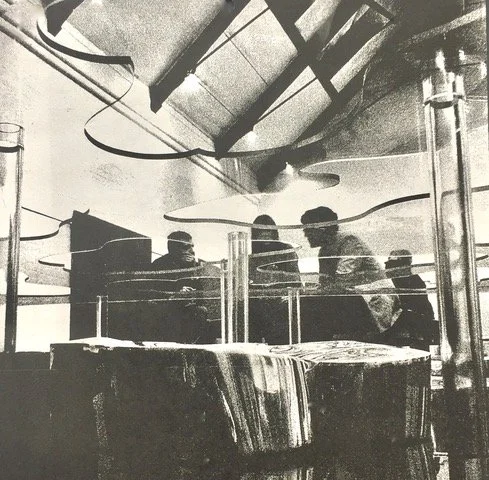
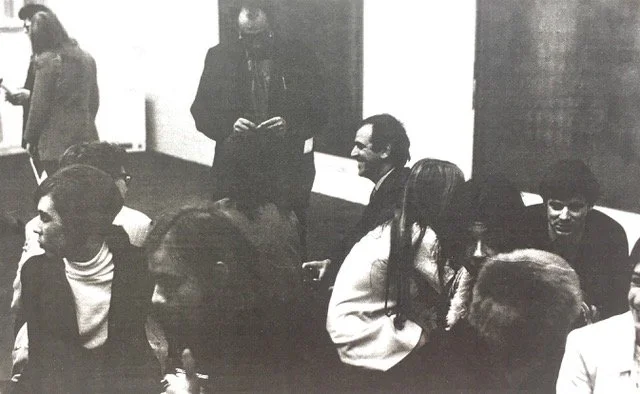
Left, Rowan Rownish, Robert Lewis; behind: Brian Wall, Nancy Patterson, Trevor Bell, and (right) Bryan Young. Photos: Anthony McCall
Anthony McCall, who Benjamin knew as a student at Ravensbourne, took a series of dramatic photos from unusual angles at the opening of the exhibition in Oxford. He posted the contact prints to Benjamin at Liverpool Road in a large brown envelope with a hand-drawn decorative label and witty ‘mirror photos’ of Benjamin looking at himself in his dandyish, new black suit from Lord John, of Carnaby Street.
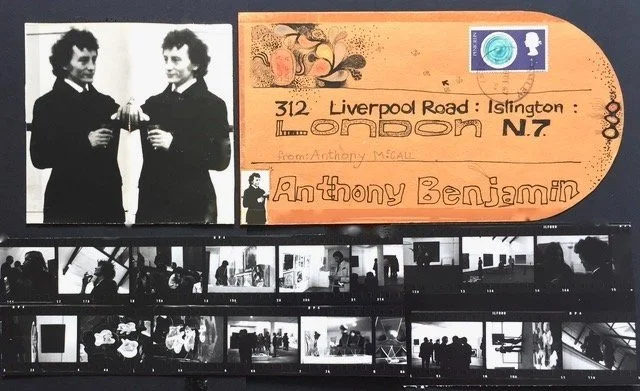
McCall was a quiet, dedicated student amongst a lot of more visible arty extroverts; however, after graduating from college, he went off to the USA and became a successful photographer. Later his interest in sculpture developed in an innovative direction as ‘Solid Light’ installations, beginning in 1973 with Line Describing a Cone. McCall had a major exhibition at the Tate Modern in July 2024.