Mid 1970s London, Laminated Sculptures
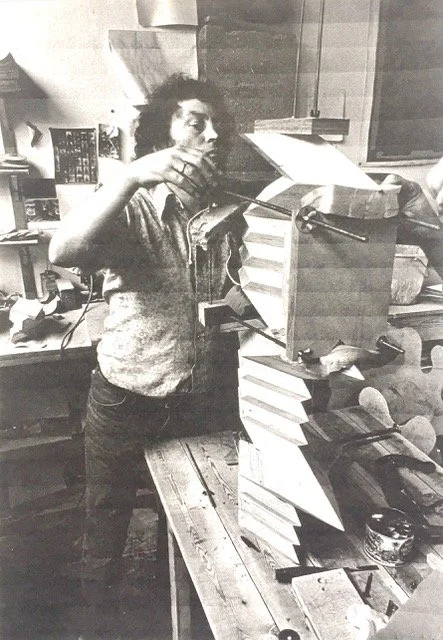
Benjamin assembling a piece. Photos…?
Benjamin and Nancy wanted to return to London as there were some alarming reports of what was going on in the Islington house. However, he was stuck having accepted the well-paid but problematic, temporary post as Head of OCA (Ontario College of Art), so Nancy flew back and found their worse nightmares confirmed. The two enthusiastic architecture students and the bright young journalist who ‘loved’ the house had disappeared after taking in a ‘friend’ who did not approve of private property… 312 had become known as the ‘Liverpool Road Hotel’. However, the place was almost restored to a liveable state by the time Benjamin returned but with fewer furnishings, as most of that had ended up in the fireplace. A lot of their other stuff was either broken or gone, but worst of all, the large ground floor room where the art had been stored—the sculpture, paintings, and several plan chests of works on paper, had been broken into—the metal parts were stacked in the backyard, the broken Perspex was in the front yard, and the plan chests had been rummaged; he was devastated.
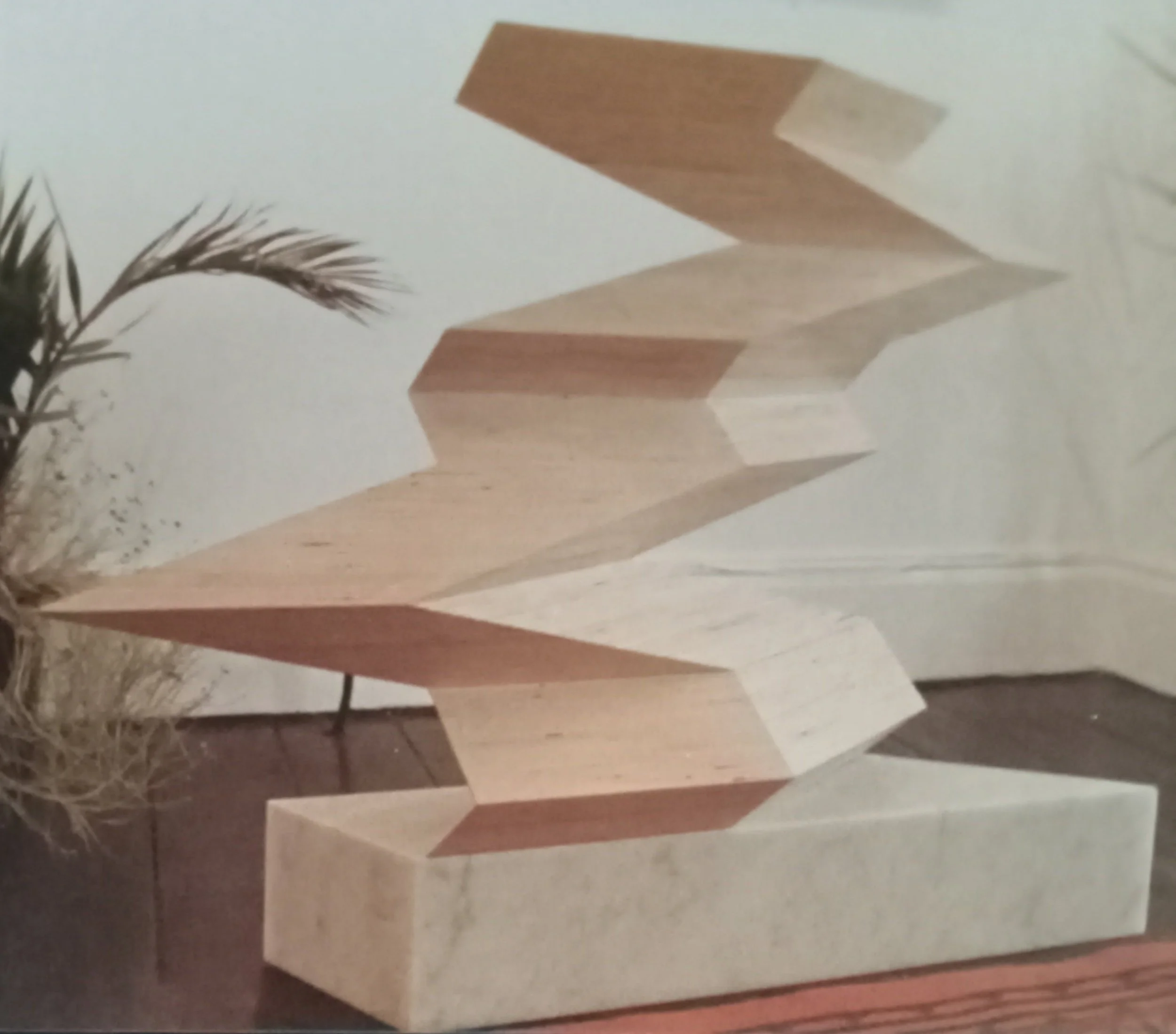
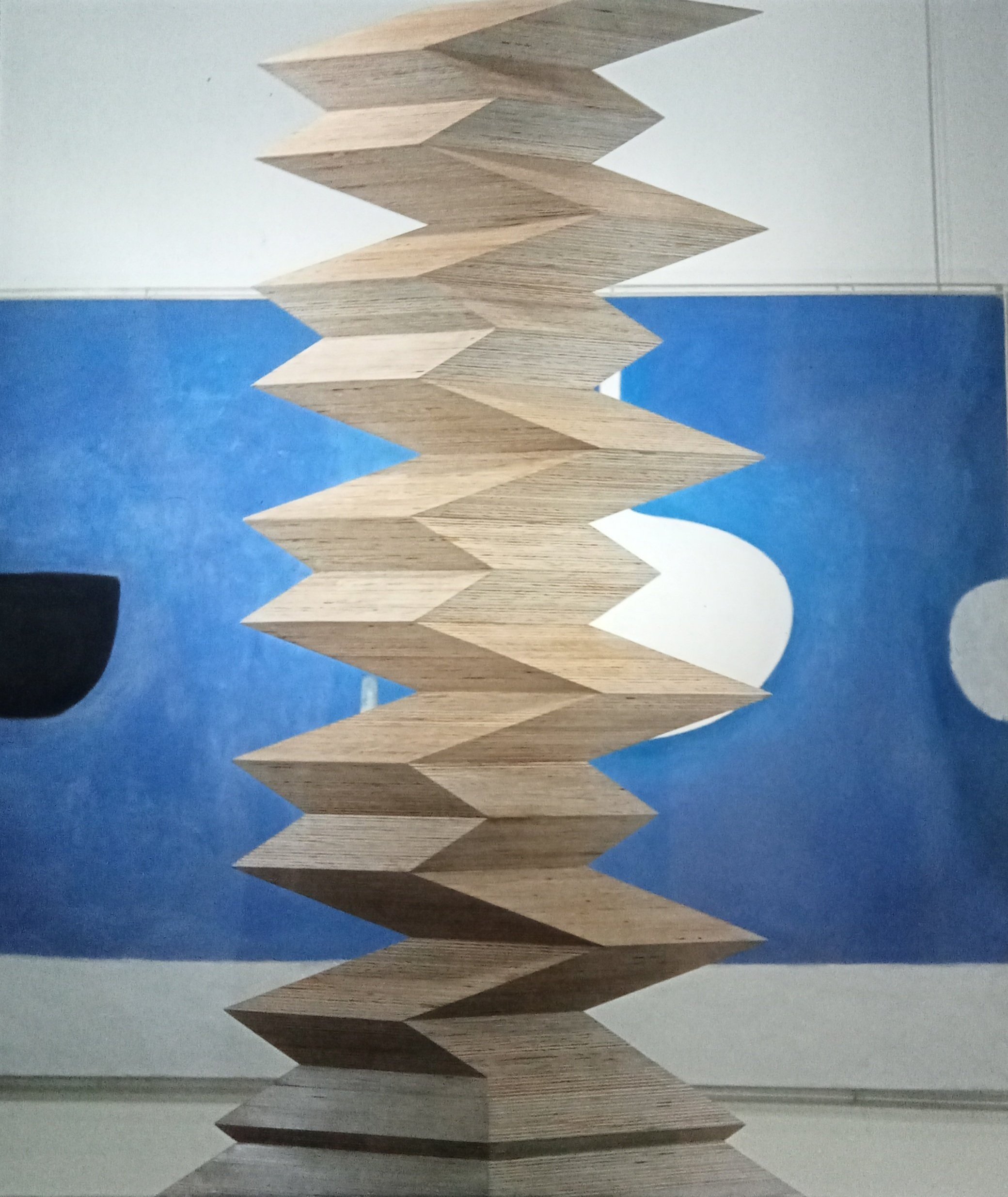
Benjamin had intended to start painting again when he returned and wanted to build a studio in the backyard, but local height restrictions meant he had to excavate a metre down which inflated the cost and increased the construction time. By the time the building was complete, he had decided to make sculpture again, partly because he had some new ideas about how to use the salvaged fluorescent Perspex. His plan was to laminate thick pieces of plywood, interleaved with Perspex, cut to approximate size, then bevelled with a radial arm saw or sanding disc to construct a series of zigzag towers. The complicated procedure worked surprisingly well and the Perspex between the plywood transmitted light in a way that looked like bands of neon. Some larger pieces were made and shown to Gimpels, who were enthusiastic, and a date for an exhibition was set.
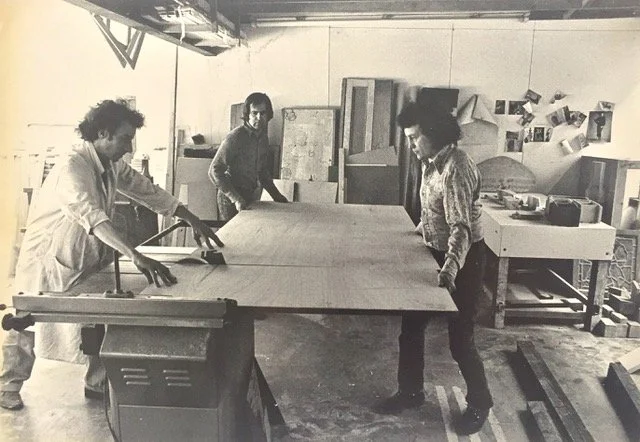
Simon Brint, Tony Staples and Benjamin, cutting plywood for the first stage of the sculpture construction.
As usual, his enthusiasm was contagious and he soon had his friends, Tony Staples, a successful lighting designer and Simon Brint, a talented musician with the Comedy Crowd, working with him and Nancy in the new studio .
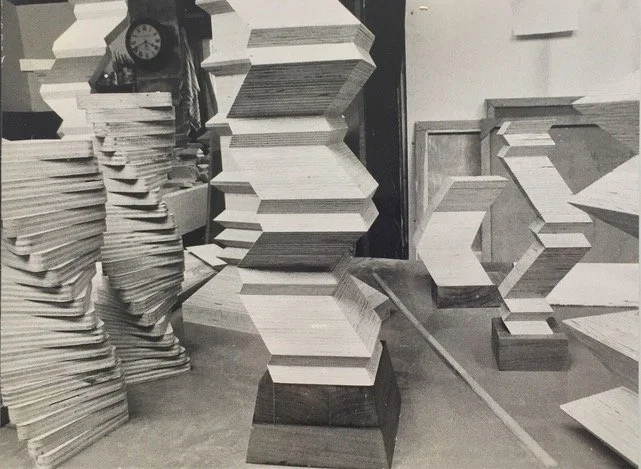
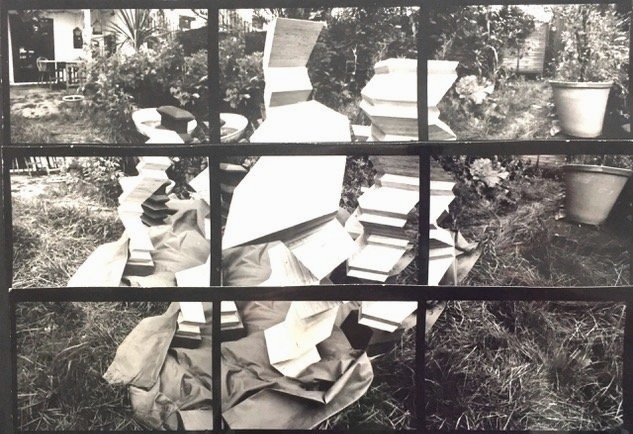
Work in progress, 1976. Photos: David Corio?
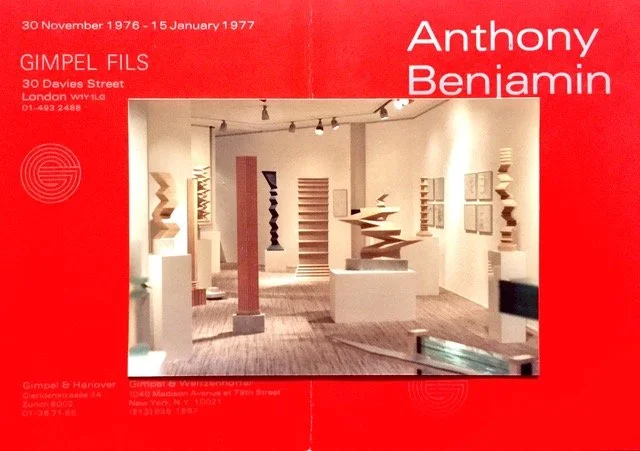
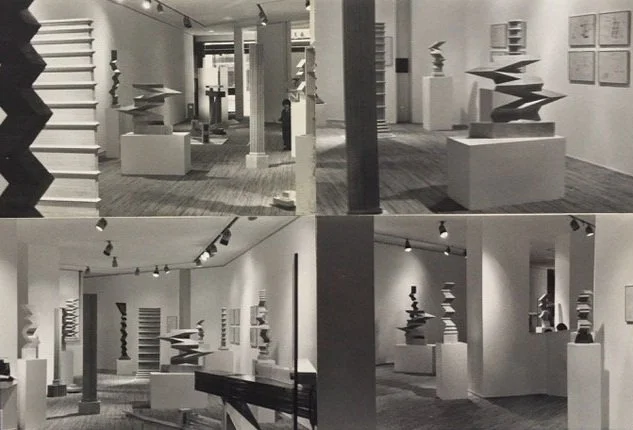
Solo Exhibition, Gimpel Fils Gallery, London, November 30, 1976 — January 15, 1977 Photos: Nancy Patterson
Zig Zag Zig, 1977. Photo: Norman Mercer
NP sending photos of small pieces to eventually sell.
Images of Space
“Simple proportions based on a geometric system of carefully constructed elements compose the plywood sculpture of Anthony Benjamin (Gimpel Fils). Although austere and abstract these zig zag counteracting movements provide a shifting of relationships that engages the eye while the play of light and shadow adds sharply exacting contrasts whose formal and orthogonal interactions are far removed from children’s bricks.”
James Burr, Round the London Galleries, 1977