
1970’s-1990’s, London & Europe: Prints and Projects
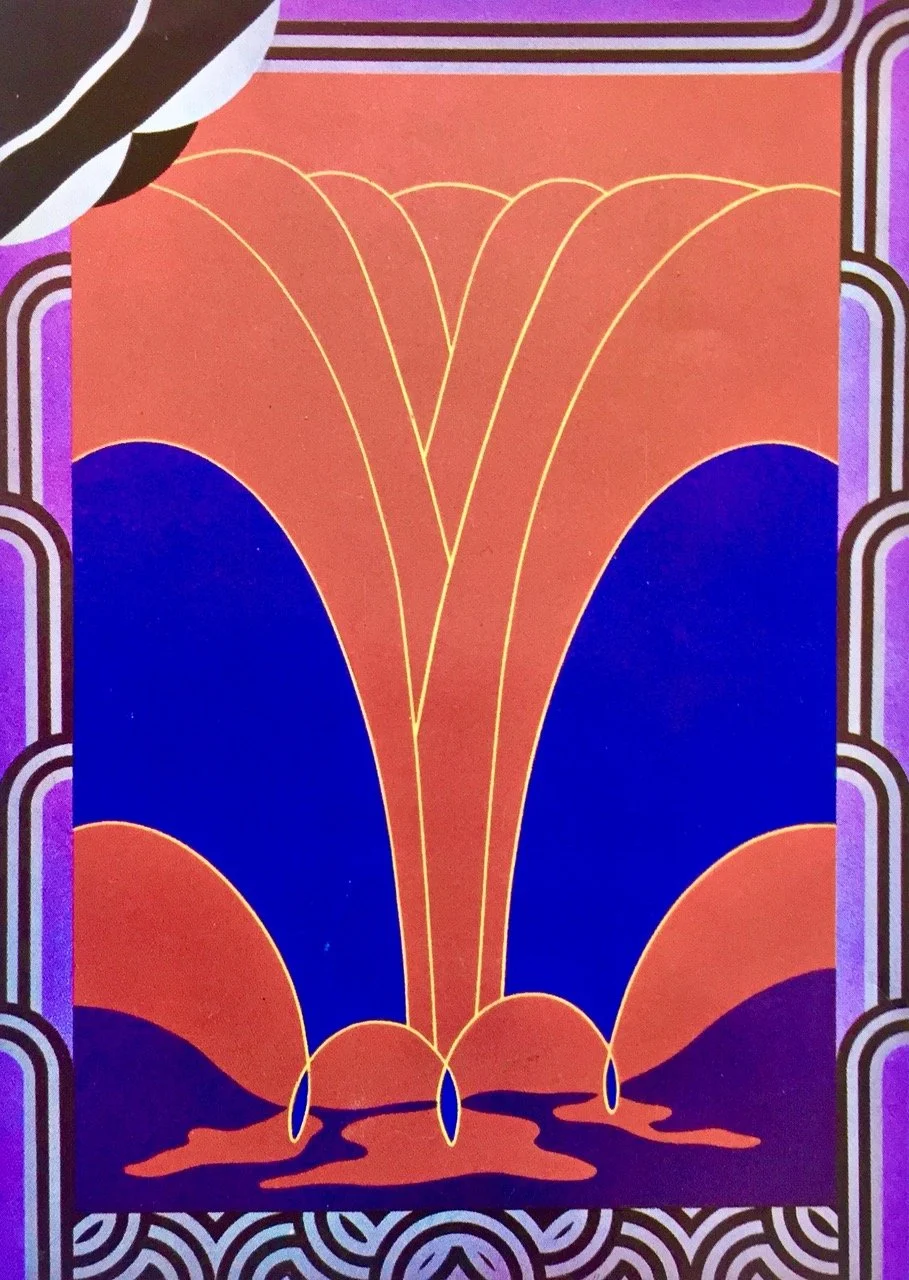
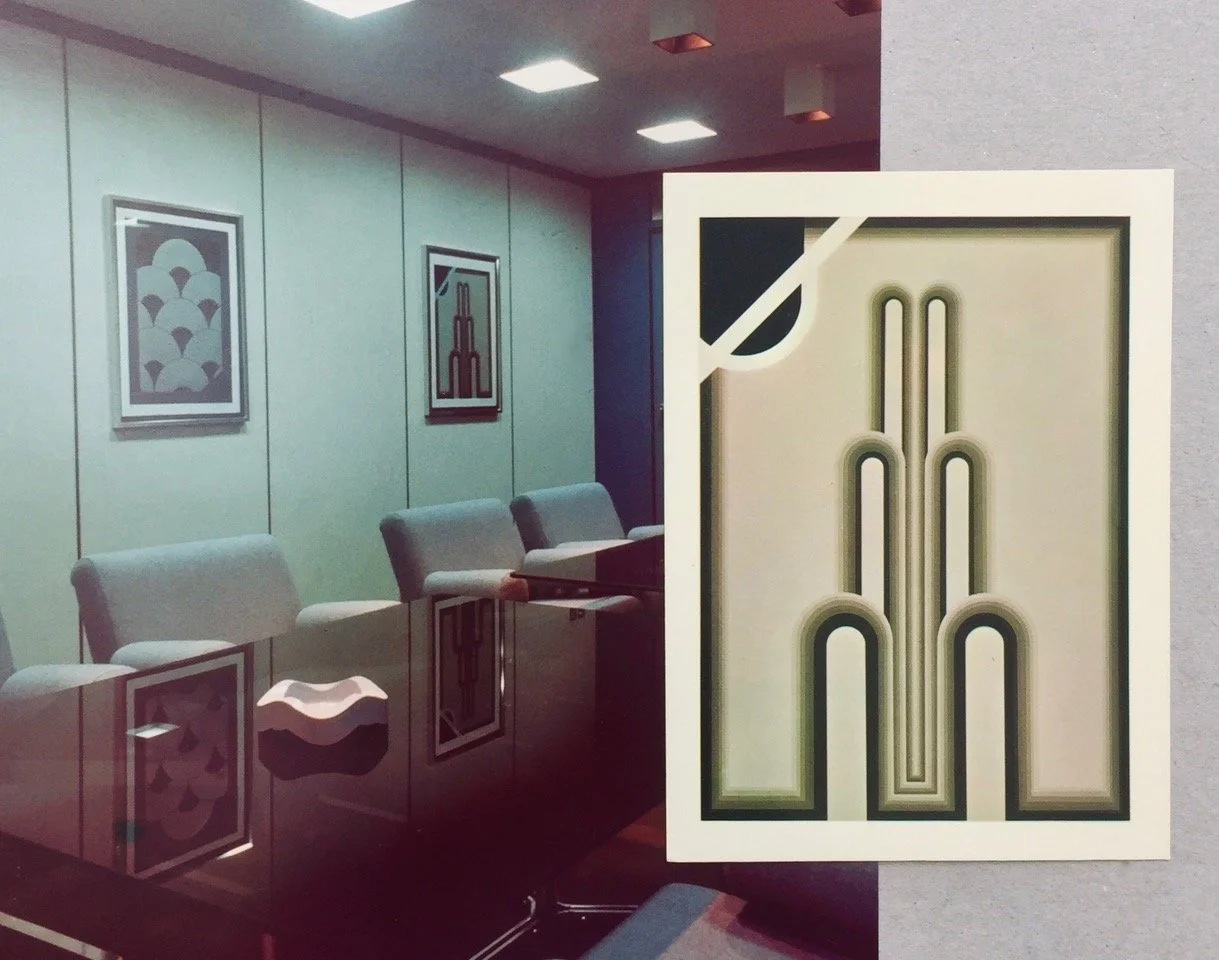
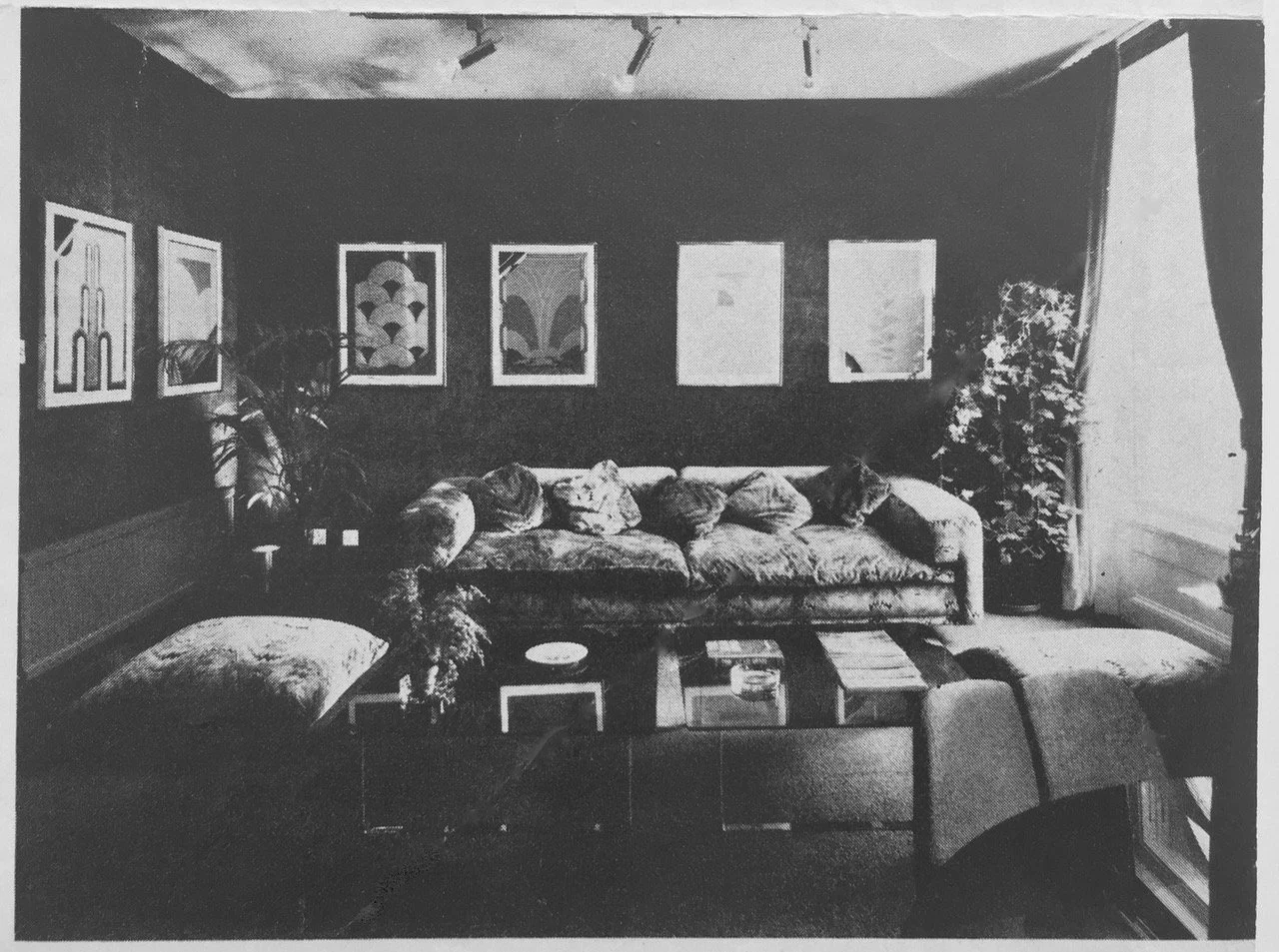
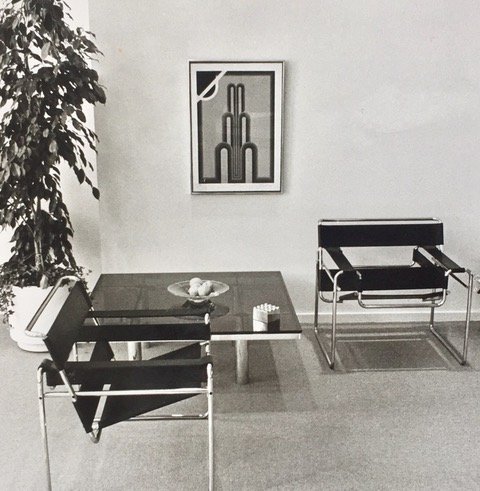
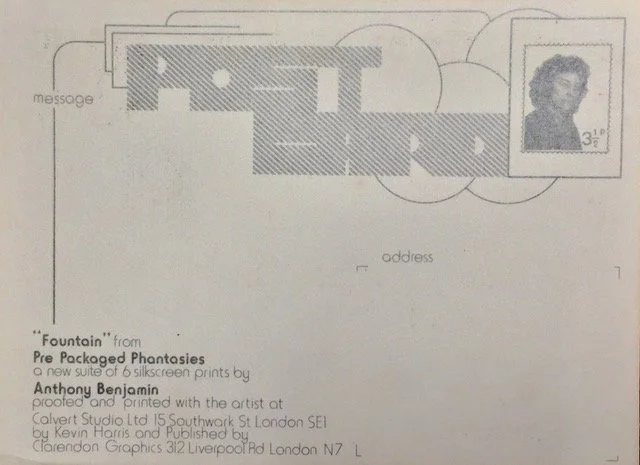
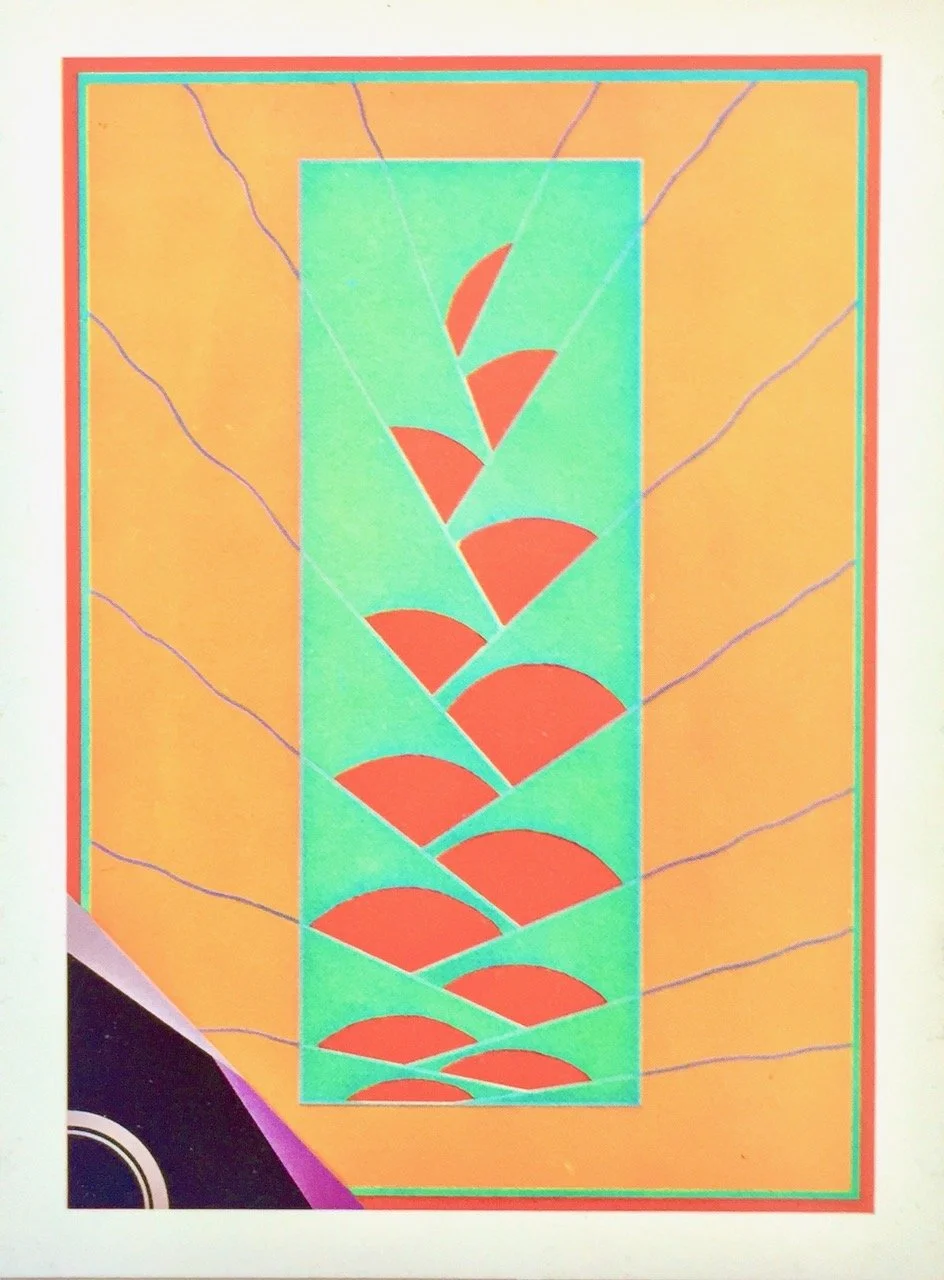
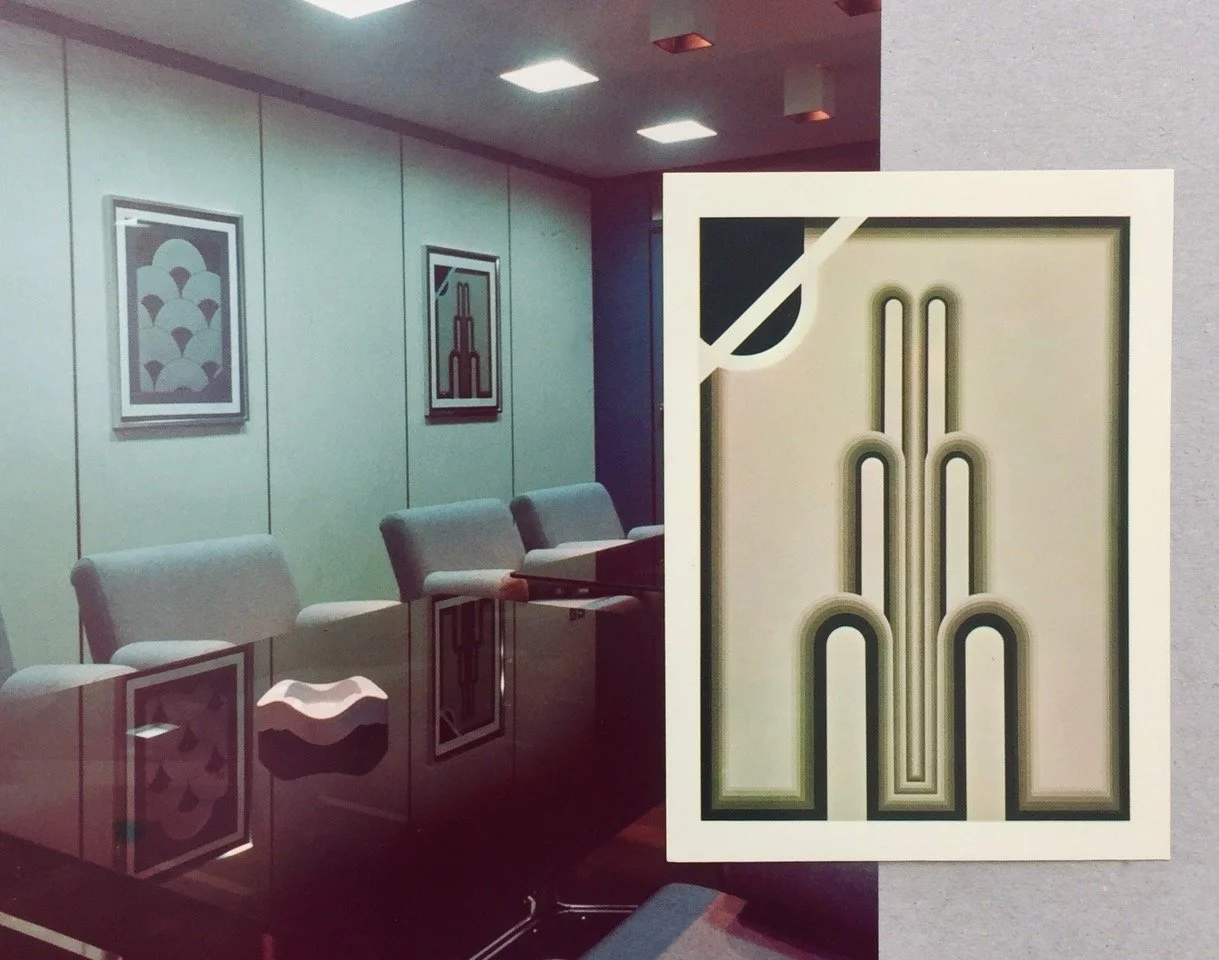
When travelling back and forth between North America and Britain, he produced the eight ‘TransAtlantic Suite’ screenprints that won prizes and sold well. When he finally left Canada in 1973 to return to London, he made a suite of six screen print images he titled ‘Pre- Packaged-Phantasies’. This was partly a reflection on modern upmarket consumerism, but also a homage to the art deco style he loved, there was always something more than might be expected in his inspiration. These beautifully images perfectly printed by Kevin Harris were an immediate success; Sheldon Williams wrote about them eloquently in 1974 as- “The Quest for Unambiguous Contact” … mentioning Fernand Leger, who Benjamin studied with in Paris: “He would have approved the interesting and competent way in which Benjamin today has discovered and tapped latent extensions of the art-deco epoch, back in public favor on a wave of nostalgia.” Interior Designer, Mary Gilliat, used the ‘Pre-Packaged’ set several times when working with Liberty’s on magazine features and show flats… one set of the six framed images was stolen from a show flat and never recovered.
While Benjamin’s main artistic activities were painting and drawing, he also enjoyed working cooperatively with skilled technicians to produce limited edition etchings and screenprints. By the early 1970s he was exhibiting widely, and winning prizes internationally - 1970 and ‘72 Cracow Print Biennale, 1971 Tokyo Print Biennale, 1972 III Exposition Internationale Rijeka, Yugoslavia, the 1972, and 1980 Frechen Internationale Grafik Biennale, 1974 Norske Internasjonale Grafikk Biennale, Fredrikstad,1975 Albright -Knox Gallery, Buffalo, New York,1979, 9 Canadian Artists, Chicago, USA, 1979 Biennale Ljubljana, Yugoslavia, 1982 Arteder Bilbao, 1982 British International Print Biennale, Bradford 1982, X Biennal Ibizagrafi, 1983, International Print Exhibition, ROC, Taiwan and many more.
Although he did not need an external stimulus to get on with making art, he tended to arrange exhibitions and set overly optimistic deadlines… time would get tight, and he would have to call in help. He was good at this because he was fun to work with, however, sometimes he would slide off sideways into something else, leaving co-worker(s) wondering why they were busy working through the night; Benjamin managed to divert Kevin Harris, ( when he was involved in printing the Pre-Packaged Phantasies for an exhibition at Gorner & Millard ), into printing posters for a musical show a friend was putting on. Fortunately, Harris was able to finish the prints to his usual high standard, as well as the posters, but sometimes not everything Benjamin started, was completed as originally intended and by the time intended.
His boundless energy and interest in cooperative activities led him to participate in Projects that sometimes ate up his time. While these projects often worked out brilliantly, sometimes they did not produce the intended results, even though Benjamin enjoyed the activities involved. He probably became overly interested in projects not directly involved with his artwork, because of his success in leading citizen groups confronting civic planning issues. The first in the early 1970s in Toronto with John Sewell (who eventually became the mayor ), when they successfully led the ‘Save Cabbagetown’ protest again Meridian, a ruthless construction company who wanted to replace the fine, but at the time slightly rundown, early 20th century properties on the margin of downtown Toronto (where they lived) and replace them with concrete towers… then later in London with the ‘Liverpool Road Association’, by preventing the installation of overnight refrigerated lorry parking at Highbury Corner. On each occasion, he made a rousing speech to a crowd of supporters from the steps of a civic building, which probably caused a bit of an adrenalin rush for him.
Islington Daze : Soon after moving back into 312 Liverpool Road, Benjamin become close with Mike Khan, a talented but unruly, Rocker from the Nottingham Meadows Khan, a charismatic singer/songwriter with a brilliant guitarist partner, Malcolm Peet, were regular weekend entertainment at The King’s Head in Upper Street, Islington. This classic19th century pub had an unusually large backroom used as a boxing arena in earlier times; this derelict space had been adapted for use as a theatrical venue in 1970 when the pub was taken over by eccentric American, Dan Crawford, and his wife, Joan, who were dedicated to promoting all manner of innovative theatre. The theatre room was used for mix of one-person performances, and scaled down previews of shows that some-times transferred to the West End. The performances were proceeded by formal Dinners at candle lit tables; occasionally Nancy helped out with service intrade for seeing the show and a tasty meal.
Crawford was more British, than most born in Britain folk; he rejected the change to decimalisation, so business over the bar was conducted in the ‘old pound, shilling and pence’ manner, using ancient, clanging cash registers… a bit of a challenge for newcomers on both side of the bar. Weekends were wild affairs with Khan and Peet playing to ecstatic crowds that include all manner of Islington Bohemia and people from all levels of the theatre world; Alan Clark, who lived nearby on Almeida Street, Roy Minton and David Yallop were frequent visitors. By the time “Closing time! Ladies and Gentlemen, Please!”,was called by Crawford, the place would be packed to the walls, with happy crowds flowing out onto the wide Upper Street pavement. Sometimes neighborhood noise complaints attracted the ‘cops’, who arrived to pull the speaker plugs. King’s Head mythology maintained that one night, Khan, Clark and Bronco, an Australian stunt man, had ended the evening by dancing on the bar with their underpants on their heads…and maybe they did? But even when the pub appeared to be Closed, insiders and friends of friends, would retire to the dim back room for more merriment.
Benjamin liked Khan’s anarchistic talent, they were like ‘blood brothers’… Khan was giving him informal guitar lessons, and he called Nancy, his ’Sister’. One evening when David Hess, an American horror film actor/director/musician, and Brian Eno, Benjamin’s former student, were at Liverpool Road for supper, soon after Eno had returned from Berlin where he had been working with David Bowie. They were all sitting on the floor in front of the fire drinking wine, when Khan burst in the door clutching his guitar and full of contagious exuberance. Catching his spirit of fun they started passing the guitar around, improvising short doggerel songs that started off with …“My ol’ friend Bowlegs, he ain’t got no legs…” the silly songs went on and on, becoming more and more outrageous, until everyone fell asleep, or passed out.
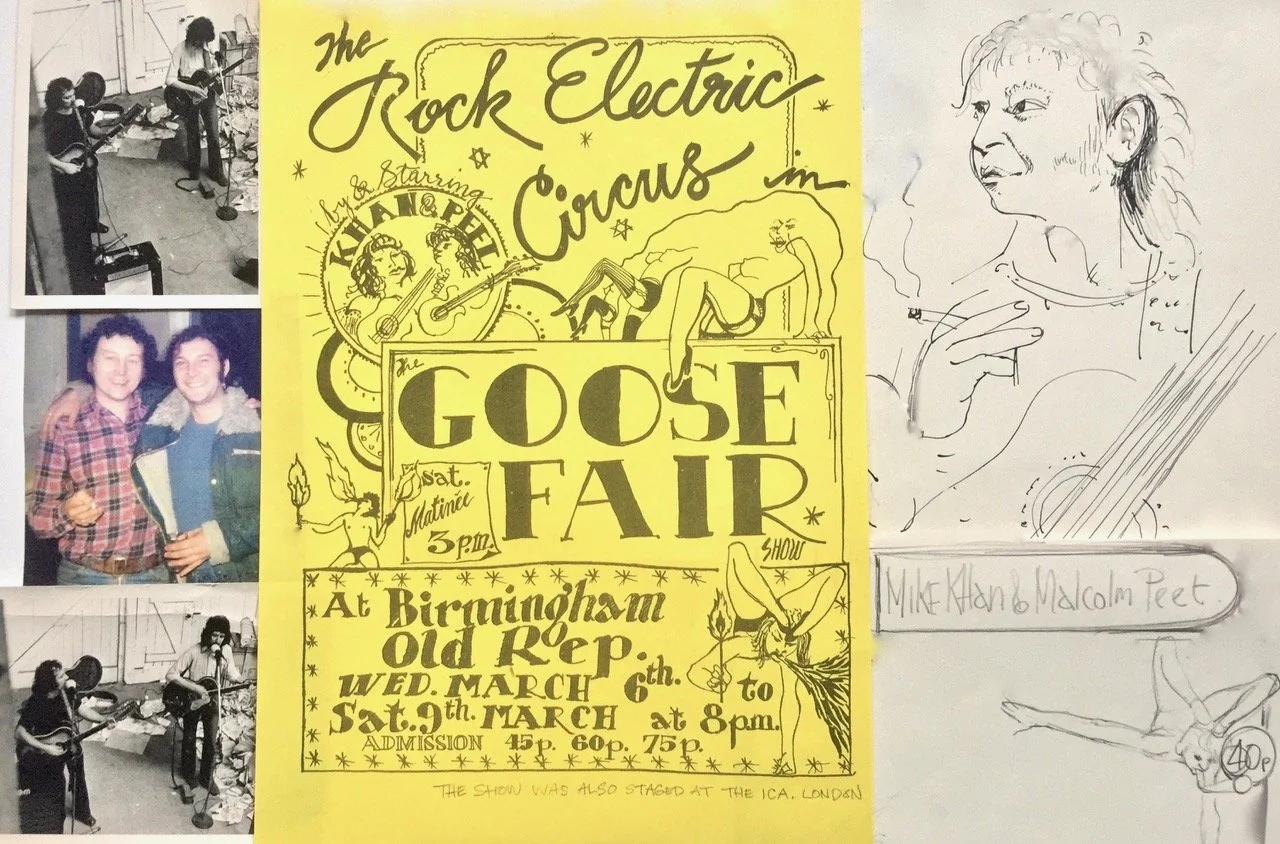
Khan had written a musical show called ‘Goose Fair’, with reference to the annual last gathering of the season of fun fairs in Britain on Forest Fields in Nottingham. He had located a venue in Birmingham, and in some other provincial towns, for a chamber version of the show, but he wanted to do the show in London as well. Somehow Benjamin managed to convince his friend Julie Lawson, to convince her boss, Sir Roland Penrose, that it might be interesting to do a couple of the 'Goose Fair’ shows at the new ICA in the Mall. Pina Bauch, the innovative contemporary dancer was booked to do some shows at the ICA soon, but another act was needed for the first half of the evening and, by some luck, that turned out to be Mike Khan’s musical.
The cast included the small ‘Manzani Family Travelling Circus’; when Nancy noticed that Benjamin had singed his eyebrows, she discovered he had been secretly practicing Fire Eating, with a member of the Manzani troop…but being conscious of his good appearance, he gave it up. The images of Fire Eaters on the poster are Self Portraits. When the clever little black cat moved from upstairs to downstairs, they named him Manzani, and he lived with them for years.
1970’s-1990’s, London & Europe: Prints and Projects
When travelling back and forth between North America and Britain, he produced the eight ‘TransAtlantic Suite’ screenprints; when he finally left Canada in 1973 to return to London, he made a suite of six screen print images titled ‘Pre- Packaged-Phantasies’. This was partly a reflection on modern upmarket consumerism, but also a homage to the art deco style he loved, there was always something more than might be expected in his inspiration. These beautifully images perfectly printed by Kevin Harris were an immediate success; Sheldon Williams wrote about them eloquently in 1974 as- “The Quest for Unambiguous Contact” … mentioning Fernand Leger who Benjamin studied with in Paris: “He would have approved the interesting and competent way in which Benjamin has discovered and tapped latent extensions of the art-deco epoch, back in public favor on a wave of nostalgia.” Interior Designer, Mary Gilliat, used the ‘Pre-Packaged’ set several times when working with Liberty’s on magazine features and show flats… one set of the six framed images was stolen from a show flat and never recovered.
However, his boundless energy and interest in cooperative activities also led him into participation in Projects that ate up his time, and while these projects often worked out brilliantly, sometimes they did not produce the intended results, even though Benjamin enjoyed the activities involved. He probably became overly interested in projects not directly involved with his artwork, because of the success he had in leading citizen groups confronting civic planning issues. The first in the early 1970s in Toronto with John Sewell (who eventually became the mayor ), when they successfully led the ‘Save Cabbagetown’ protest again Meridian, a ruthless construction company who wanted to replace the fine, but at the time slightly rundown, early 20th century properties on the margin of downtown Toronto, where we lived and are now incredibly valuable, and replace them with concrete towers… then later in London with the ‘Liverpool Road Association’, by preventing the installation of overnight refrigerated lorry parking at Highbury Corner. On each occasion he made a rousing speech to a crowd of supporters from the steps of a civic building, which probably caused a bit of an adrenalin rush.
Although he did not really need an external stimulus to get on with making art, he tended to arrange exhibitions and set deadlines that were overly optimistic …time would get tight, and he would have to call in help. He was good at this, because he was fun to work with. however, sometimes he would slide off sideways into something else, leaving his co-worker(s) wondering why they were busy working through the night; Benjamin had managed to divert Kevin Harris, ( when he was involved in printing the Pre-Packaged Phantasies in time for an exhibition at Gorner & Millard ), into printing posters for a musical show a friend was putting on. Fortunately Harris was able to finish the prints to his usual high standard, as well as the posters, but sometimes not everything Benjamin started, was finished as intended.
Benjamin’s main artistic activities were painting and drawing, but he also enjoyed making things and working cooperatively to produce limited edition etchings and screenprints. By the early 1970s he was exhibiting widely, and winning prizes internationally - 1970 and ‘72 Cracow Print Biennale, 1971 Tokyo Print Biennale, 1972 III Exposition Internationale Rijeka, Yugoslavia, the 1972, and 1980 Frechen Internationale Grafik Biennale, 1974 Norske Internasjonale Grafikk Biennale, Fredrikstad,1975 Albright -Knox Gallery, Buffalo, New York,1979, 9 Canadian Artists, Chicago, USA, 1979 Biennale Ljubljana, Yugoslavia, 1982 Arteder Bilbao, 1982 British International Print Biennale, Bradford 1982, X Biennal Ibizagrafi, 1983, International Print Exhibition, ROC, Taiwan and many more.
Crawford was more British, than most born in Britain folk; he rejected the change to decimalisation, so business over the bar was conducted in the ‘old pound, shilling and pence’ manner, using ancient, clanging cash registers… a bit of a challenge for newcomers on both side of the bar. Weekends were wild affairs with Khan and Peet playing to ecstatic crowds that include all manner of Islington Bohemia and people from all levels of the theatre world; Alan Clark, who lived nearby on Almeida Street, Roy Minton and David Yallop were frequent visitors. By the time “Closing time! Ladies and Gentlemen, Please!”,was called by Crawford, the place would be packed to the walls, with happy crowds flowing out onto the wide Upper Street pavement. Sometimes neighborhood noise complaints attracted the ‘cops’, who arrived to pull the speaker plugs. King’s Head mythology maintained that one night, Khan, Clark and Bronco, an Australian stunt man, had ended the evening by dancing on the bar with their underpants on their heads…and maybe they did? But even when the pub appeared to be Closed, insiders, and friends of friends, would retire to the dim backroom for more merriment.
Benjamin liked Khan’s anarchistic talent, they were like ‘blood brothers’… Khan was giving him informal guitar lessons, and he called Nancy, his ’Sister’. One evening when David Hess, an American horror film actor/director/musician, and Brian Eno, Benjamin’s former student, were at Liverpool Road for supper, soon after Eno had returned from Berlin where he had been working with David Bowie; they were all sitting on the floor in front of the fire drinking wine, when Khan burst in the door clutching his guitar and full of contagious exuberance. Catching his spirit of fun they started passing the guitar around, improvising short doggerel songs that started off with …“My ol’ friend Bowlegs, he ain’t got no legs…” the silly songs went on and on, becoming more and more outrageous, until everyone fell asleep, or passed out.
Khan had written a musical show called ‘Goose Fair’, with reference to the annual last gathering of the season of fun fairs in Britain on Forest Fields in Nottingham. He had located a venue in Birmingham, and in some other provincial towns, for a chamber version of the show, but he wanted to do the show in London as well. Somehow Benjamin managed to convince his friend Julie Lawson, to convince her boss, Sir Roland Penrose, that it might be interesting to do a couple of the 'Goose Fair’ shows at the new ICA in the Mall. Pina Bauch, the incredibly, innovative contemporary dancer was booked to do some shows at the ICA soon, but another act was needed for the first half of the evening and, by some luck, that turned out to be Mike Khan’s musical. The cast included the small ‘Manzani Family Travelling Circus’; when Nancy noticed that Benjamin had singed his eyebrows, she discovered he had been secretly practicing Fire Eating, with a member of the Manzani troop…but being conscious of his good appearance, he gave it up. The images of Fire Eaters on the poster are Self Portraits. When the clever little black cat moved from upstairs to downstairs, they named him Manzani, and he lived with them for years.
INSERT THE ‘GOOSE FAIR’ POSTER & PHOTOS
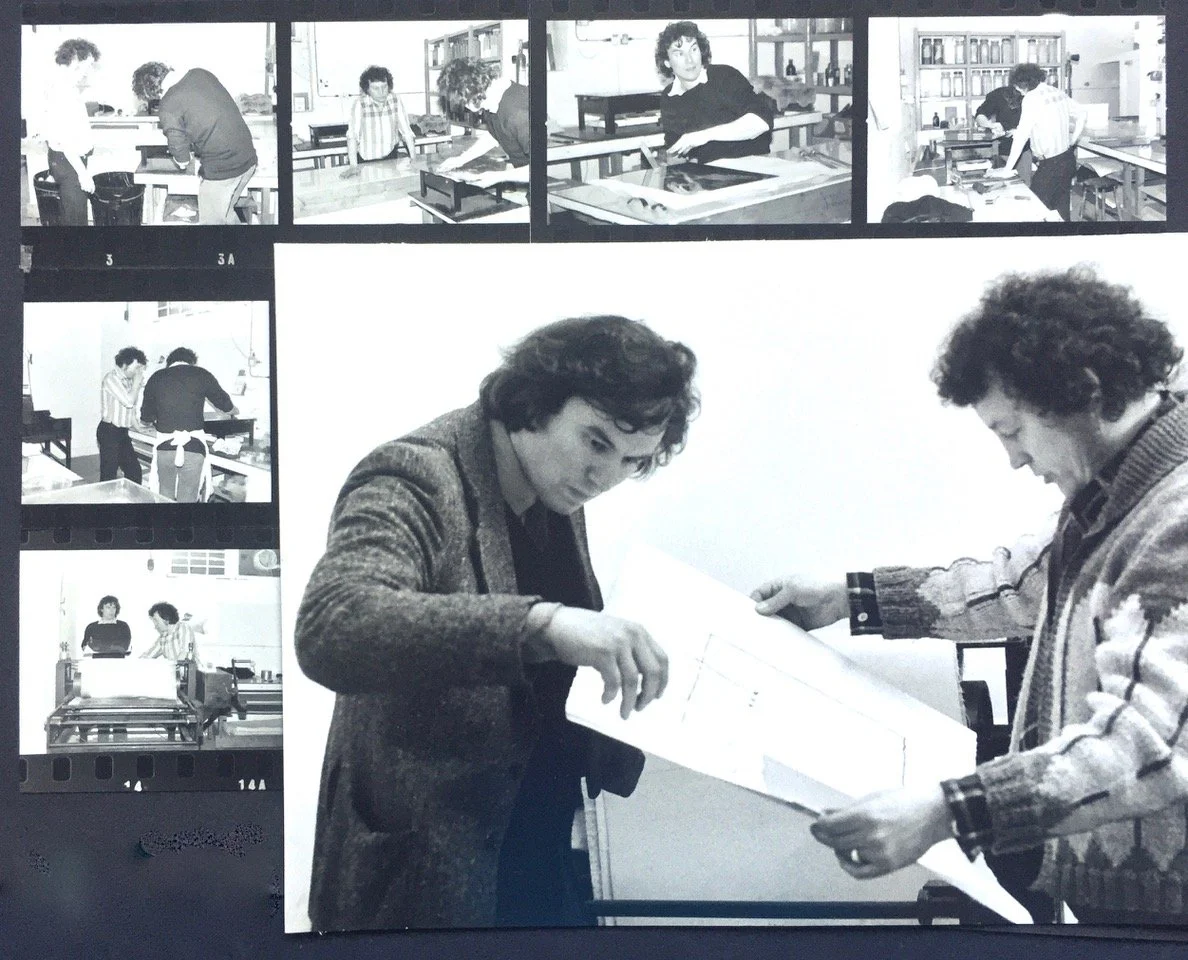
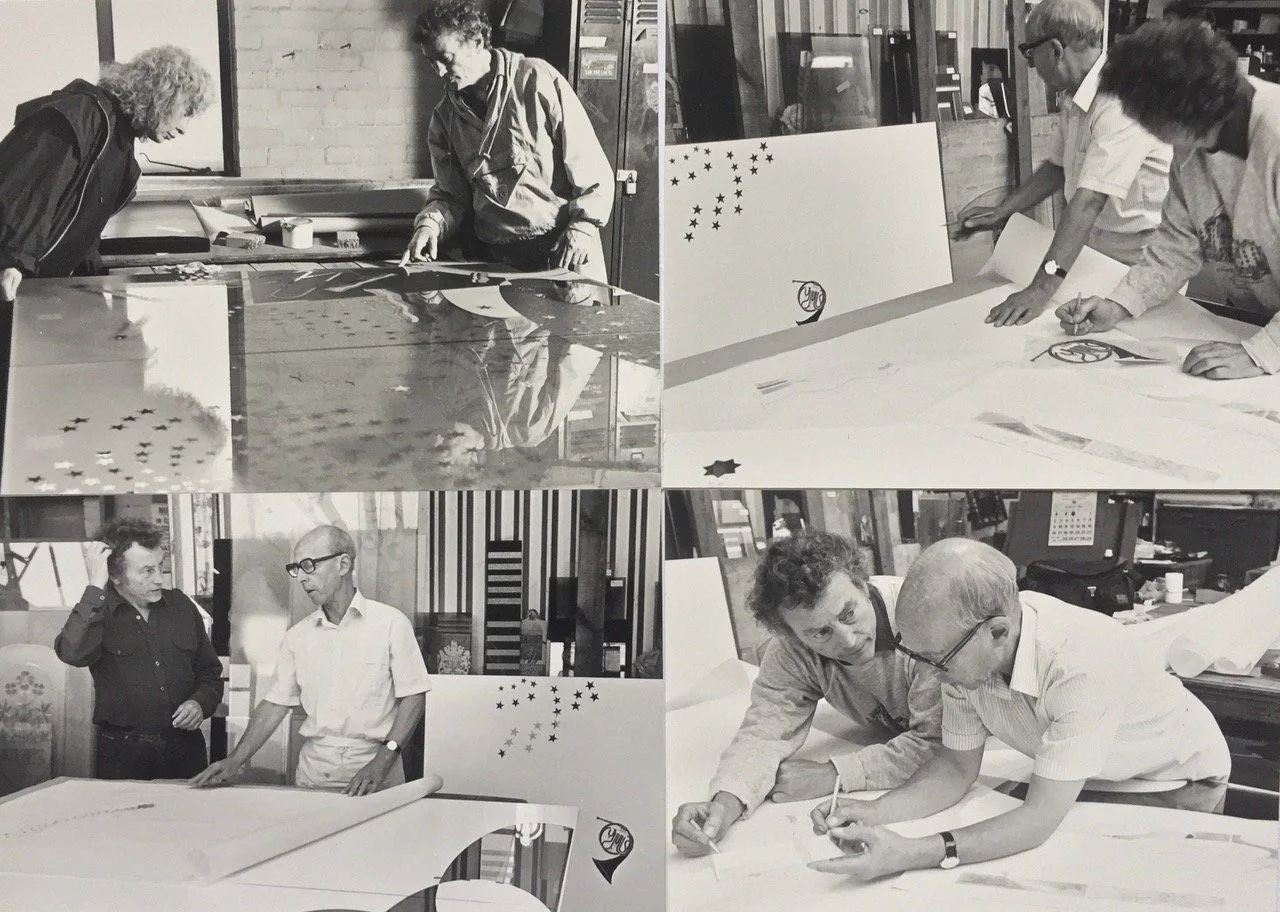
Benjamin became fully engaged with both screen printing and etching in the mid-1960 in Britain and then in Canada and the USA from 1968, which he enjoyed and provided good returns. When back in Britain in the early 1970s, working with Kevin Harris on screenprints, he also began working with dedicated intaglio printer, Hugh Stoneman, starting with the ‘Sculptor’s Garden’,and the ‘Sculptor’s Sketchbook’, series that used limited colour.
Benjamin became fully engaged with both screen printing and etching in the mid-1960 in Britain and then in Canada and the USA from 1968, which he enjoyed and provided good returns. When back in Britain in the early 1970s, working with Kevin Harris on screenprints, he also began working with dedicated intaglio printer, Hugh Stoneman, starting with the ‘Sculptor’s Garden’,and the ‘Sculptor’s Sketchbook’, series that used limited colour.
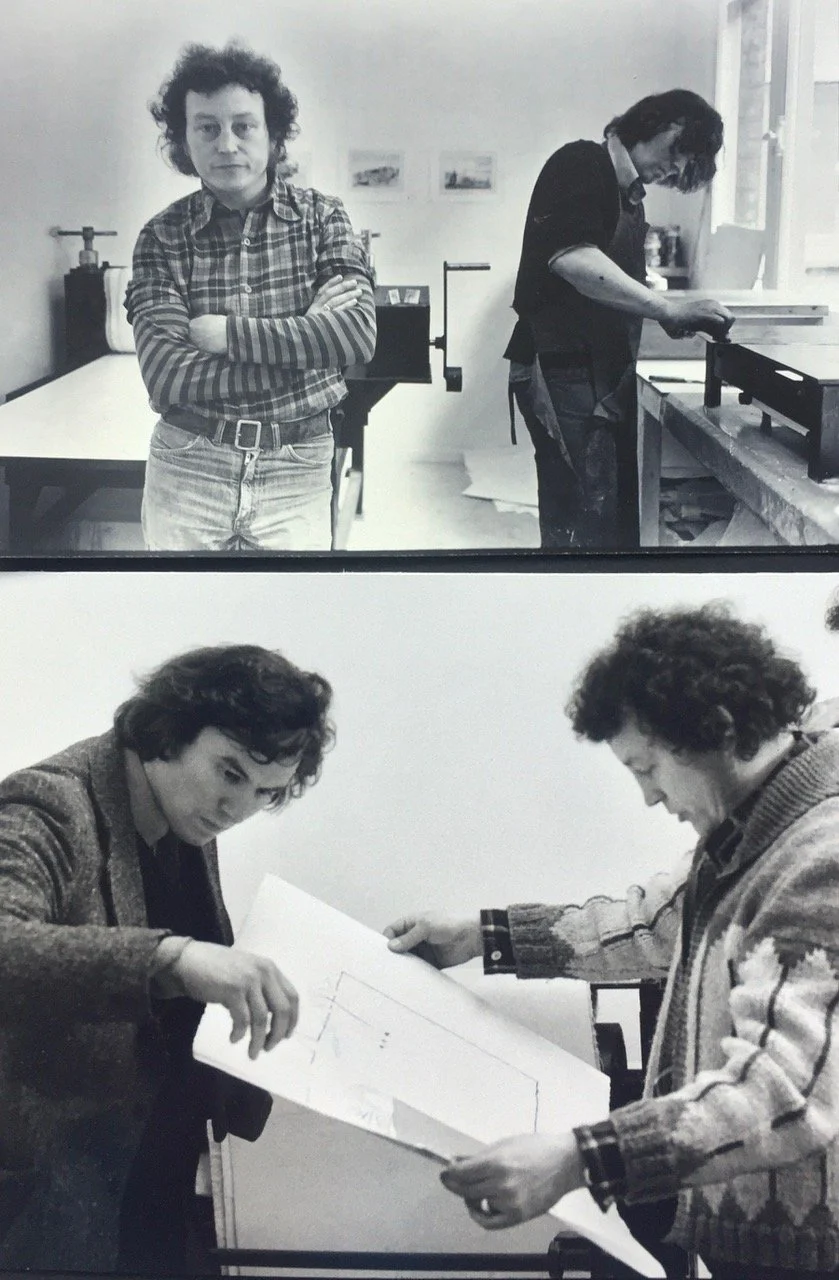
INSERT PHOTOS OF BENJAMIN MAKING ETCHINGS with Hugh Stoneman
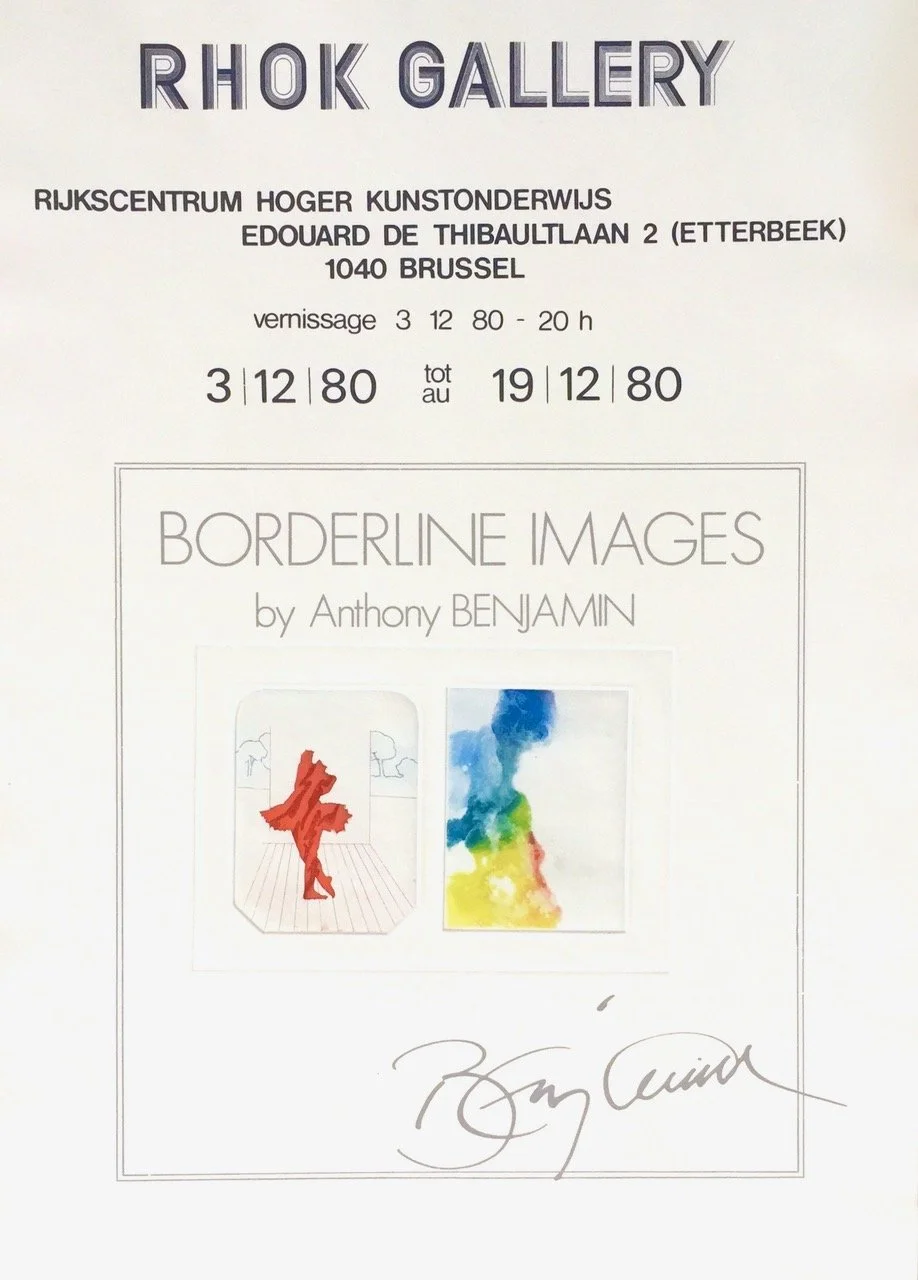
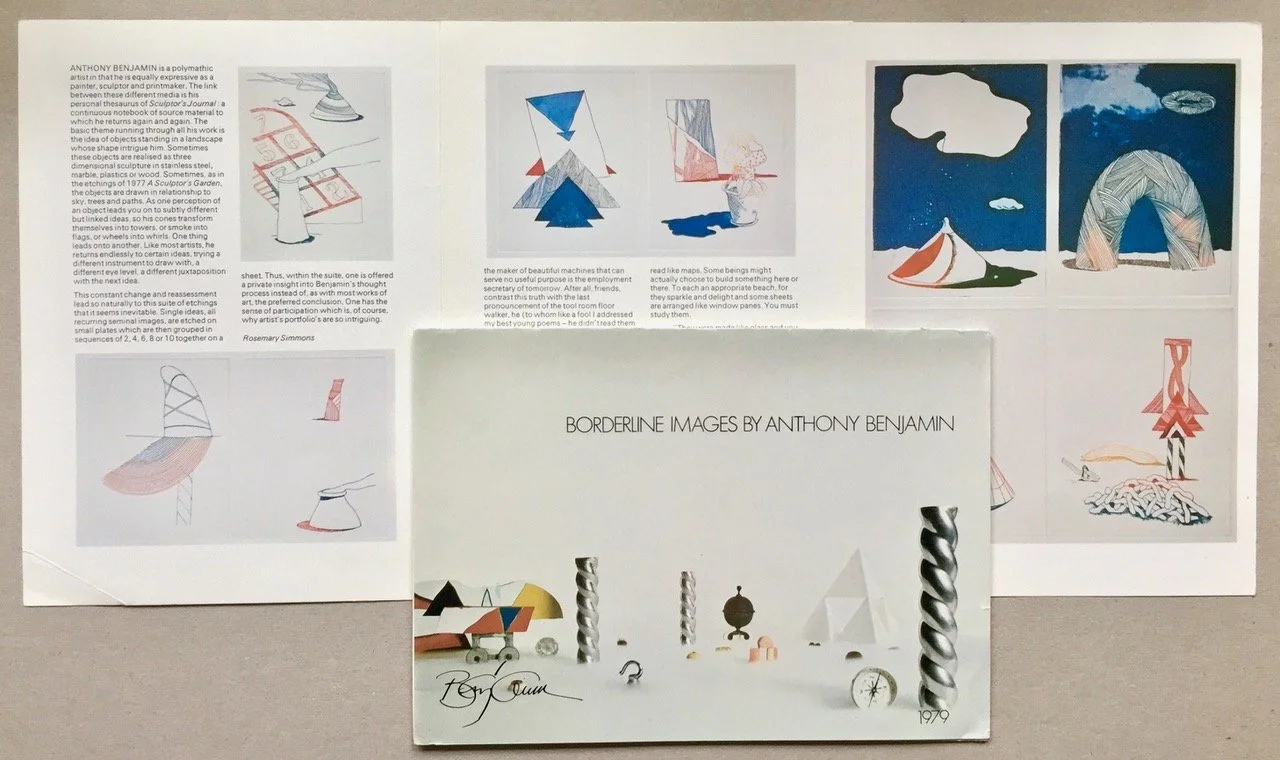
His enthusiasm for etching increased and he installed a press and plate making equipment in his studio in the garden at Liverpool Road and started publishing etchings as Clarendon Graphics, working with Glenn Mingham, another fine printer. They gradually increased the use of colour using a precise, labour intensive technique referred to as-‘a la Poupee’, that involved inking with fine pointed Q Tips so the borders of the coloured areas could have sharp edges, not blended, or faded out. The printing process was further complicated in 1979 when Benjamin started working on the - ‘Borderline Images Volume 1, A portfolio of 10 assemblage etchings… Proofed and printed by Glenn Mingham …at Clarendon Graphics Studio’.
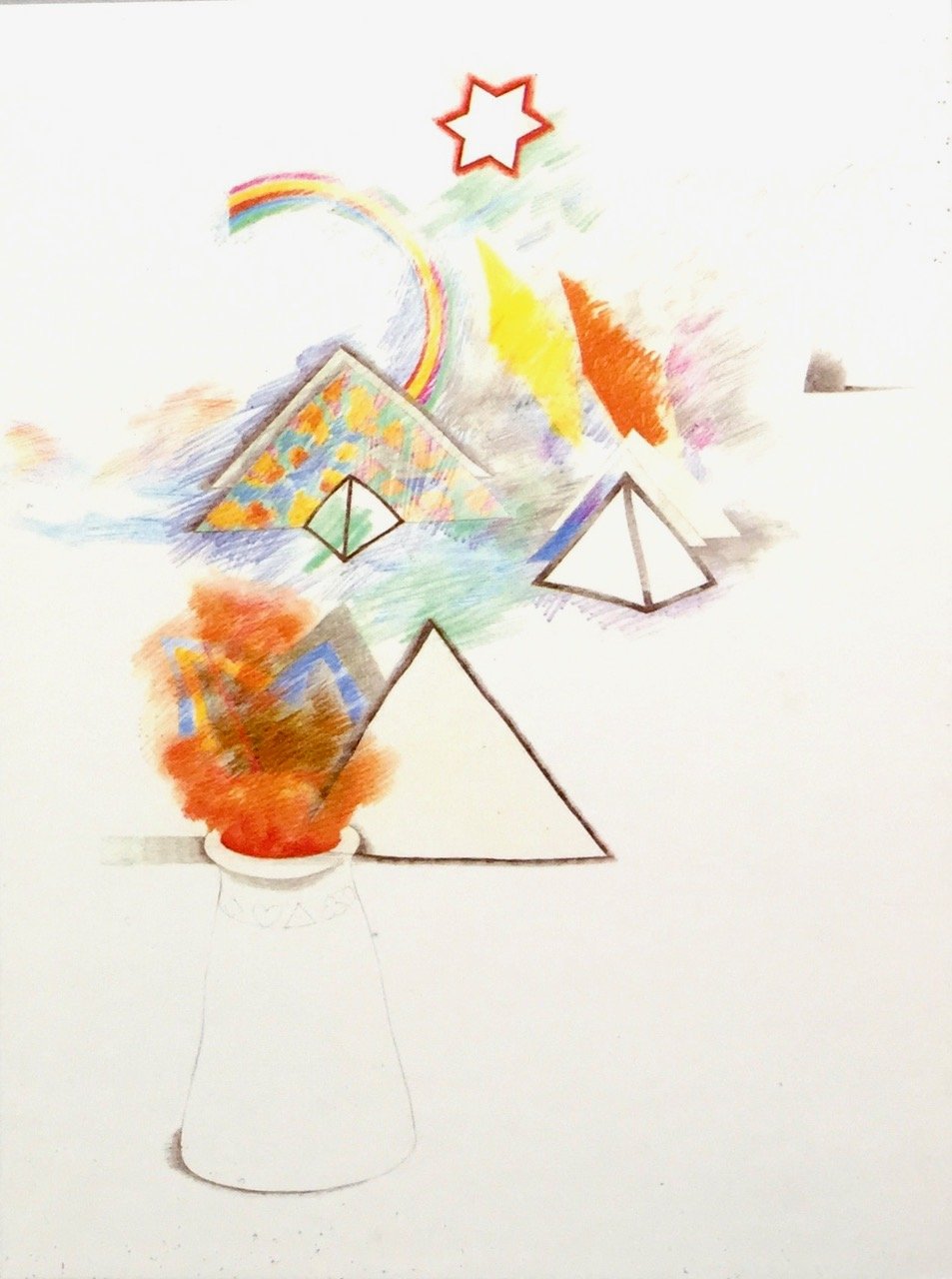
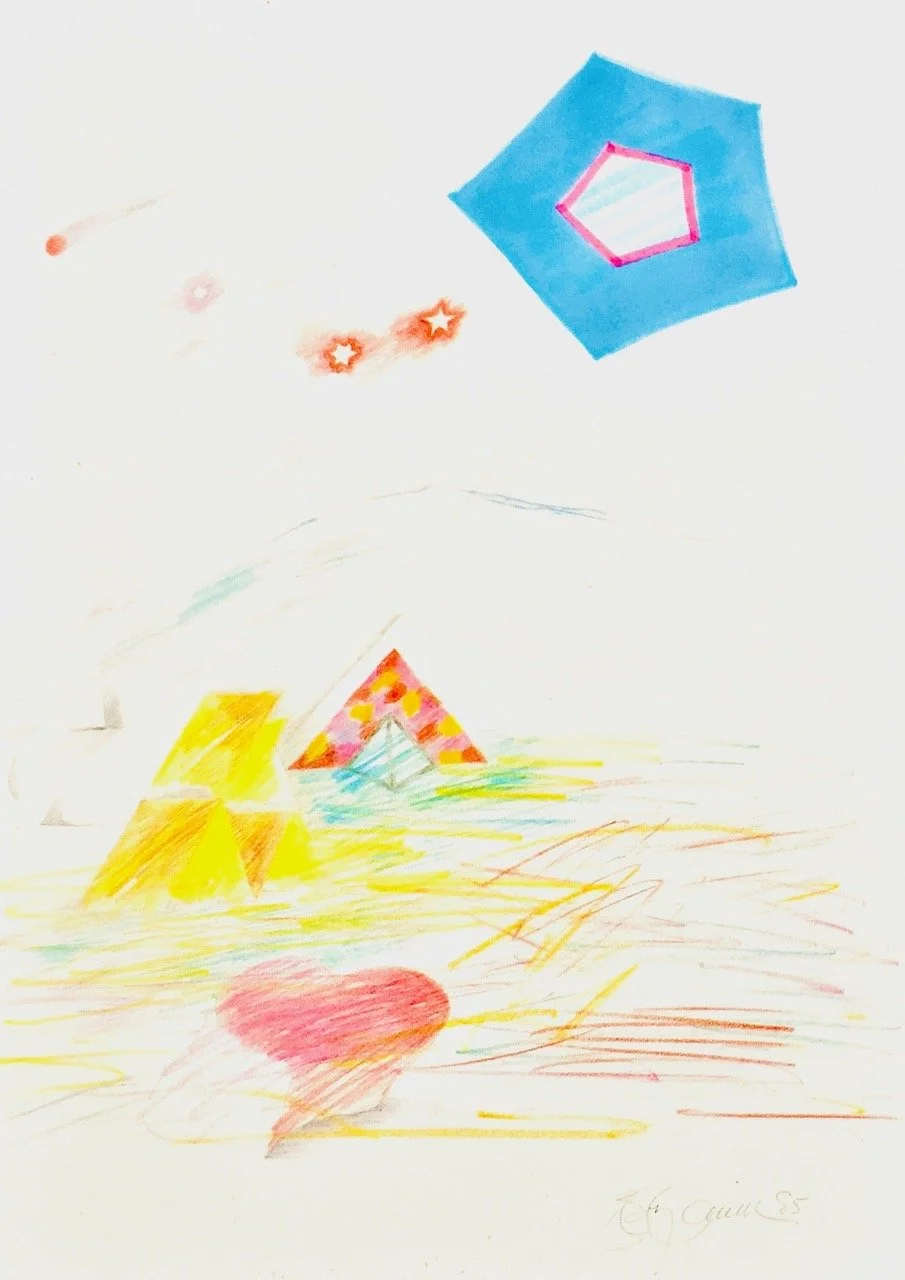
The 10 images were like an abbreviated diary of his art and life, made up of combinations of small plates, 3 inches by 4 inches, in varying groups that involved 3, 4, 6, 8 or 9 plates, in both horizontal and vertical arrangements. The images on the mini-plates were a collection of his favourite visual preoccupations- kites, cakes and deserts, smoke plumes, pyramids, a compass, details of his sculptures, and a range of other oddities. The titles included the complicated- 'Equivalence for Megalothis’- (a favored saying of his beloved Grandma), printed in bright red and blue, ‘N.Y. N.Y.’ a place of urban surprise, printed in red, blue, yellow and green, and the simple 4 plate -‘Columbus’ with a compass and a rainbow on a horizon. The images related to each other, and related to him and his work. The complex printing process required concentration and total precision from both Benjamin and Mingham but they seemed to enjoy themselves throughout. The project went well and was featured in many exhibitions, and in many public collections, including the Tate and V&A.
INSERT PHOTO OF BORDERLINE IMAGES CATALOGUE
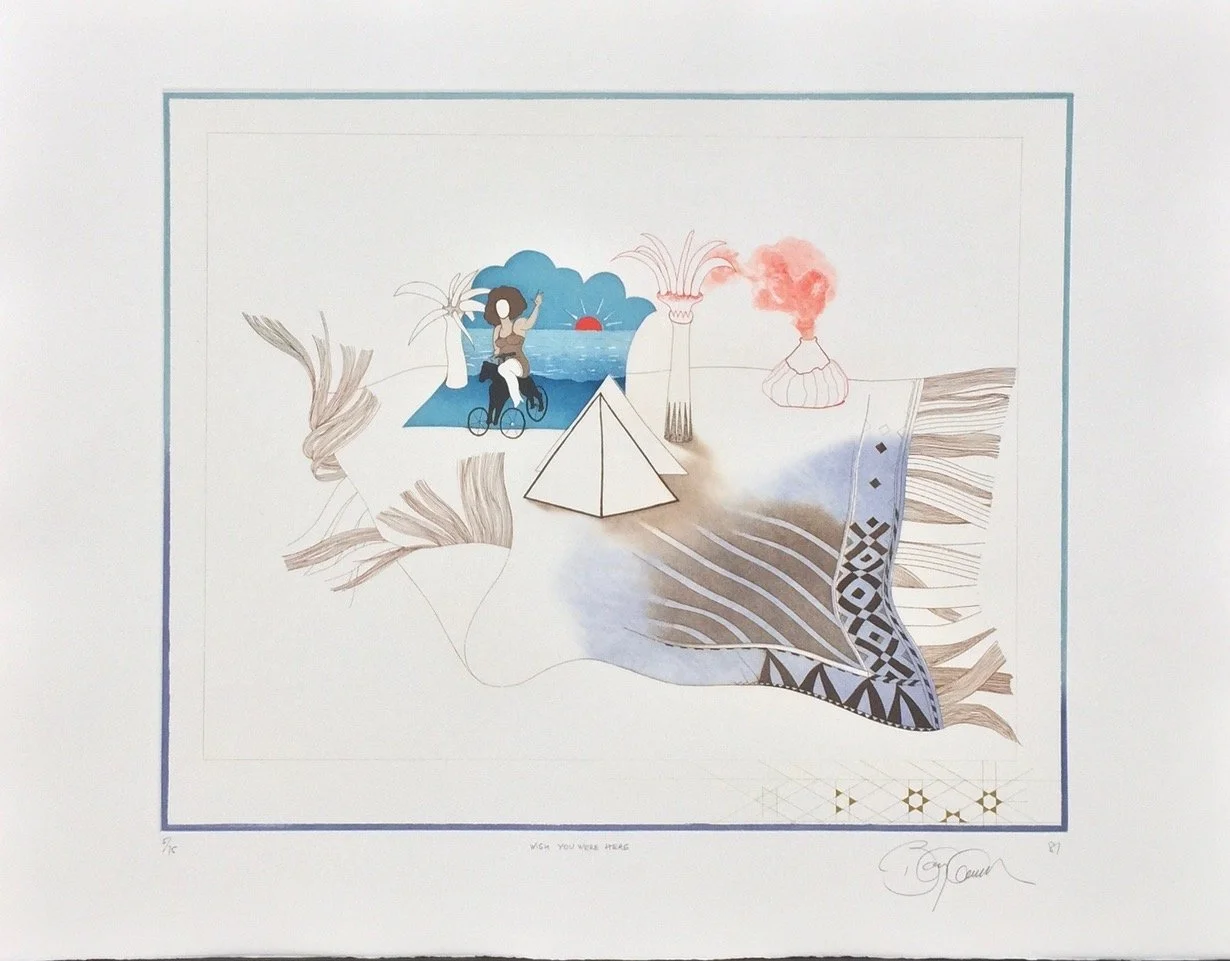
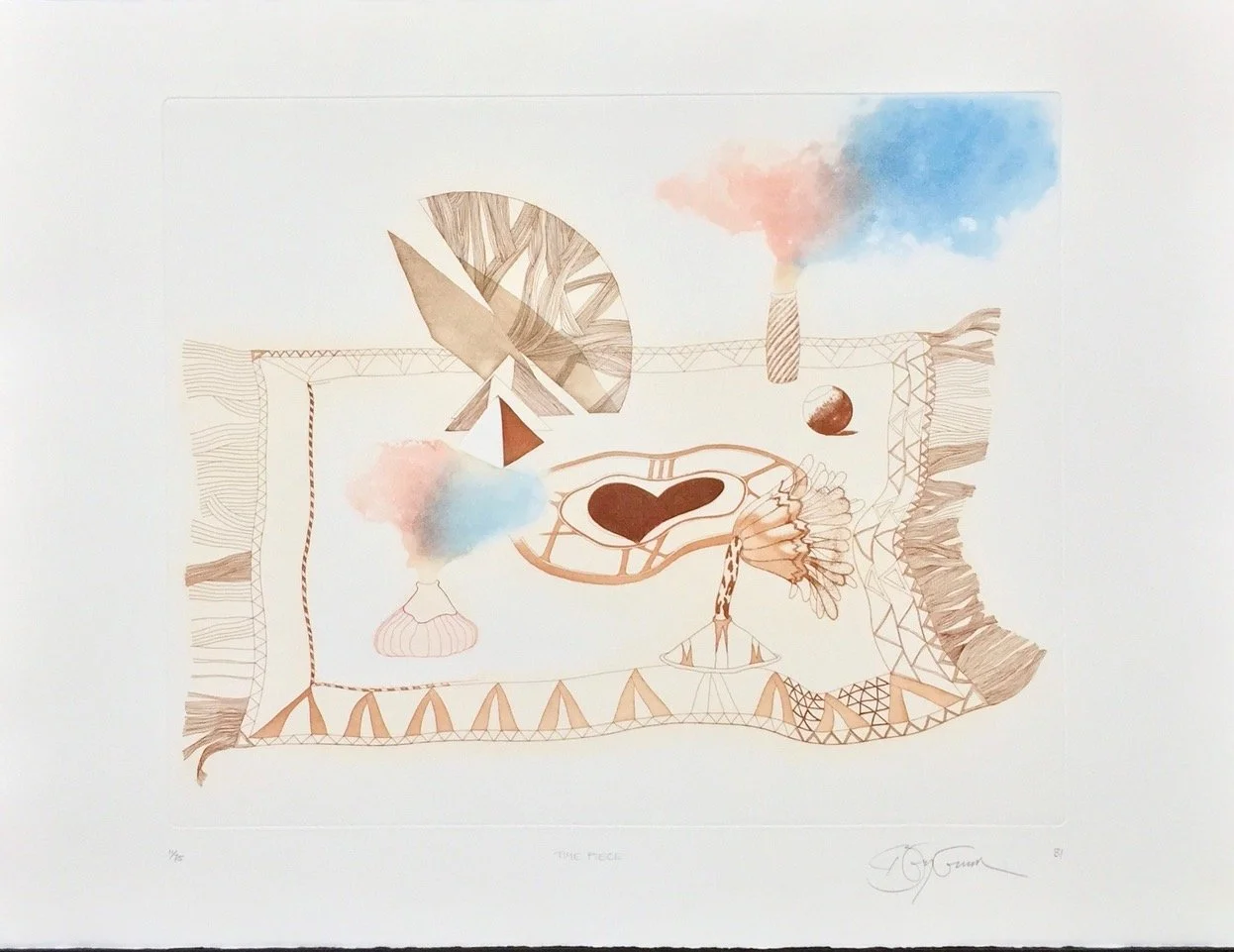
“ Each of the 10 etchings in the suite was composed of small plates which are then grouped in sequences, together on a sheet. Thus, within the suite, one is offered a private insight into Benjamin’s thought process instead of, as with most works of art, the preferred conclusion”. (Rosemary Simmons, Arts Review) By the time Borderline project was completed he had become totally engrossed in the intaglio process; he then produced two very different fanciful images - ‘Wish you were here’ and ‘Timepiece’, that both incorporated a very full range of plate making and colour printing technique.
INSERT PHOTOS OF BENJAMIN MAKING ETCHINGS … and ‘Wish you were here’ & ‘Timepiece’ images
Switching the use of the studio in the garden at Liverpool Road from to a place for his own art work, to a venue where other artists and technicians came to make limited edition prints, had stopped him painting. Eventually he decided to refocus himself on being an Artist, rather than a Publisher of Prints… so he handed the business, and the bulky equipment on to the dedicated printers, Simon and Pete…and transferred the balance of the stocks of Clarendon Graphics editions to the Graffiti Gallery run by Peter Leigh, a cheerful and charming young man who was already selling Clarendon publications, as well as staging exhibitions and selling art in central London, where Nancy joined him as a director of the Gallery.
Islington Daze : Soon after moving back into 312 Liverpool Road, Benjamin become close with Mike Khan, a talented but unruly, Rocker from the Nottingham Meadows who had moved in upstairs where Brian Wall lived before he left for California. Khan, a charismatic singer/songwriter with a brilliant guitarist partner, Malcolm Peet, were the regular weekend entertainment at The King’s Head in Upper Street, Islington. This classic19th century pub had an unusually large backroom used as a boxing arena in earlier times; this long derelict space had been adapted for use as a theatrical venue in 1970 when the pub was taken over by eccentric American, Dan Crawford, and his wife, Joan, who were dedicated to promoting all manner of innovative theatre. The theatre room was used for mix of one-person performances, and scaled down previews of shows that some-times transferred to the West End. The performances were proceeded by formal Dinners at candle lit tables; occasionally Nancy helped out with service intrade for watching the show and a tasty meal.
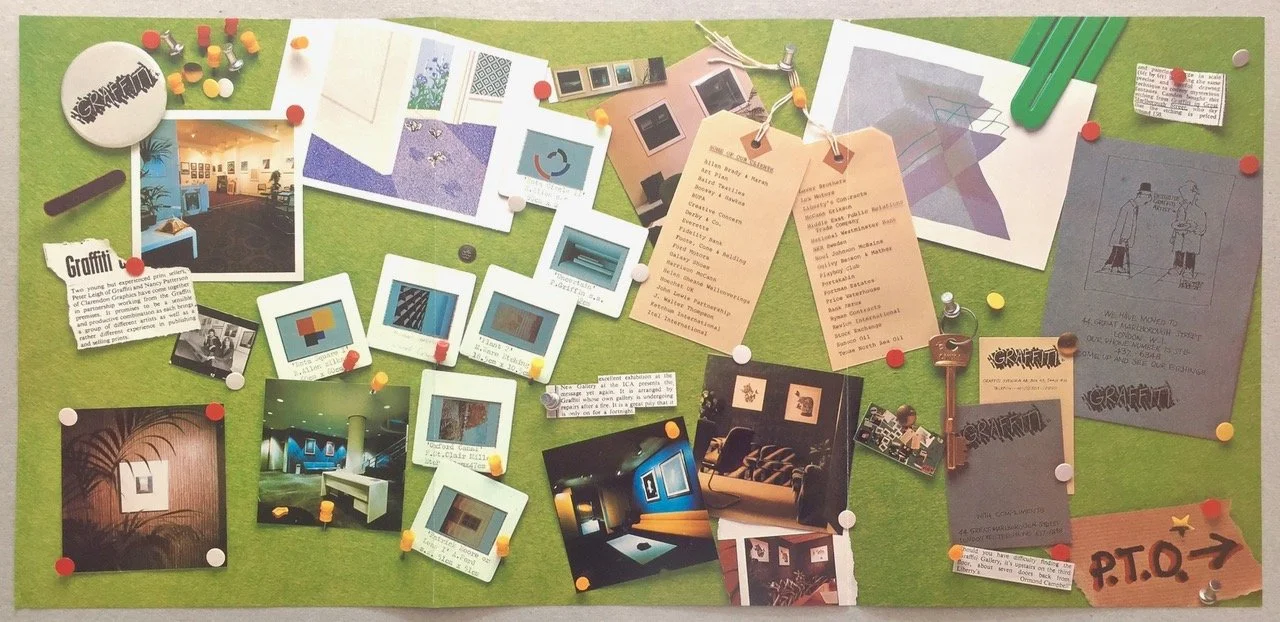
INSERT PHOTO OF GRAFFITI BROCHURE
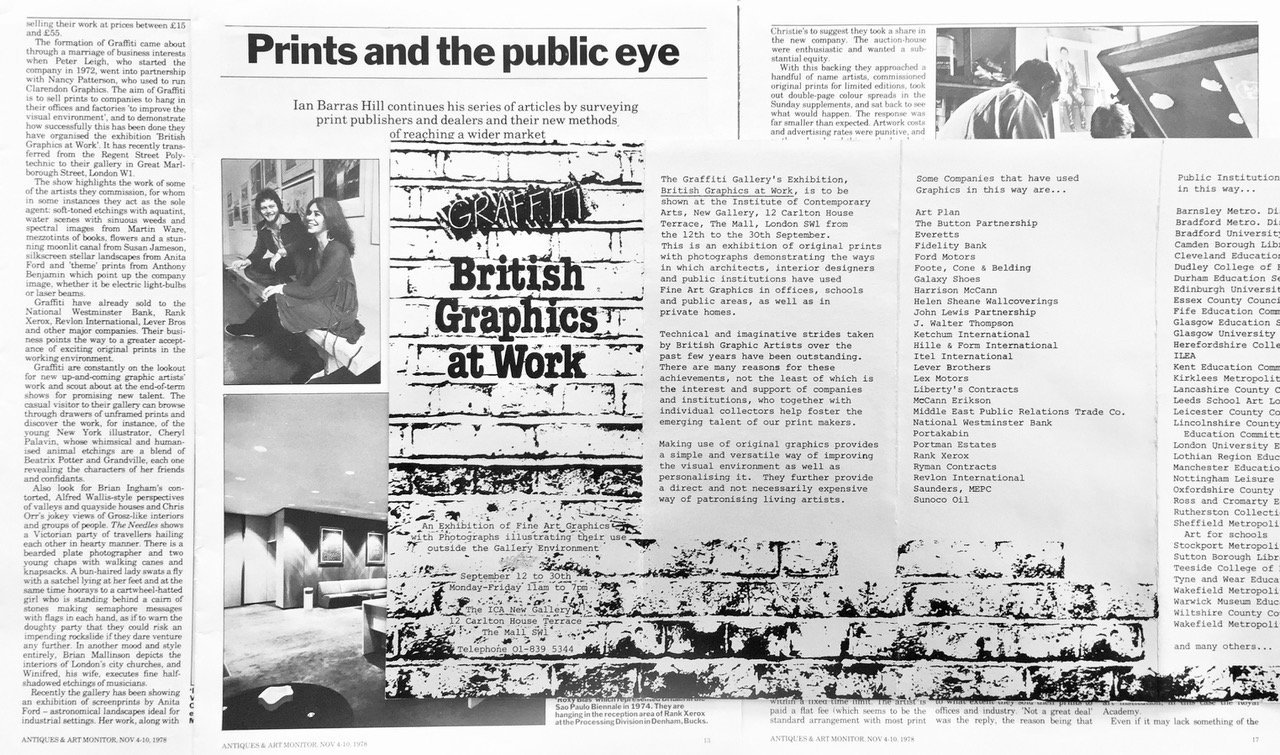
Graffiti staged a very successful show in 1978- British Graphics at Work at the ICA, in the spacious new venue in Carlton HouseTerrace, in the Mall. This had come about because of Benjamin’s friendship with Sir Roland Penrose, the director, and Julie Lawson his diligent P A, who were open to new ideas for exhibitions. Selling art to advertising agencies, corporations, architects, designers etc. was a relatively new thing in Britain at the time. Graffiti had come into the rapidly expanding niche market, more by happy accident than intention; Peter Leigh’s first partner in a gallery located on the street level of an ad-agency in Soho, had been a professional copy-writer named Richard Gordon Freeman, who was also a poet…his clients became Graffiti’s first clients, but when the business grew, Leigh moved on to a larger premises on the third floor of a 19th century building on Great Marlborough Street near Liberty’s and Oxford Circus. At that time most West End/Bond Street art dealers, were too snobby to chase the Business Clients, but after the Royal Academy opened the Business Art Gallery and Christie’s Fine Art Auction House started publishing Fine Art Limited Edition prints as Christie’s Contemporary Art, it soon became a competitive scramble.
INSERT PHOTO OF BRITISH GRAPHICS AT WORK BROCHURE
INSERT PHOTO OF GRAFFITI BROCHURE
Graffiti staged a very successful show in 1978- British Graphics at Work at the ICA, in the spacious new venue in Carlton HouseTerrace, in the Mall. This had come about because of Benjamin’s friendship with Sir Roland Penrose, the director, and Julie Lawson his diligent P A, who were open to new ideas for exhibitions. Selling art to advertising agencies, corporations, architects, designers etc. was a relatively new thing in Britain at the time. Graffiti had come into the rapidly expanding niche market, more by happy accident than intention; Peter Leigh’s first partner in a gallery located on the street level of an ad-agency in Soho, had been a professional copy-writer named Richard Gordon Freeman, who was also a poet…his clients became Graffiti’s first clients, but when the business grew, Leigh moved on to a larger premises on the third floor of a 19th century building on Great Marlborough Street near Liberty’s and Oxford Circus. At that time most West End/Bond Street art dealers, were too snobby to chase the Business Clients, but after the Royal Academy opened the Business Art Gallery and Christie’s Fine Art Auction House started publishing Fine Art Limited Edition prints as Christie’s Contemporary Art, it soon became a competitive scramble.
INSERT PHOTO OF BRITISH GRAPHICS AT WORK BROCHURE
INSERT PHOTOS OF CHRISTIE’S PUBLICATIONS and possibly a photo of the AKHENATEN Perspex and bronze sculpture?
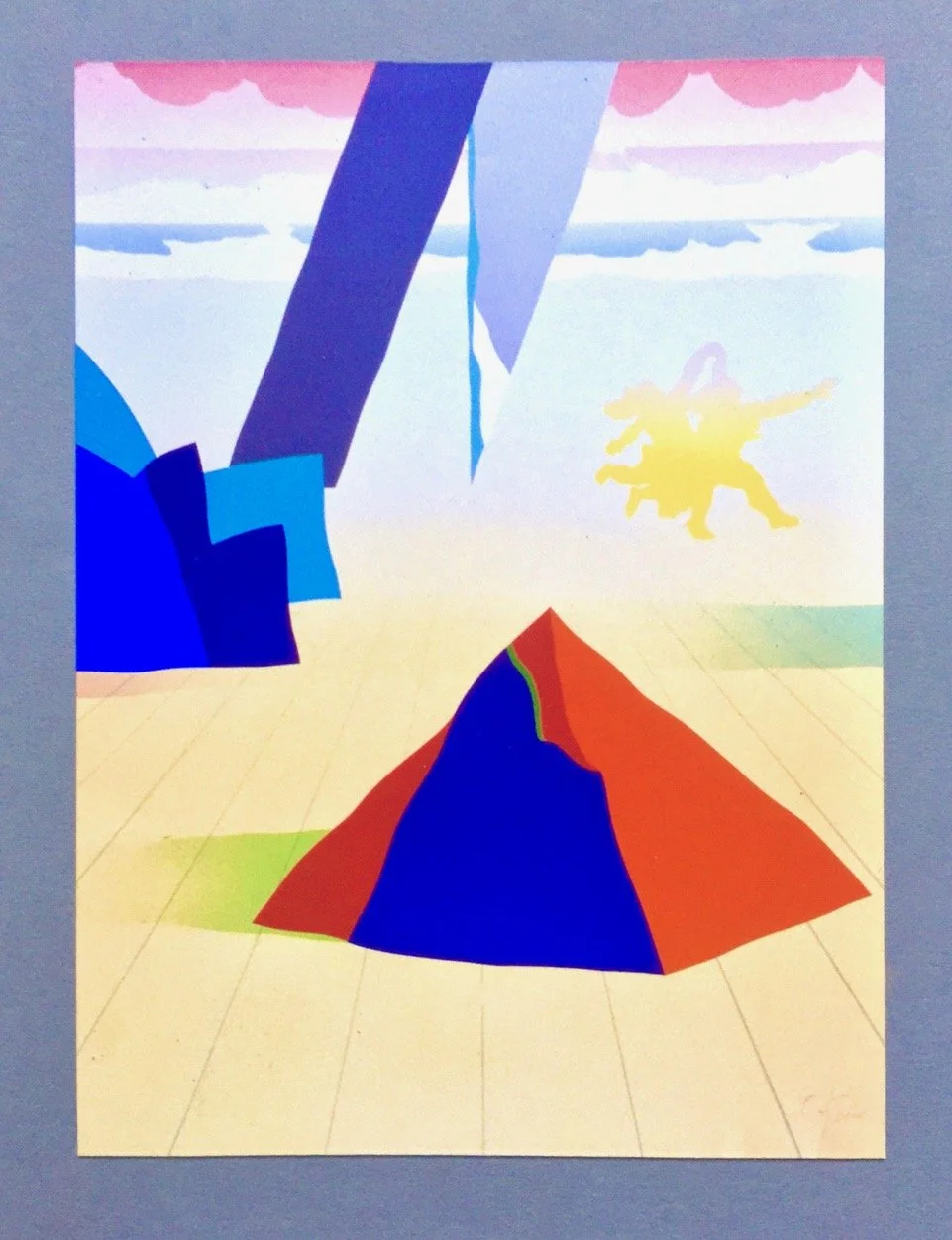
Benjamin produced a commissioned screen print for Westinghouse with a small calendar along the lower margin, then another commissioned to produce a larger screen print that could be adapted into a poster for Rosco, a company that supplied materials for theatrical productions. A silhouette in yellow in the middle distance of two exuberant female figures running was borrowed from a painting by Picasso and placed on a spacial perspective ground with the mysterious pyramid he had used in several other prints. He maintained an enduring fascination with the rebel Pharaoh Akhenaten, represented by a variety of pyramid shapes in his prints and drawings.
INSERT PHOTO OF ‘ROSCO’ IMAGE
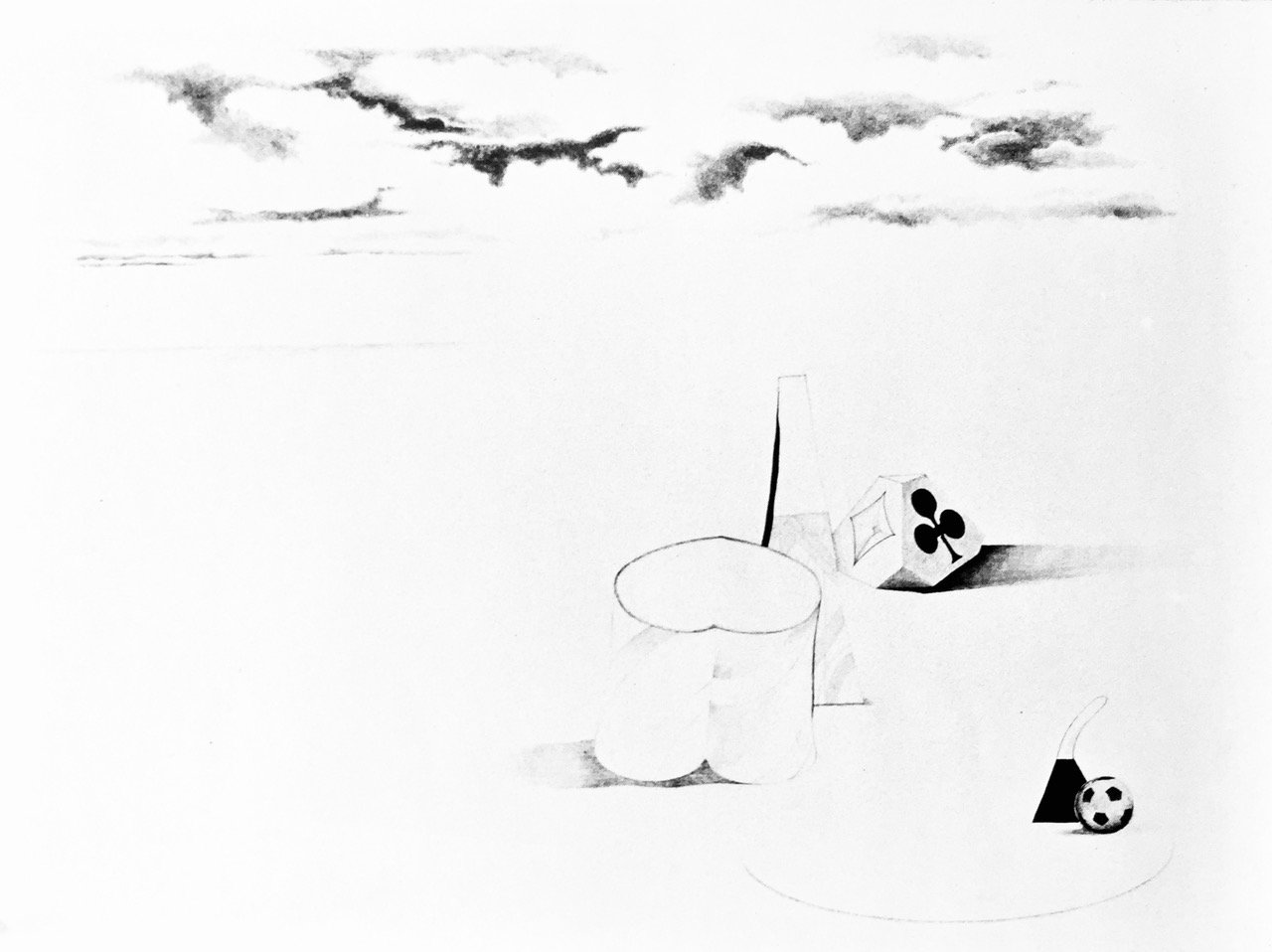
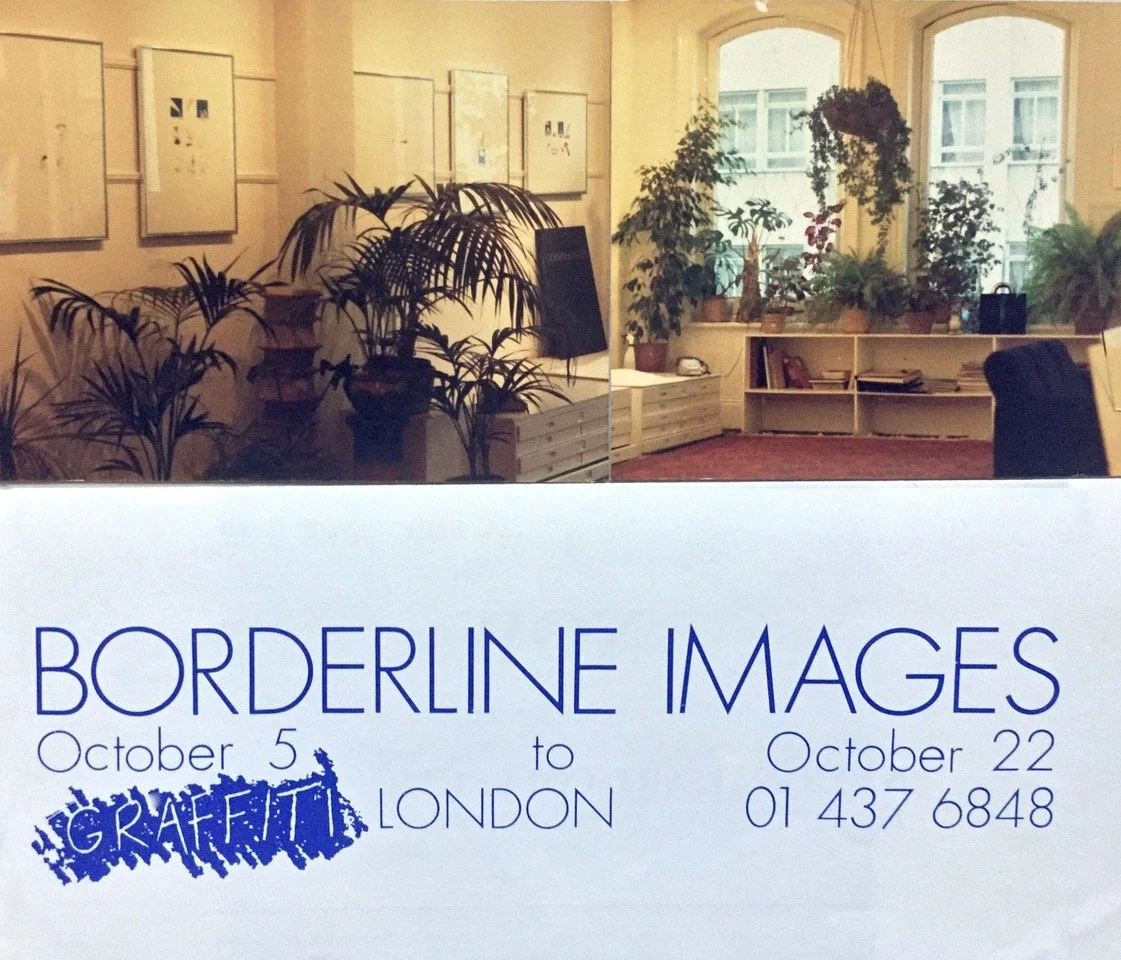
The Graffiti Gallery - Late one evening in early 1979, the unusual, upstairs Gallery was discovered by a visiting Swede named Lars Hedman. He had noticed the bright lights shining out of the big windows on the third floor of the seedy old building, while the rest of the building and most of Great Marlborough Street was very quiet and almost dark. Graffiti did not have a street presence; the nameplate on the door was less than three inches long, and so tarnished as to be invisible, but as the main clientele were corporate customers and a few keen collectors, it did not matter. The Times Critic, Geraldine Norman, had recently written an enthusiastic piece about the gallery - “… a highly enjoyable place to browse, get one’s eye in, and weigh up the visual images of the Seventies. Drawer upon drawer of unframed prints carries one from highly detailed figurative work, through misty surreal images, to bright abstracts in primary colours…Graffiti was started by Peter Leigh in 1972 … and now has a new partner, Nancy Patterson, a Canadian who used to run Clarendon Graphics…It becomes clear that you are moving into another world as you reach the third floor (no lift) where scruffy lino stops and carpeting begins. The gallery itself is a light large room with colourful carpets and quantities of potted plants. The partners do their business in a comfortably relaxed manner encouraging purchasers, large and small, to stay as long as they like looking through the prints.”
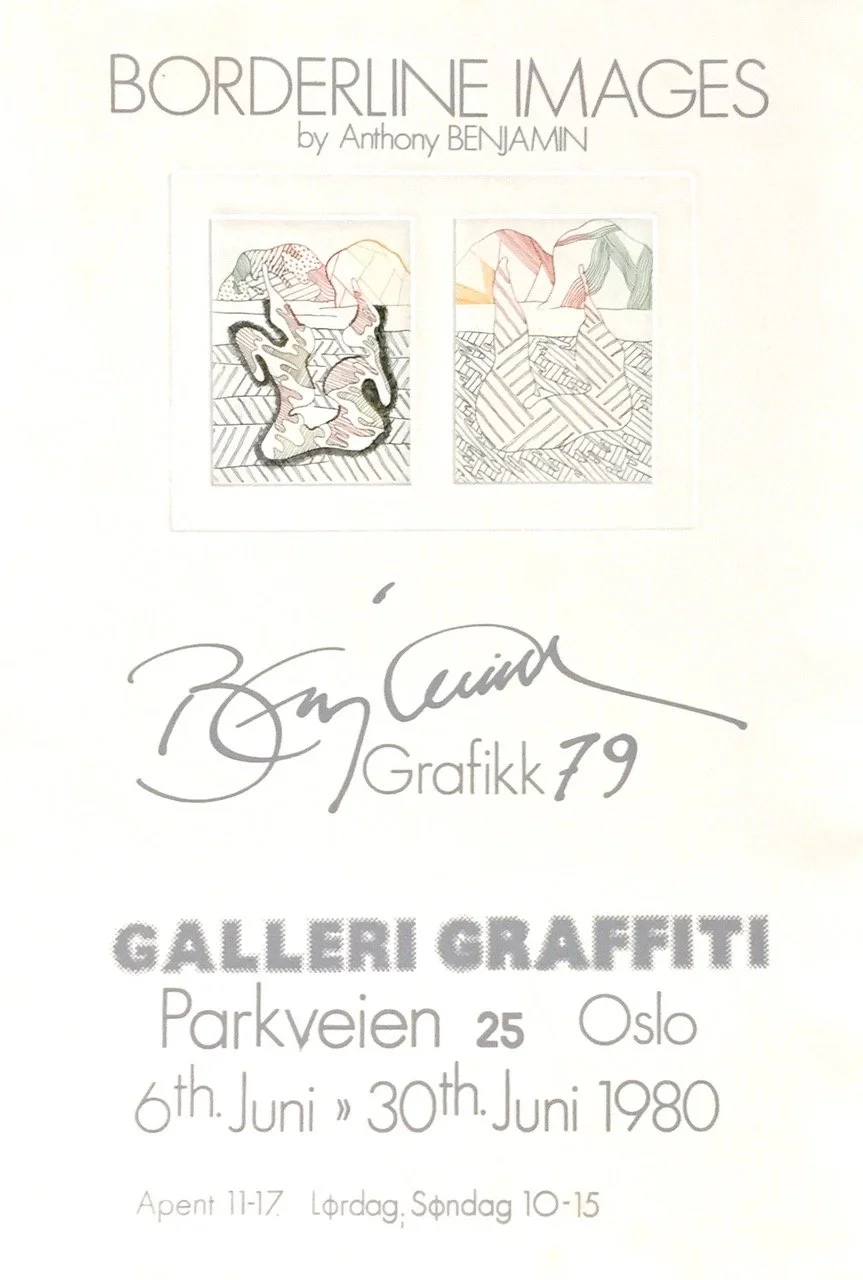
The adventurous Swede found the heavy wooden street door open, and a distant sound of jazz drifting from above so he climbed the creaky carpeted stairs toward the light and music coming from the bright white space where Nancy Patterson, Peter Leigh, her gallery business partner, Robert Renack, the AFI consultant, and Anthony Benjamin, the artist, and sometimes publisher of limited editions, were occupied with hanging a show of the portfolio of his etchings named - ‘Borderline Images’.
INSERT PHOTOS OF THE 2 RELEVANT POSTERS & PHOTO OF THE GALLERY WITH BORDERLINE IMAGES ON THE WALL, HERE ? OR BELOW NEXT TEXT ?
OTO
Pleased with the Benjamin works, Geraughty commissioned wall hangings from a diverse group of artists including, Phillip Sutton, Derrick Greaves, Richard Allen, Suad Al Attar and Rima Farah. These were shown in the Berni Gallery, at the Arts Centre in Jersey, and reviewed in the Jersey Evening Post 3.12.87… “Pulling the wool over your eyes at the Arts Center…” Diane Simon- wrote enthusiastically about Benjamin’s wall hangings as -“vibrant and fresh in appearance…geometric pattern in rich beckoning colours which the onlooker feels distinctly comfortable with”.
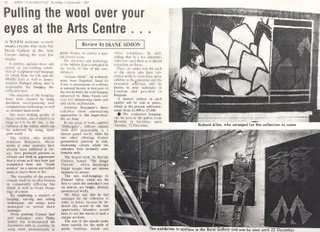
Jersey Evening Post, 3.12.1987, Photo showing Benjamin’s Wall hangings being hung in the Berni Arts Centre, Jersey
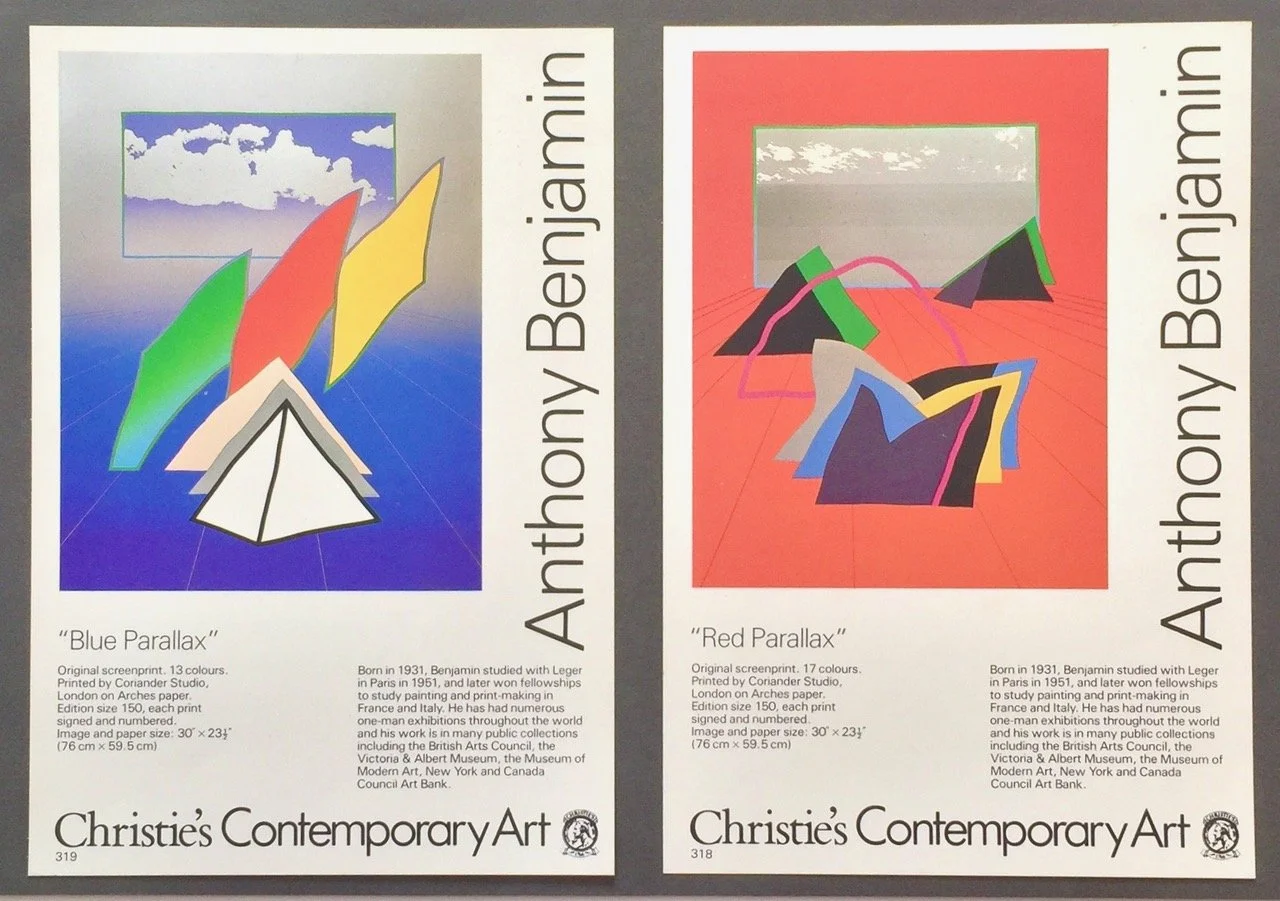
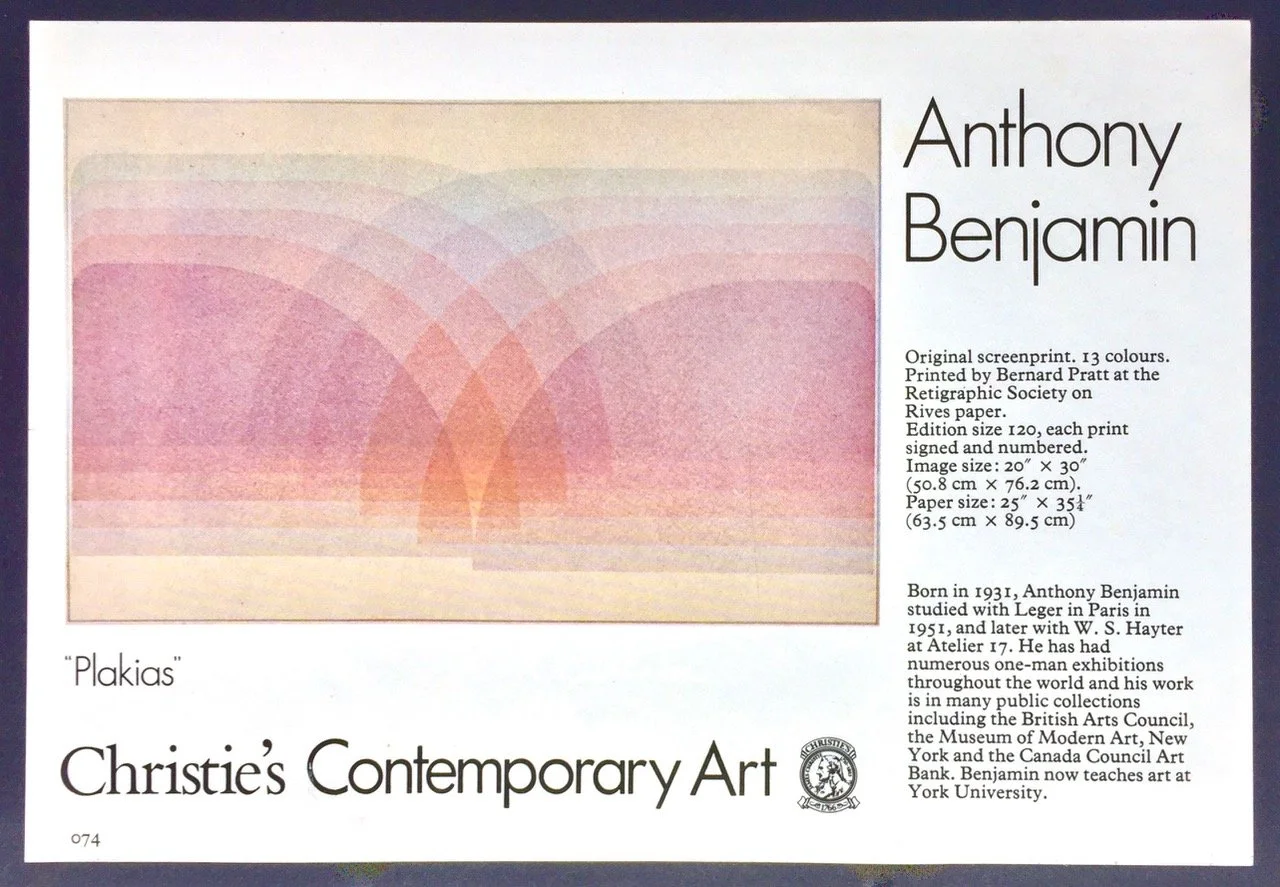
As usual Benjamin was involved in other projects at the same time; he was working with another very skillful technician, Brad Faine at Coriander Press producing limited edition silk screen prints published in pairs by Christie’s Contemporary Art. The first - ‘Red Parallax’ and ‘Blue Parallax’ were vibrantly coloured irregular geometric forms floating above parallel lines that rushed into a distant suggestion of clouds.. The prints were a great success and the editions fairly flew out of Christie’s Gallery.
INSERT THE ‘PARALLAX’ IMAGES HERE…
bl
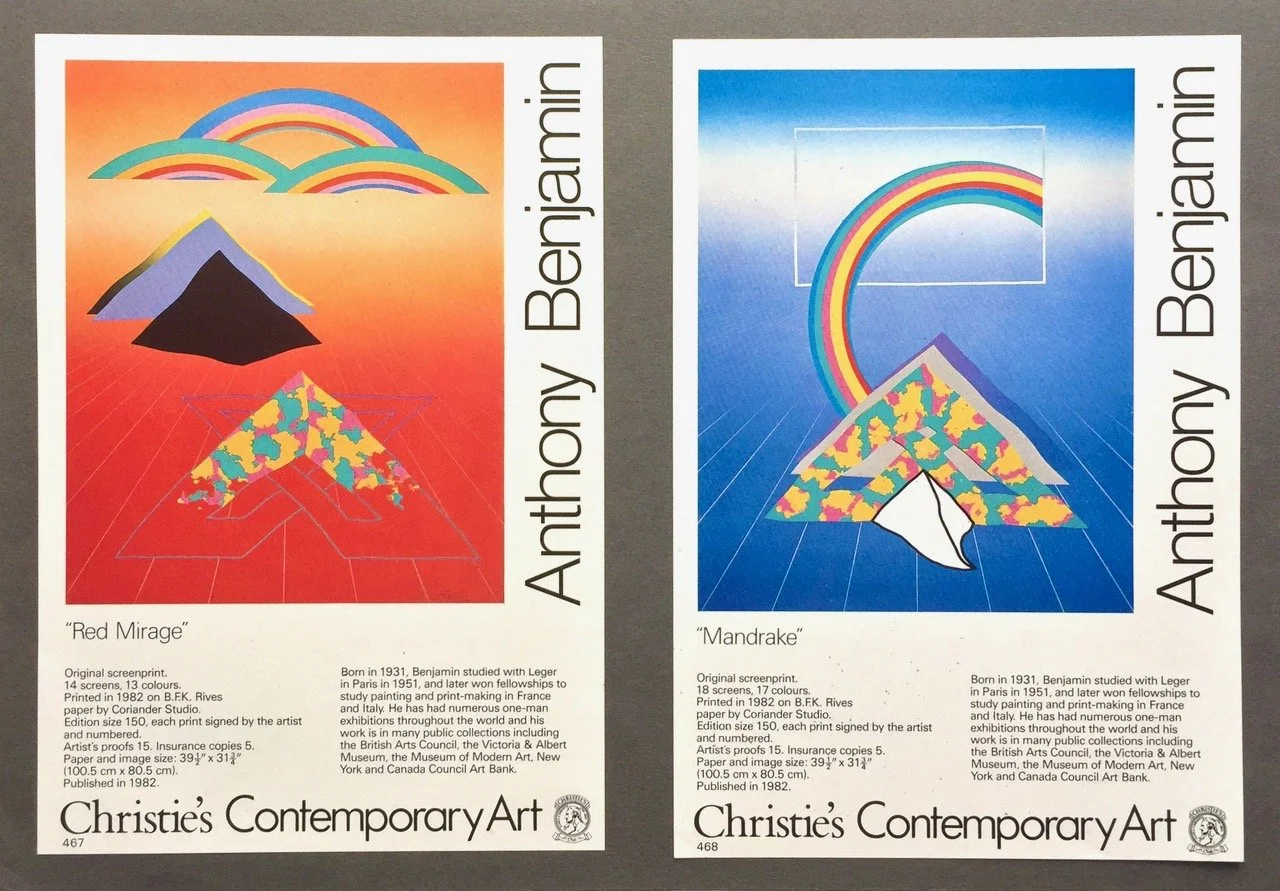
The prints looked fresh and energetic and Christie’s sales were very satisfactory. They commissioned further editions of larger images were irregular pyramids hovering over a converging perspective headed to some energetic rainbows springing out of the horizon. There was something optimistic and positive about the images that provoked a feeling of calm, that pleased both corporate, and private customers.
INSERT THE ‘RED MIRAGE’ AND ‘MANDRAKE’ IMAGES HERE
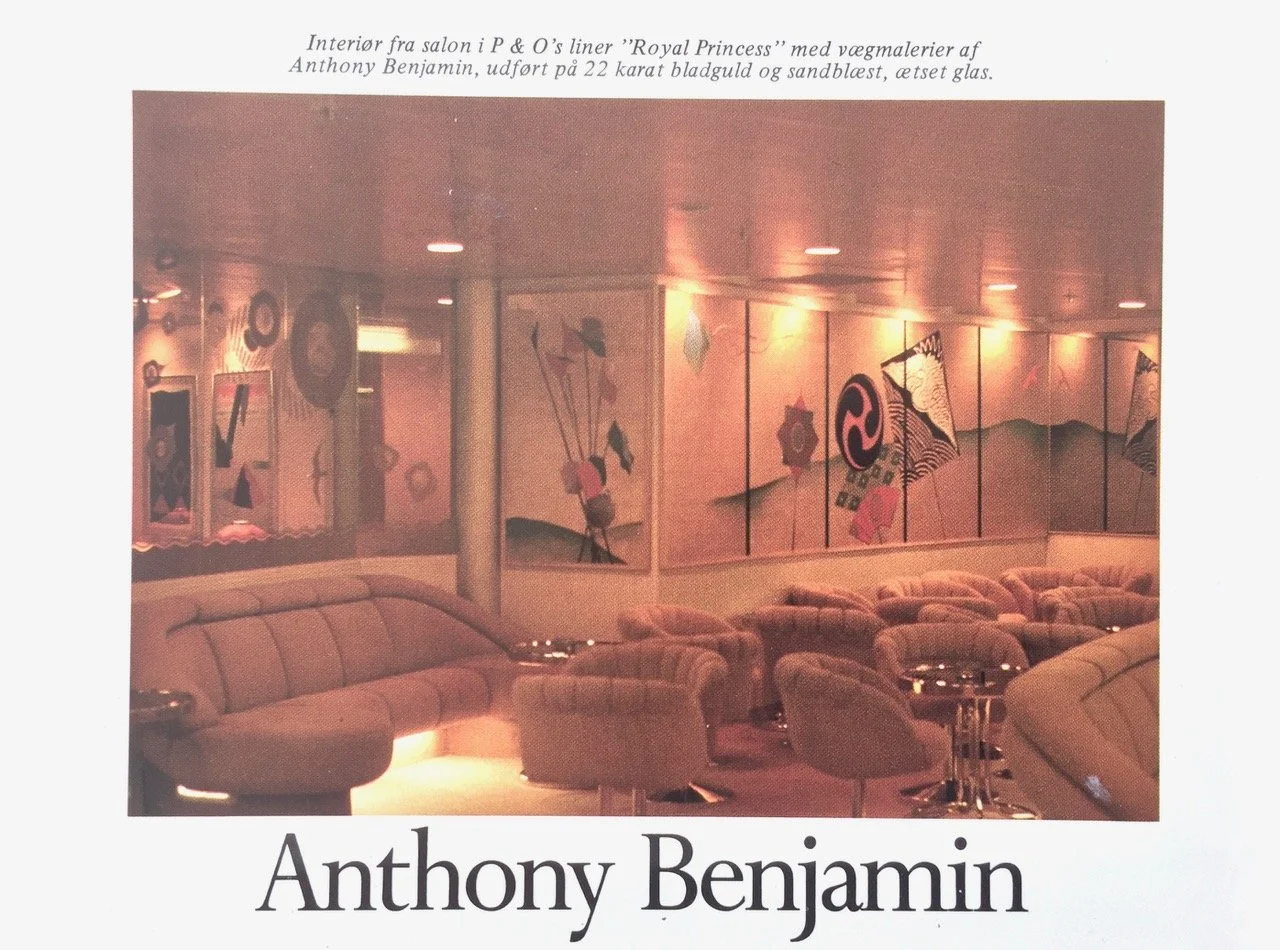
Benjamin had a good relationship with David Case, head of fine art publishing at Christie’s; he arranged an exhibition of Benjamin’s artwork relevant to the P&O “Royal Princess” commission at the Galerie Æblegaarden, in Holte, near Copenhagen. Benjamin was delighted to go to Denmark to the private view .
INSERT PHOTO OF THE CATALOGUE WITH THE SHOT OF THE P&O LINER LOUNGE WITH AB MURALS
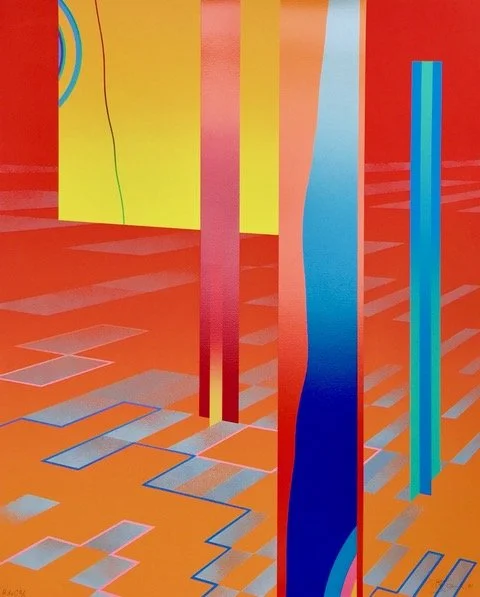
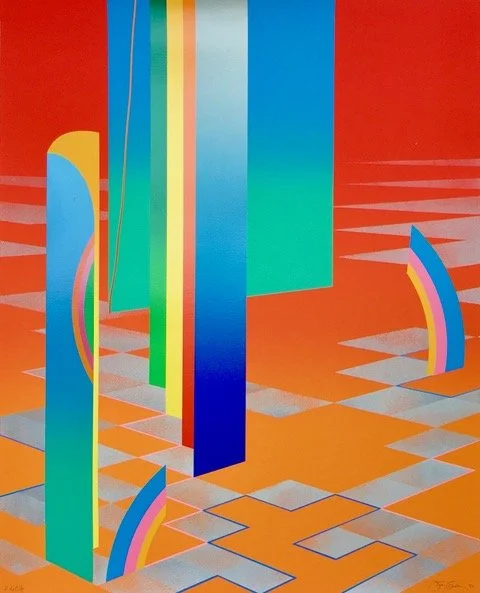
Benjamin continued to work with Brad Faine and they produced a spectacular Screenprint triptych titled - Canton I, II & III. each print 1m x 80cm. The three prints work well as individual pieces, and dynamically when hung together in close proximity, leading the viewer off in a suggestion of spacial infinity with glimpses of partial rainbows, and subtly blended blue skies that contrast vibrantly with the warmth of the glowing red/orange background colour.
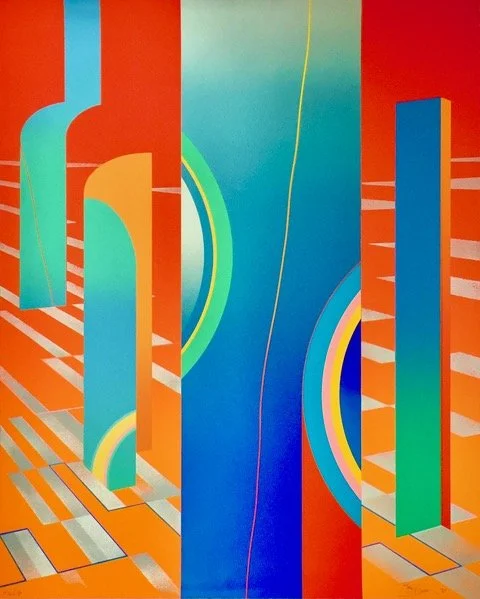
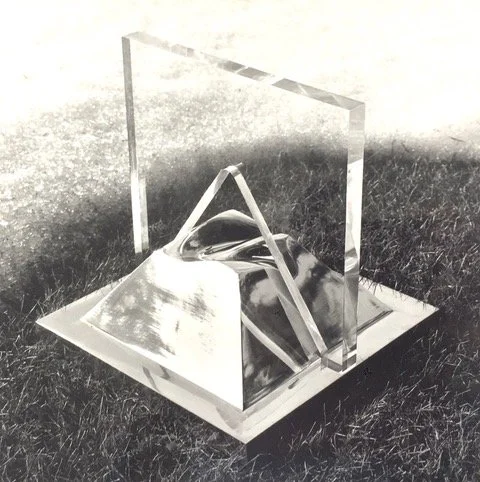
When Christie’s got into publishing limited edition prints the department was headed by a charming gentleman named David Case. He liked Benjamin’s work and went on to publish a series of his screen prints that looked good and sold very well. The vibrant images used perspectives that disappeared into cloudy spaces, with references to three-dimensional Pyramid forms on top of a perfectly blended background that Kevin Harris had skillfully printed. Benjamin’s fascination with rebel Egyptian Pharaoh, Akhenaten, and pyramids, first appeared in 1968 in a piece of sculpture featuring a polished bronze pyramid with a modified tip, and an upright faceted Perspex blade that acted as a spectrum to light. Reference to pyramid forms continued to turn up in his drawings and prints ever after.
“Canton I, Canton II, Canton III, Screenprints 80cm x 100cm. Limited edition of 45 sets plus AP’s - printed by Brad Faine at Coriander Studios, London, 1987
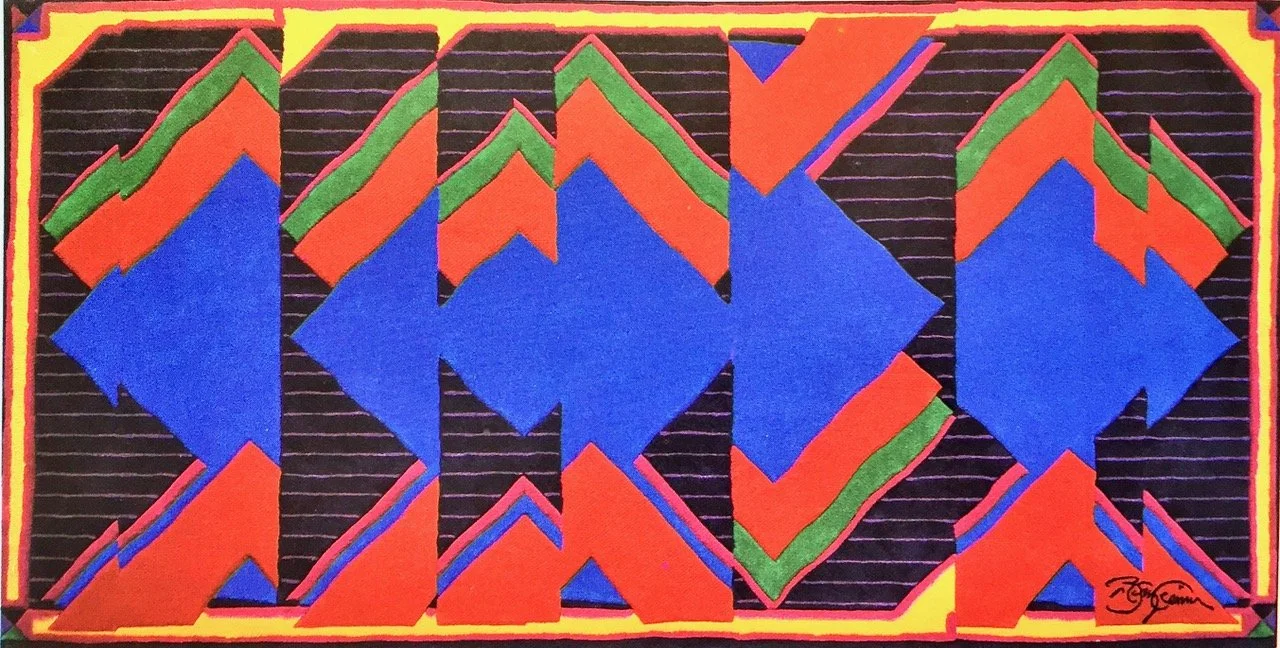
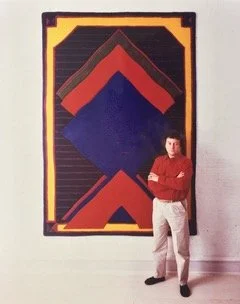
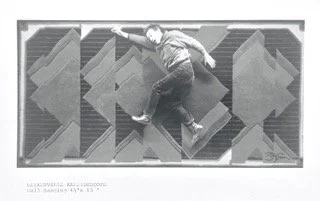
Baskerville Serif, Wallhanging-1986 size 2.650 x 1.850 mm. from the original limited edition 1972 screenprint
DO WE NEED THIS???
1979-89 Mediterranean Excursion 1979-89 Mediterranean Excursion
may be able to delete
THE MEDITERRANEAN OPEN STUDIO 1981 add photo of brochure
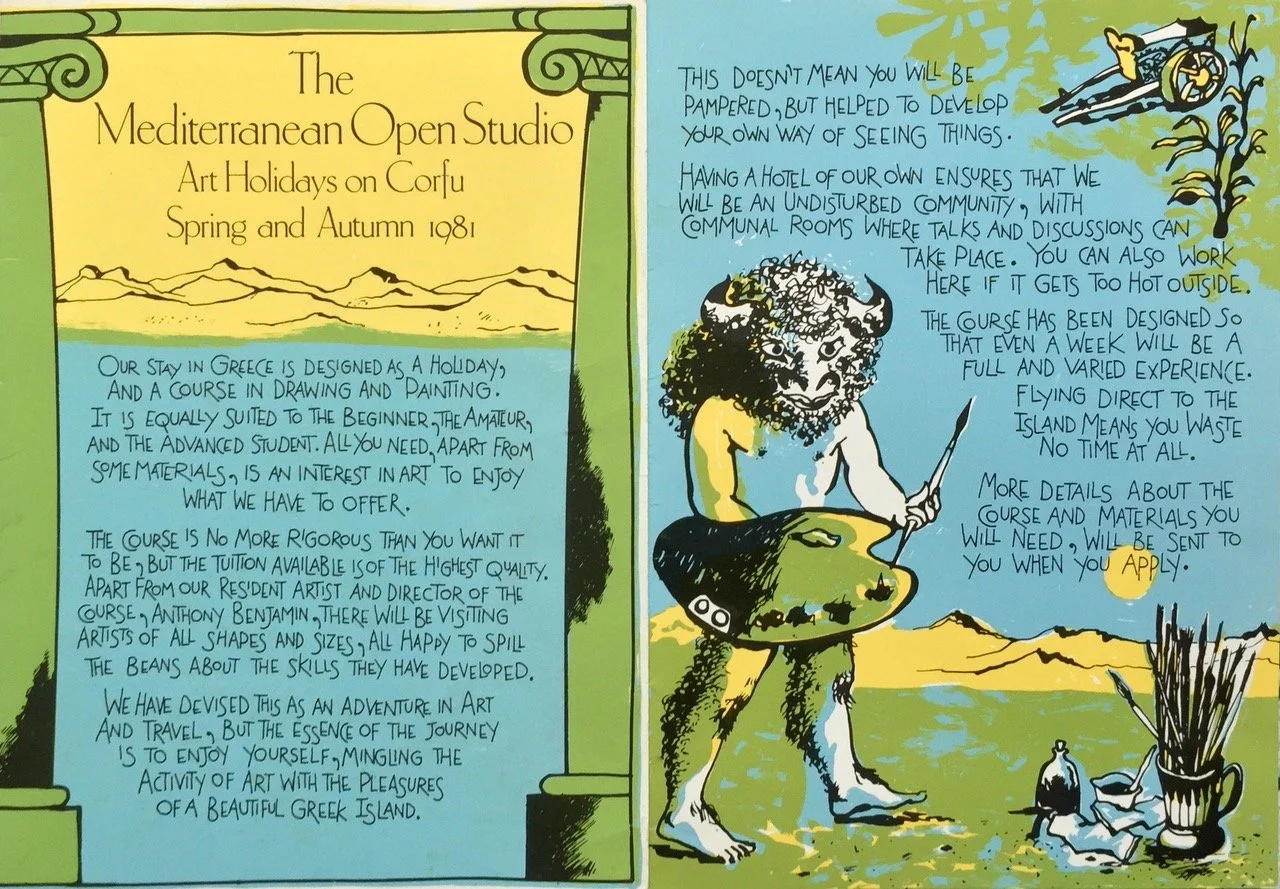
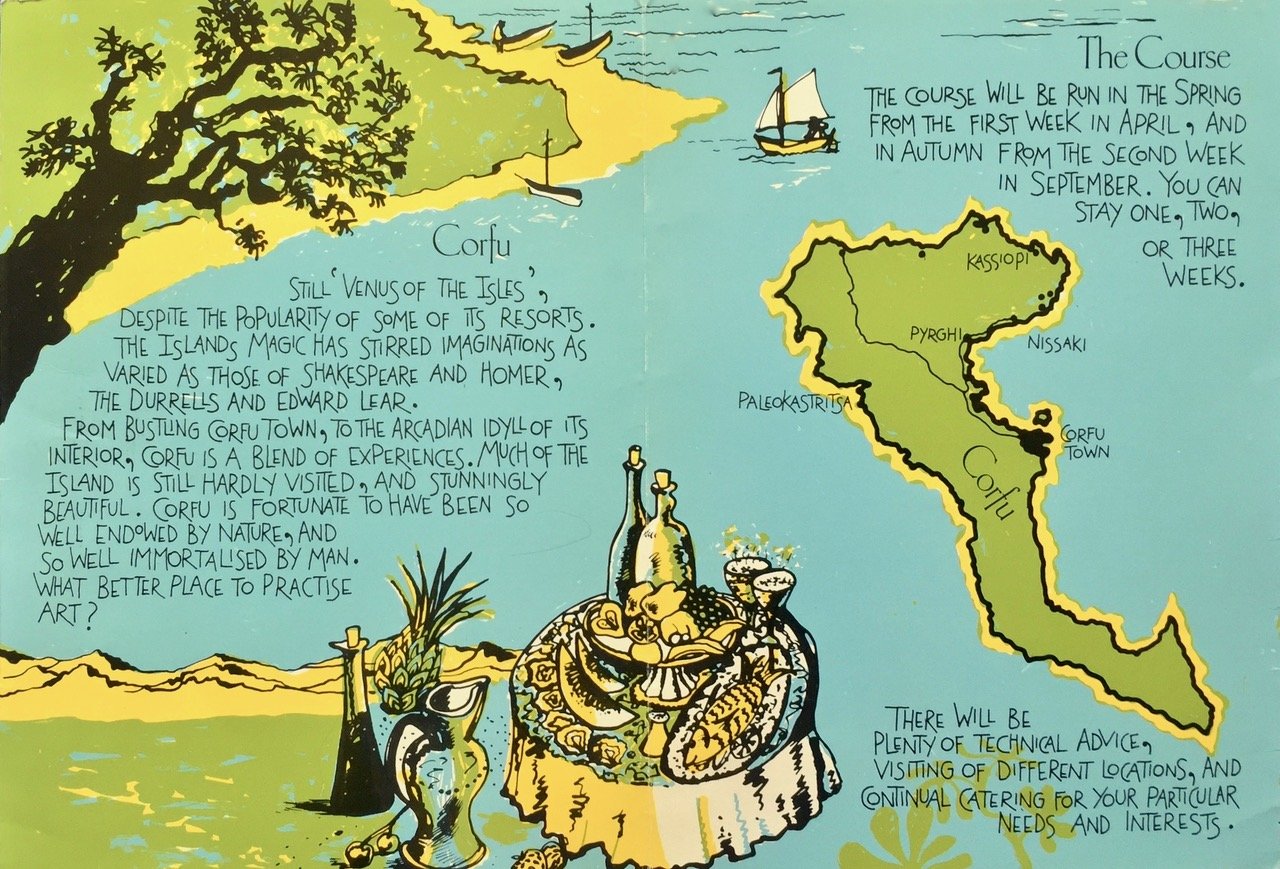
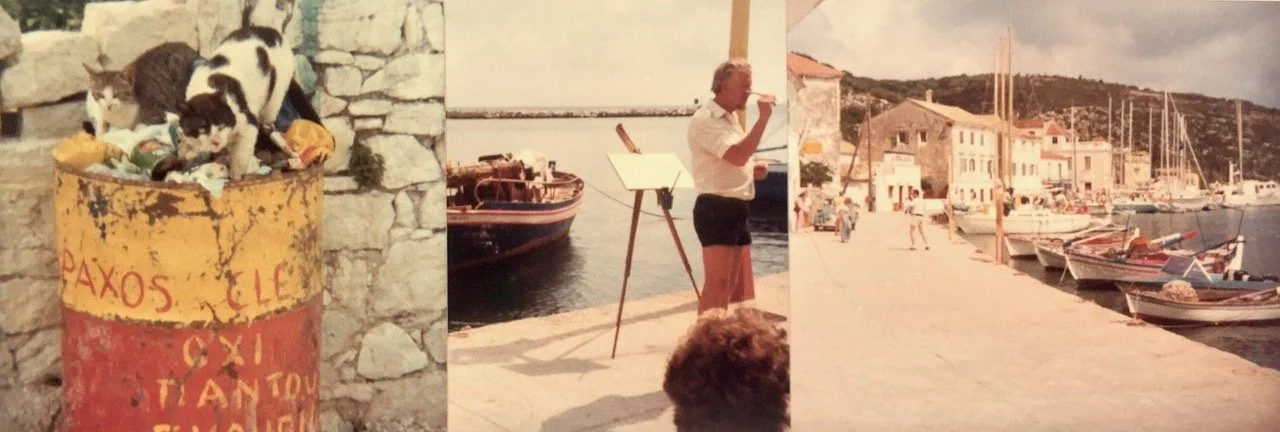
In the the spring of 1979 Benjamin had been employed as a last minute replacement for an assistant teacher on a week-long, art holiday excursion to a Greek Island called Paxos organised by an artist/ entrepreneur, named Ronald Ransome. It was not Benjamin’s kind of art, but he was a good teacher of any kind of art, including the traditional watercolour landscapes most of the folk in the group wanted to paint. He and Nancy got their transport and accommodation as payment and it had been fun, particularly the half day voyage from Corfu on an ancient steamboat to the small Island. So when back in the UK at the Graffiti Gallery in cahoots with Robert Renak( Art for Industry) they decided to have a go at something similar that might appeal to the more sophisticated artist/travellers. They did a bit of research, wrote the copy and Benjamin designed an interesting brochure that attracted just enough would-be-artists to make the project viable… maybe? When the time came off they went to Corfu and fortunately it worked well enough, but they had underestimated almost everything and returned to the UK, exhausted, with empty pockets and some bills to pay, so although it had been an interesting experience, they did not repeat it. However it was not the first time, or the last, that a time devouring project would take Benjamin over. The Liverpool Road Association of which Benjamin was the President was the next good cause, and it was even greedier than the - Save Cabbagetown had been in Toronto, but at least, back then in the early 1970s John Sewell, eventually the Mayor of Toronto, had been at the head of the movement. Unfortunately Benjamin had too much appetite for other activities, and sometimes became involved in complicated projects that overwhelmed him, ate up his time and diverted his energy from making art.
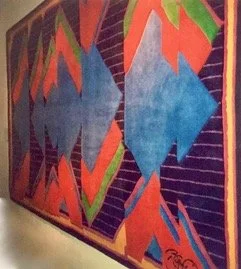
Benjamin and Baskerville Kaleidoscope Wallhanging,1987, 13’-0 long x 6’.6” high. Design - a collage of 4 Baskerville Serif 1972 Screenprints
SEPARATE SECTION ON WALLHANGINGS
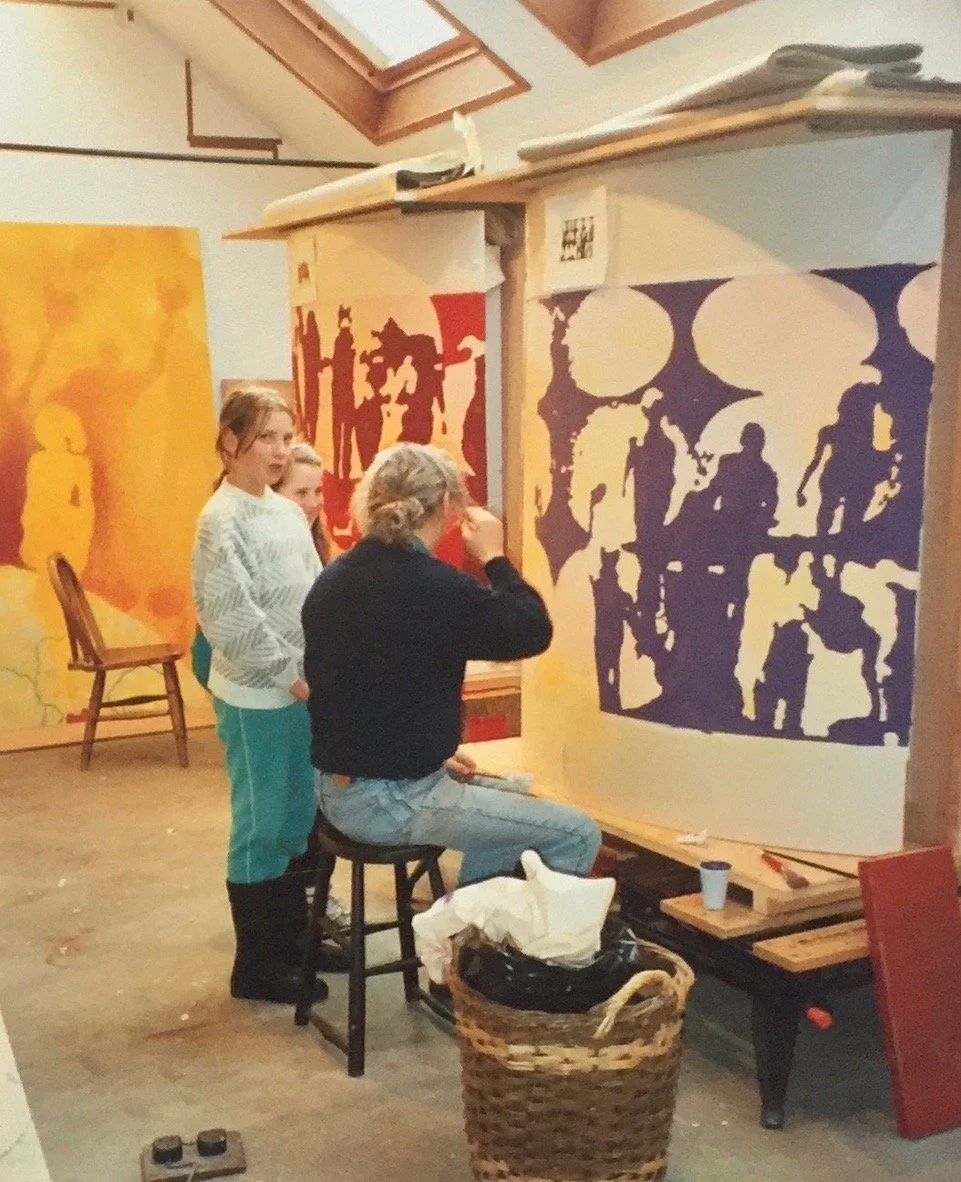
SEPARATE SECTION ON WALLHANGINGS
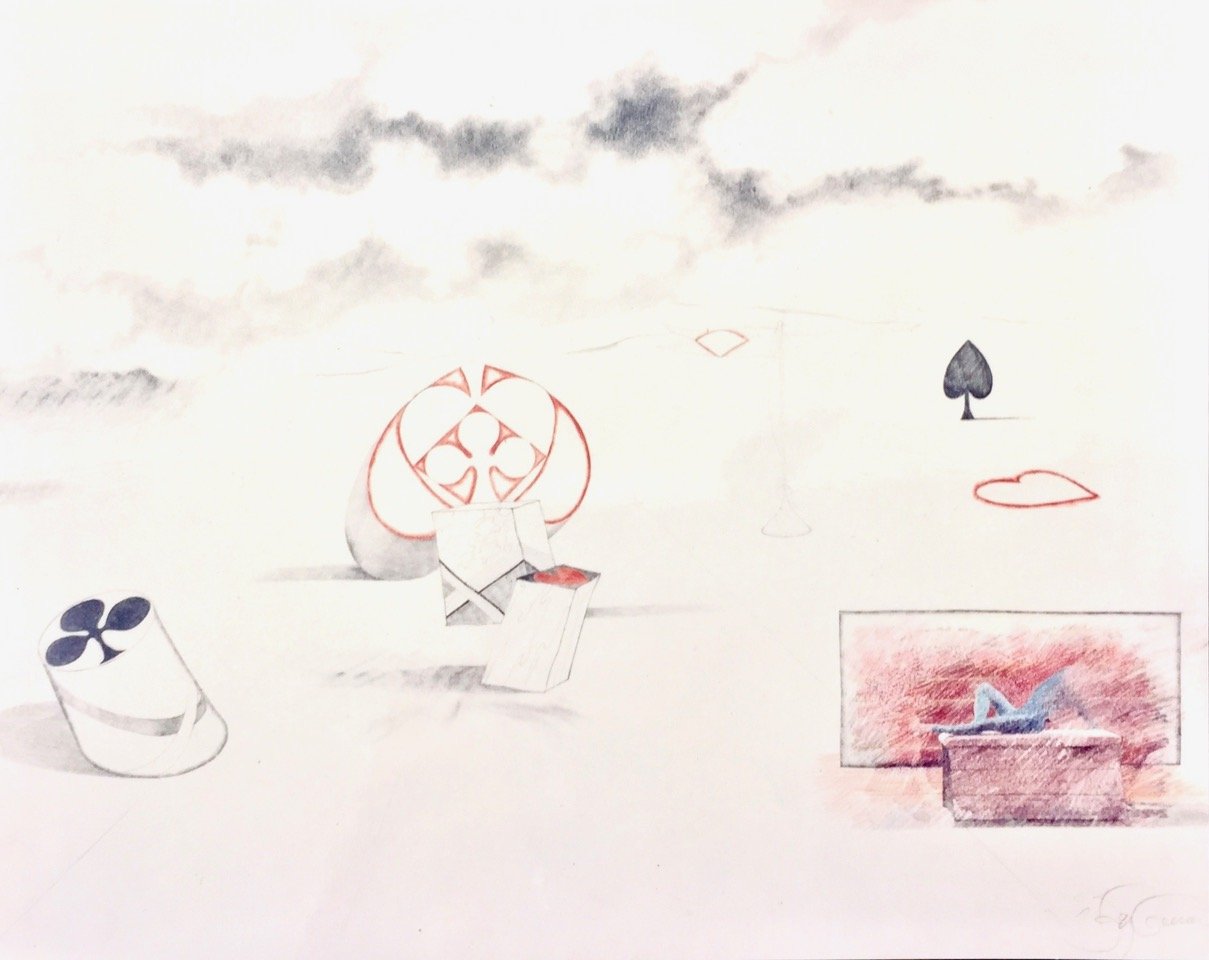
CRUISE SHIP CARD ROOM LOTS OF PLAYING CARD DRAWINGS NEW SECTION?
Graffiti Svenska - Hedman was well over six feet tall, and not in the least shy, or apologetic about turning up unexpectedly and out -of-hours in the gallery…nor were the busy gallerists surprised to see him standing in the doorway grinning, as gallery hours were always very flexible. Hedman cheerfully introduced himself as a commercial photographer who had spent several years working in California, and recently returned to live in Sweden again. He accepted a large glass of Valpolicella and started looking intently at the work on the walls, while Benjamin explained the complex techniques involved in making and printing the work. The big Swede seemed absolutely fascinated and asked lots of questions, then explained that he worked with NKR, a major producer of office installations in Sweden … everything, including the design, construction, furnishings and equipment, as well as the framed art for the walls. So they all sat down and drank some more wine, and the gallery did not put the lights out and lock up until after 2 AM …then on June 3rd,1979, Graffiti Svenska ( in Hjo, nearJönköping in the south of Sweden) opened with an substantial exhibition of Anthony Benjamin’s limited edition prints… and on June 6th,1980, almost exactly a year later, another similar exhibition opened at Galleri Graffiti in Oslo. Lars Hedman was a man of action and fun, as well as a professional photographer.
INSERT 1, OR 2, NKR OFFICE PHOTOS WITH AB PRINTS ON THE WALL
In the early 1980s they became involved in - ‘Contemporary Arab Graphics’ and had a series of successful group and solo exhibitions by Arabic artists, mainly from Iraq, Egypt, Algeria and Syria, that expanded and reinforced both Benjamin’s and Nancy’s interest in Arabic culture and music. A leading artist, Suad Al- Attar had several very successful solo shows at Graffiti, also made some exquisite etchings at Clarendon Graphics, and became a close friend with Nancy.
INSERT PHOTO OF ARAB GRAPHICS BROCHURES
Mediterranean Art Holidays - Benjamin loved the Greek Islands; he had rather accidentally participated as an assistant instructor on a Art Holiday in 1979 to the small remote Greek Island of Paxos, organised by Ron Ransom, a keen, traditional artist/entrepreneur. On the last evening when the group were sitting at a restaurant on the harbour front, when a large luxury yacht arrived, tied up and lowered a walkway. Eventually the comedian Peter Sellers and his wife disembarked with the intention of dinning at one of the many restaurant. A waiter rushed out and placed a table and chairs for the couple, who sat down and started taking photos of each other. Ransome quickly recognised the actor, and approached eagerly to invite him to view the group’s exhibition nearby. Sellers graciously followed him, looked briefly at the show, but did not buy anything. He returned to quickly eat dinner with his wife, then rapidly disappeared back on board the yacht. The walkway was taken up, and they sailed away… an event that could easily have been a scene in a comedy film.
INSERT PHOTO OF PAXOS HARBOUR ?
This odd adventure planted the idea in Benjamin’s active imagination of possibly doing something similar on the larger island of Corfu, which would be easier to access from the UK, and where he could set the agenda in a more contemporary manner. Robert Renack, of Art for Industry, was enthusiastic and dove in with keen practical assistance. They did some research, drew up a programme and budget, and produced a skilfully printed, two fold, three colour brochure, featuring a slightly menacing, but friendly Minotaur, appropriately carrying a painter’s palette and brush…
INSERT PHOTO OF THE MED. ART HOLIDAY BROCHURE HERE
Fortunately the trip went very well for the lucky clients who produced some rather nice art, but needless to say the arrangements were much more complicated and time consuming, than the organisers anticipated, and not surprisingly the costs were higher budgeted for. So Benjamin returned to the UK with bills to pay and not a penny of profit. He enjoyed the trip and met some lovely people, but unfortunately it did not dampen his spirit or his enthusiasm for ‘Projects’, but having cleared his studio of the bulky parfanailia of print publication, he had stretched some large canvases, purchased a full range of new Lascaux Acrylics and turned his attention back to Painting … but along came the enterprising Robert Renack with an unusual, but intriguing proposition of producing an art installation for a new super size, luxury cruise ship being built for the P&O Line.
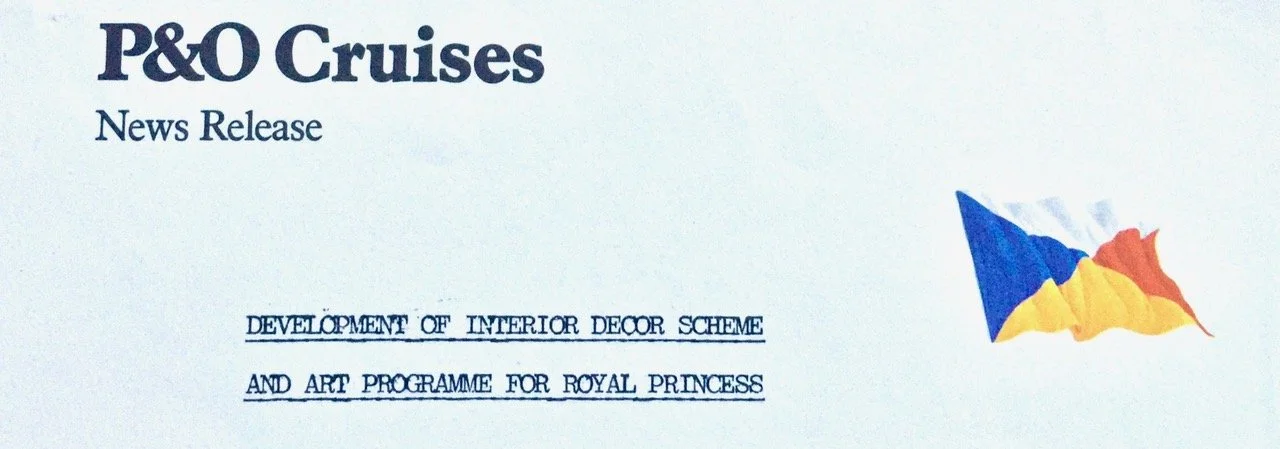
INSERT P&O HEADING
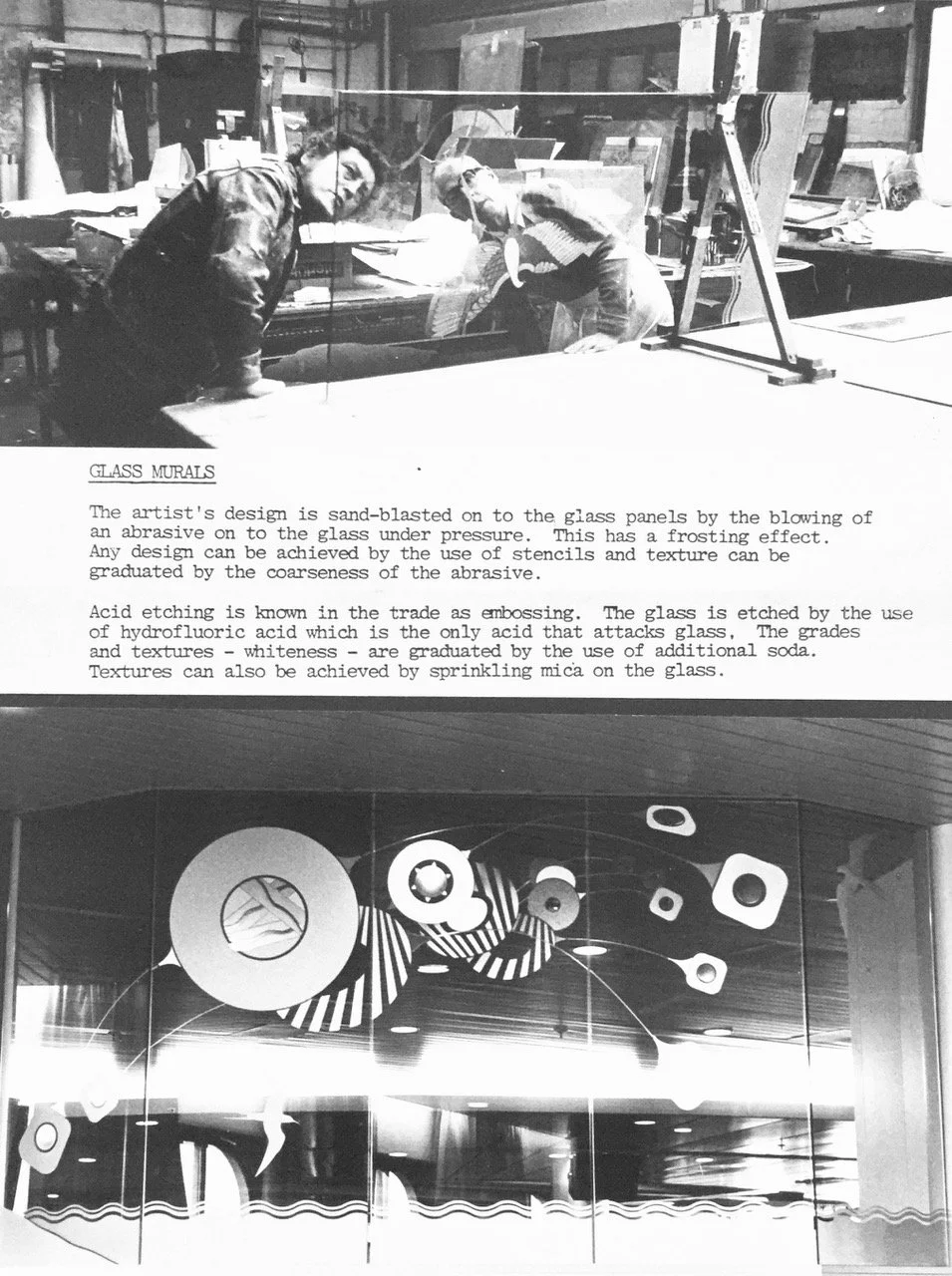
A Cruise Liner Commission - the ‘Royal Princess’ The 31. 7.1984 P&O press release stated, the- “new $150m, 45,000 ton cruise ship Royal Princess, due to be delivered from the Wartsila Shipyard, Helsinki,at the end of 1984 ... The Princess of Wales has indicated that she hopes to name the ship in Southampton in mid-November… Royal Princess will sail for Miami on 19 November, and will be operated out of Los Angeles by P&O’s subsidiary company Princes Cruises Inc. on voyages to Alaska, Mexico or the Caribbean.” … ” An interesting aspect of the Royal Princess furnishings is the artwork. Each piece is an original item especially commissioned for the ship. The brief did not constrain the appointed artists- they were chosen because their style was sympathetic to the brief itself. From then on they joined in the process of developing the programme by presenting items on imagery. The extent of the project was vast. Each item was considered quite separately and emerged to meet the particular requirements of the space in which it would appear. The collection is valued at around $400,00…glass and gesso murals in the International Lounge by Anthony Benjamin.”
INSERT PHOTO OF AB WITH GLASS ENGRAVING TECHNICIAN
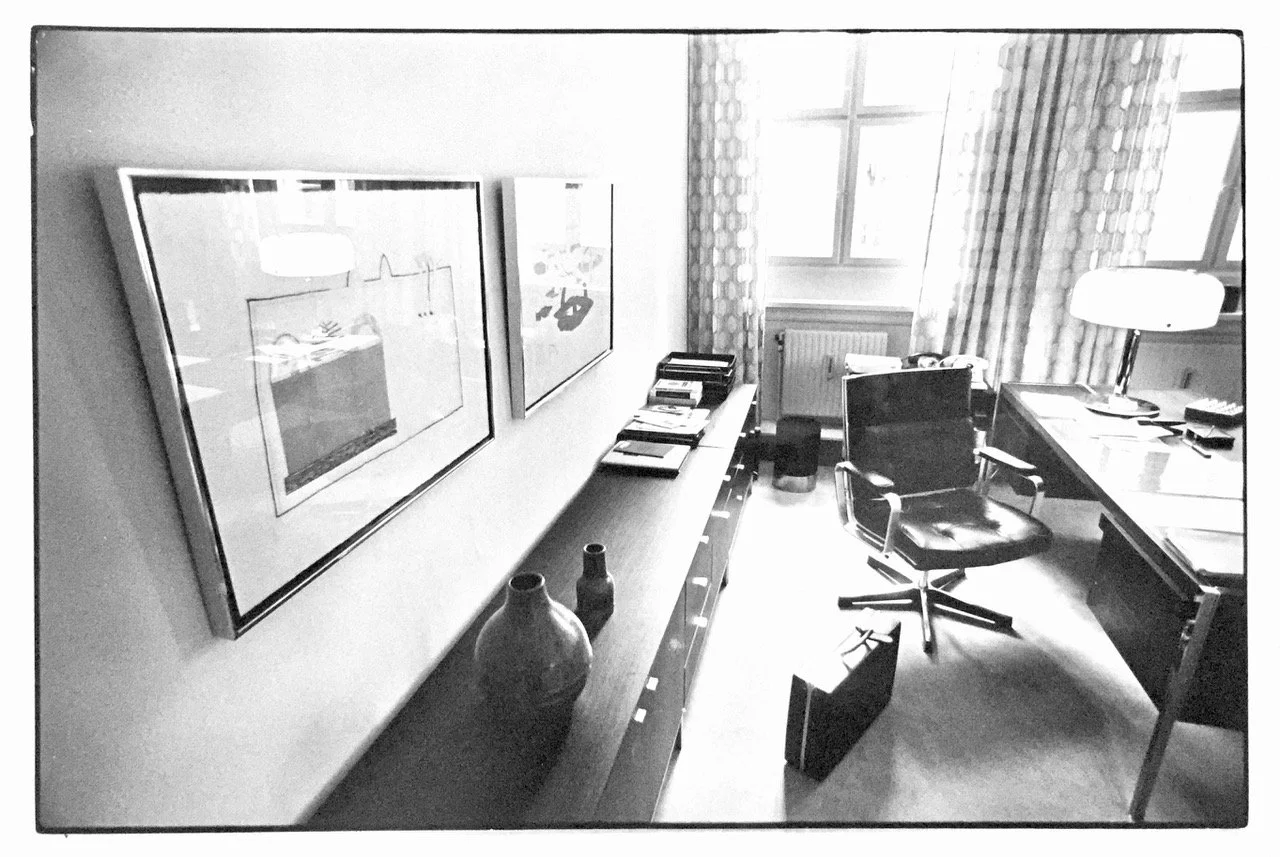
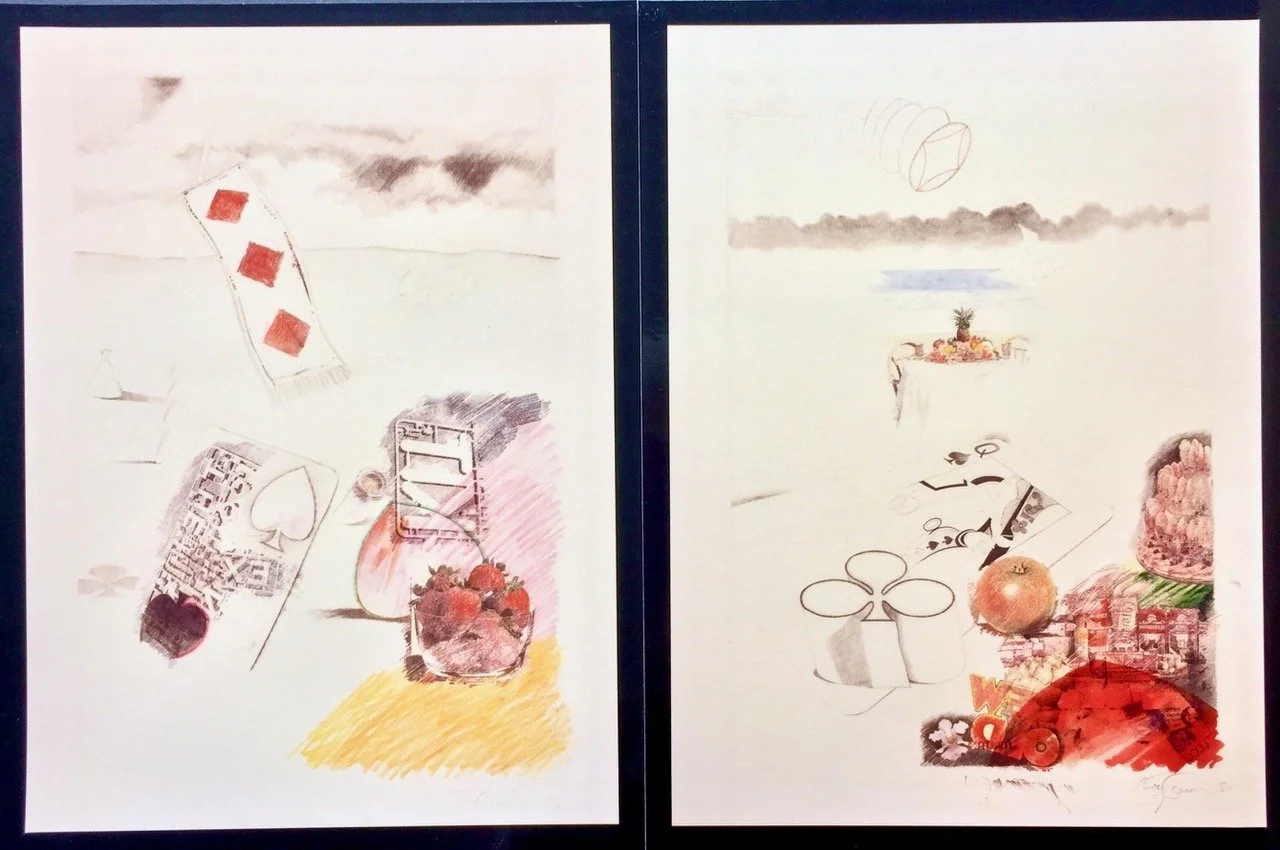
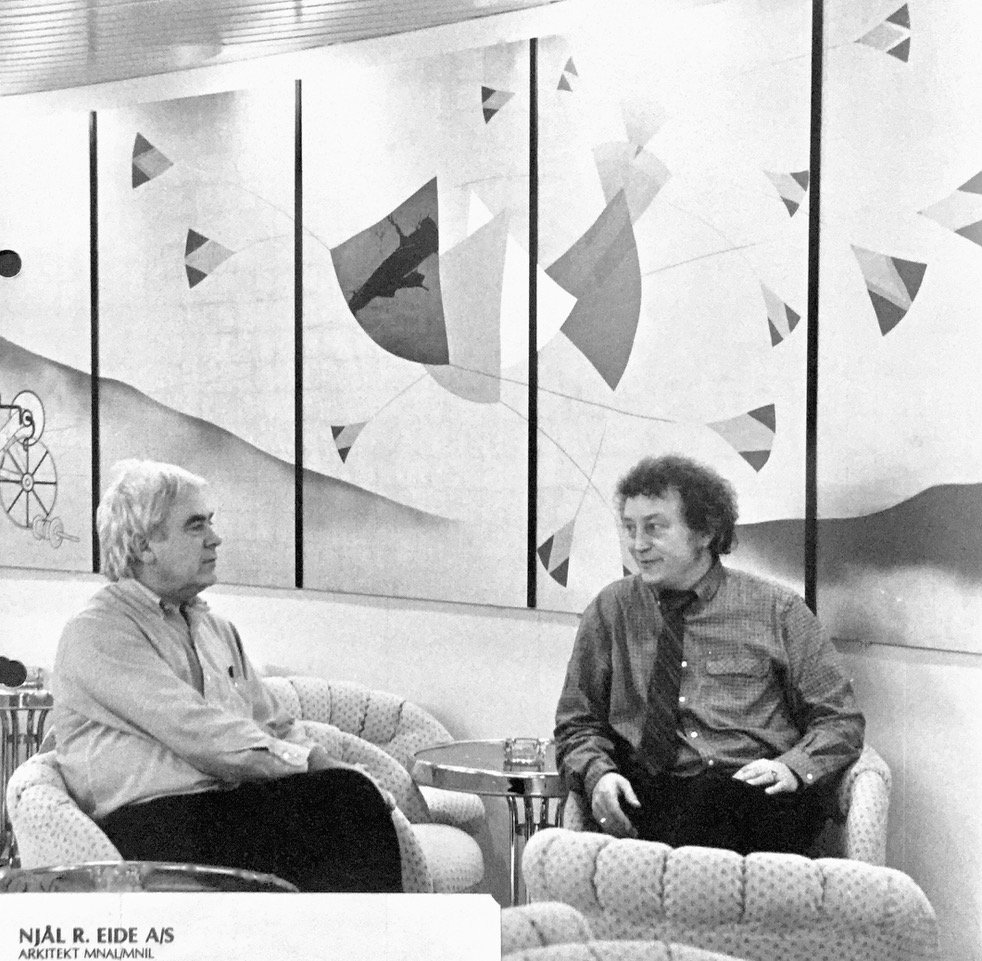
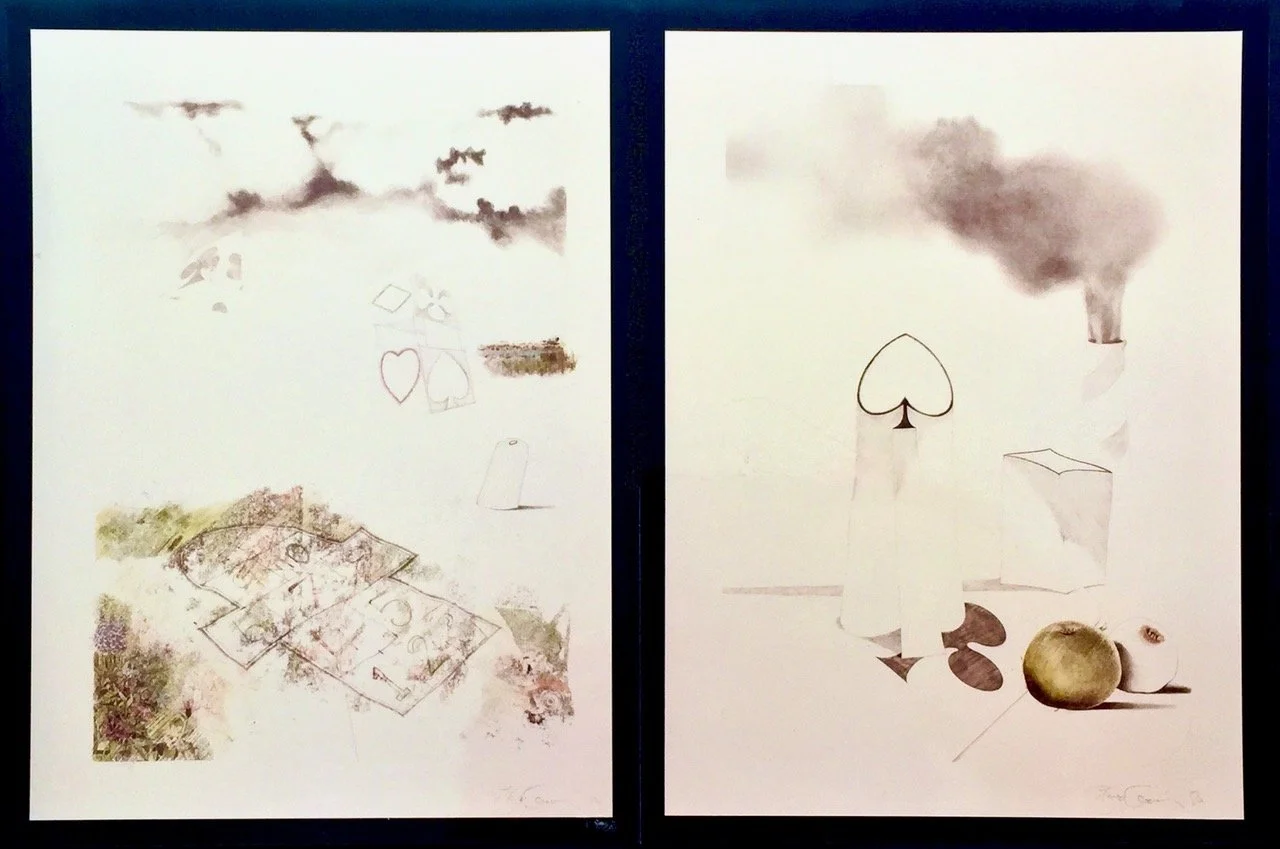
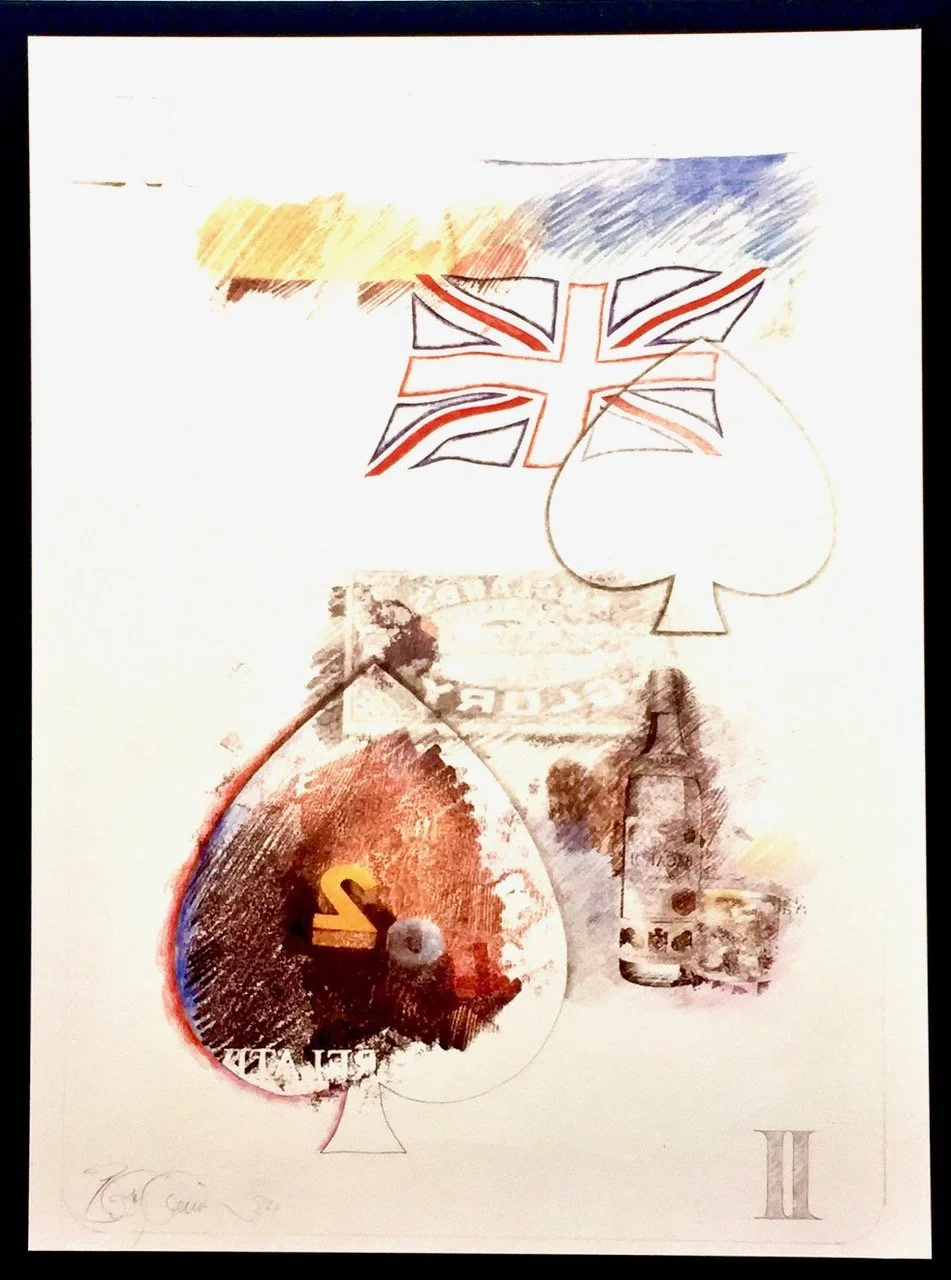
Norwegian Architect, Njal Eide in charge of the P&O project liked Benjamin’s approach to the project and gave him the Card Room to decorate as well, which really delighted him, as he already had an interest in the familiar images of playing cards- the King, Queen and Jack in the four houses, black spades, and clubs, red hearts and diamonds, and the wild, free Joker. He had taken part in the ‘Artist’s Deck of Cards’ project devised by Andrew Jones in 1976, with his image of the four of spades, using a wide variety of graphic techniques, including frottage…this was a great opportunity to take it all further.
INSERT PHOTO AB WITH EIDE and CARD ROOM IMAGES ( more available if wanted)
David Case at Christie’s Contemporary Art was very enthusiastic about this project and arranged for Benjamin to have a comprehensive exhibition of sculpture, graphics, and preparatory work for the P&O commision at Galerie AEblgaarden, (Christie’s Danish agents) near Copenhagen in March,1985.
INSERT PHOTOS OF THE GALERIE AEBLGAARDEN BROCHURE
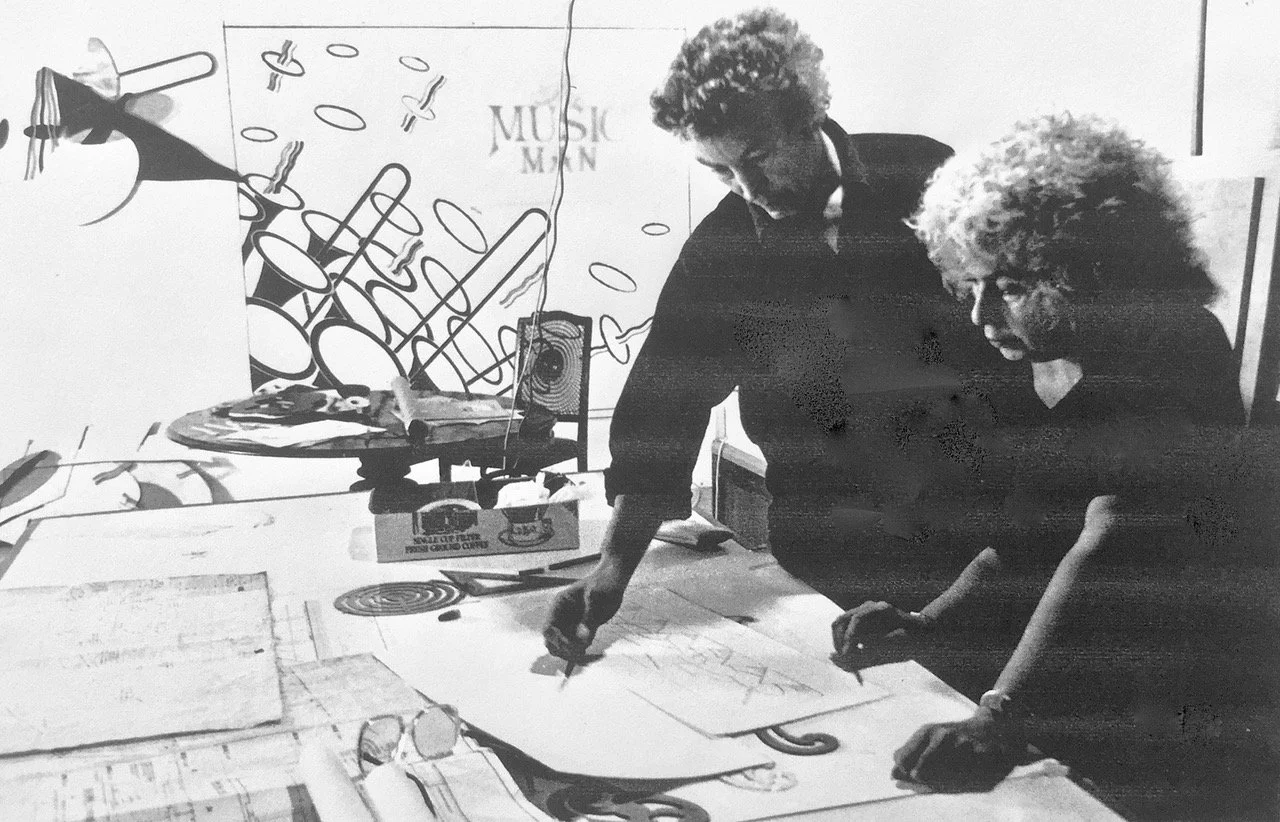
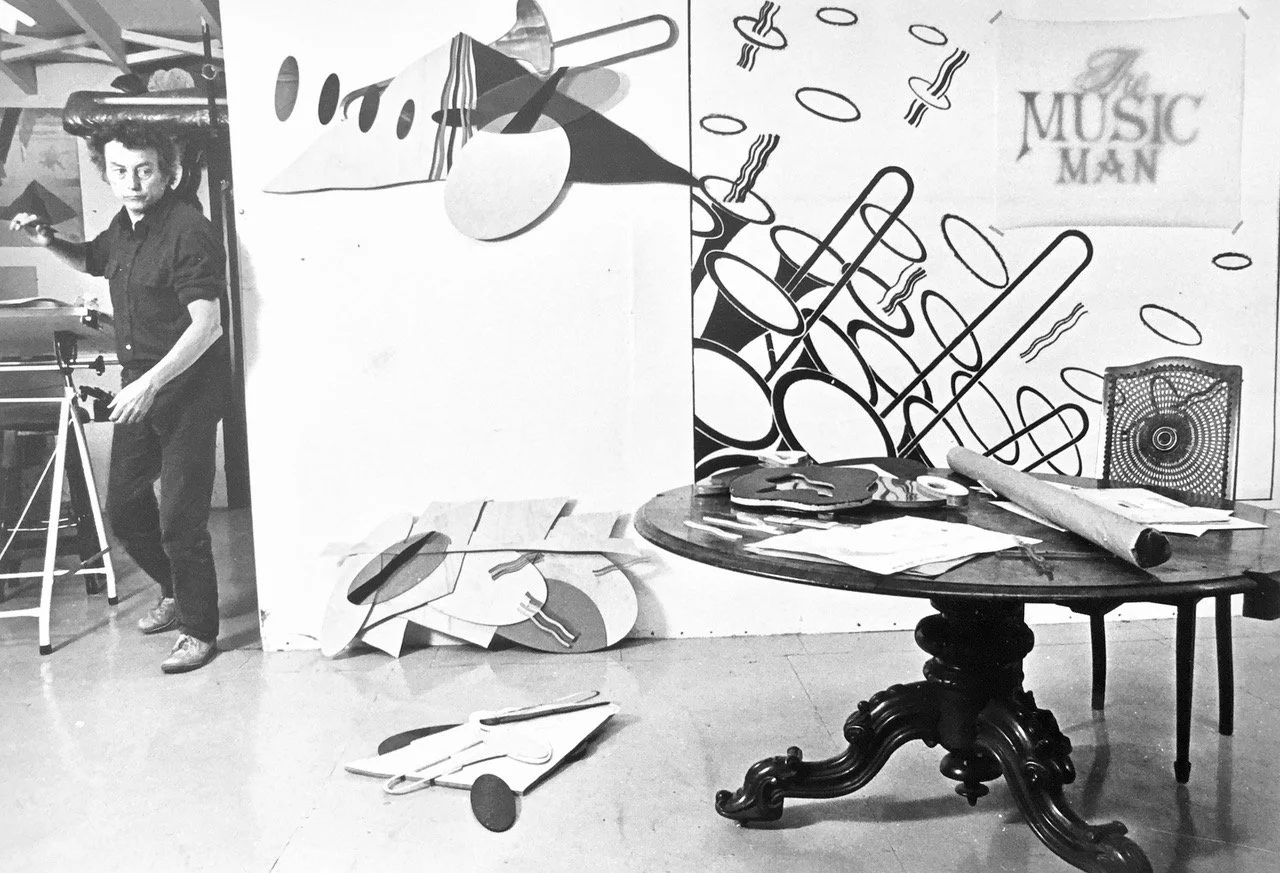
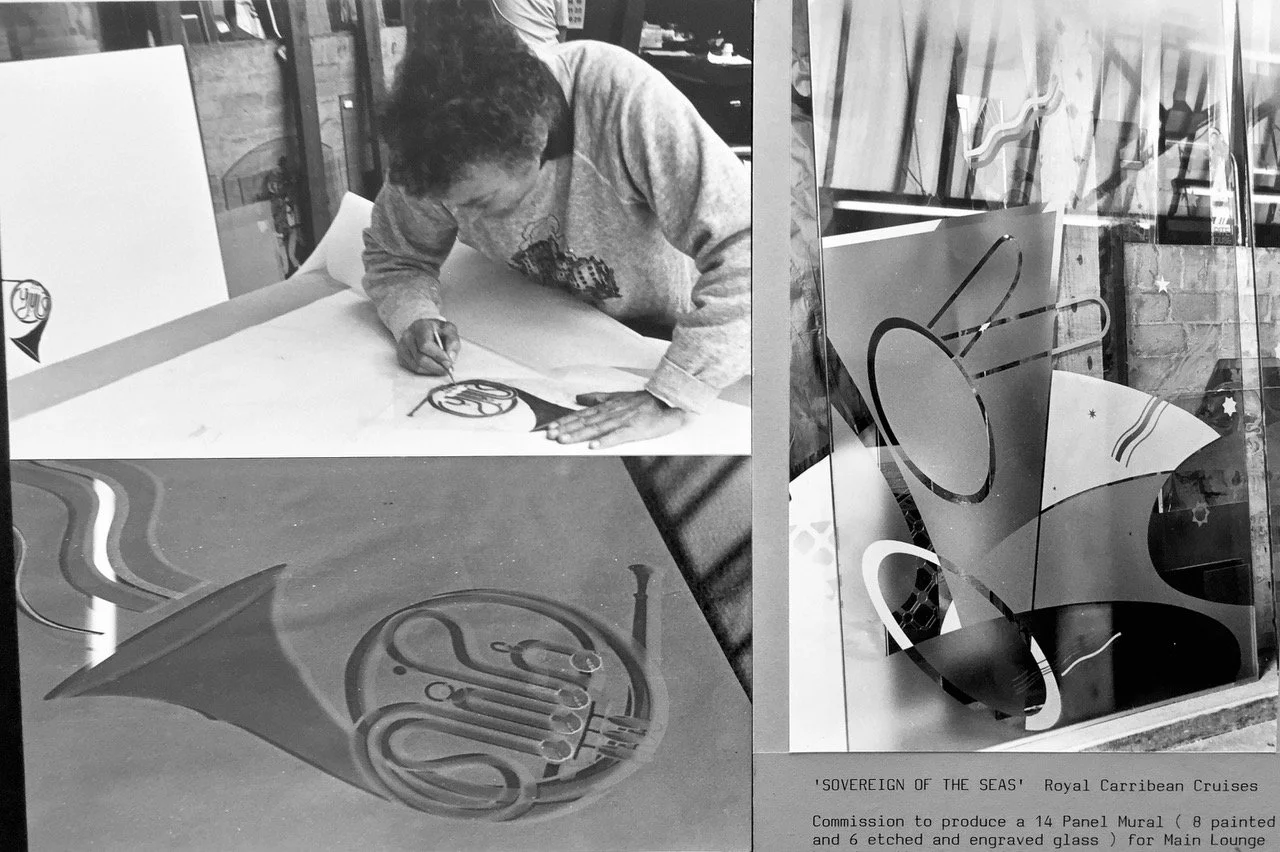
More Cruise Ships - The well-managed P&O project was finished in time and everyone was pleased with the results. Benjamin was well paid, and he had a great time on the ‘shakedown cruise’, so when another similar project turned up for a new ship the - Sovereign of the Seas, in the Royal Caribbean Line, he readily accepted the commission for the decor of the main lounge, even though he had just started getting into his own work again. However, this time the theme for the decor was more specific … it was ‘The Music Man’, a popular 1962 film of an American musical that Benjamin was not familiar with. Viewing it on video was a bit of a shock for him as it was not the sort of entertainment he liked much, but the final big number - ‘Seventy-six Trombones’ gave him something to focus on as he liked the refined geometric shapes of the brass instruments, and the feeling of celebration the film finished with, as well as the opportunity to make a couple of tapestries with Philip Geraghty, and Perspex relief sculptures with Nancy’s technical help.
to
INSERT PHOTOS OF WORKING ON ‘THE MUSIC MAN’
The ship was built in in France at St.Nazaire, and again it all went well and looked good. The Evening Standard Travel page commented on the launch; headline, 8. 2.1988 - “Monsters of the deep…The world’s largest cruise liner, Sovereign of the Seas…She is larger than the QE2 and as tall as the Statue of Liberty. It took twice as much steel to build her as went into the Eiffel Tower…” but the project management was not quite as smooth as it had been on the Royal Princess, and it was a wild rush to get the artwork delivered on time. This was not an unusual situation for Benjamin as he tended to assume that everything would proceed as intended, no hangups or delays were ever expected; he also had faith in his ability to charm, coerce, or gently bully anyone he knew with useful skills, when time was short and he needed help.
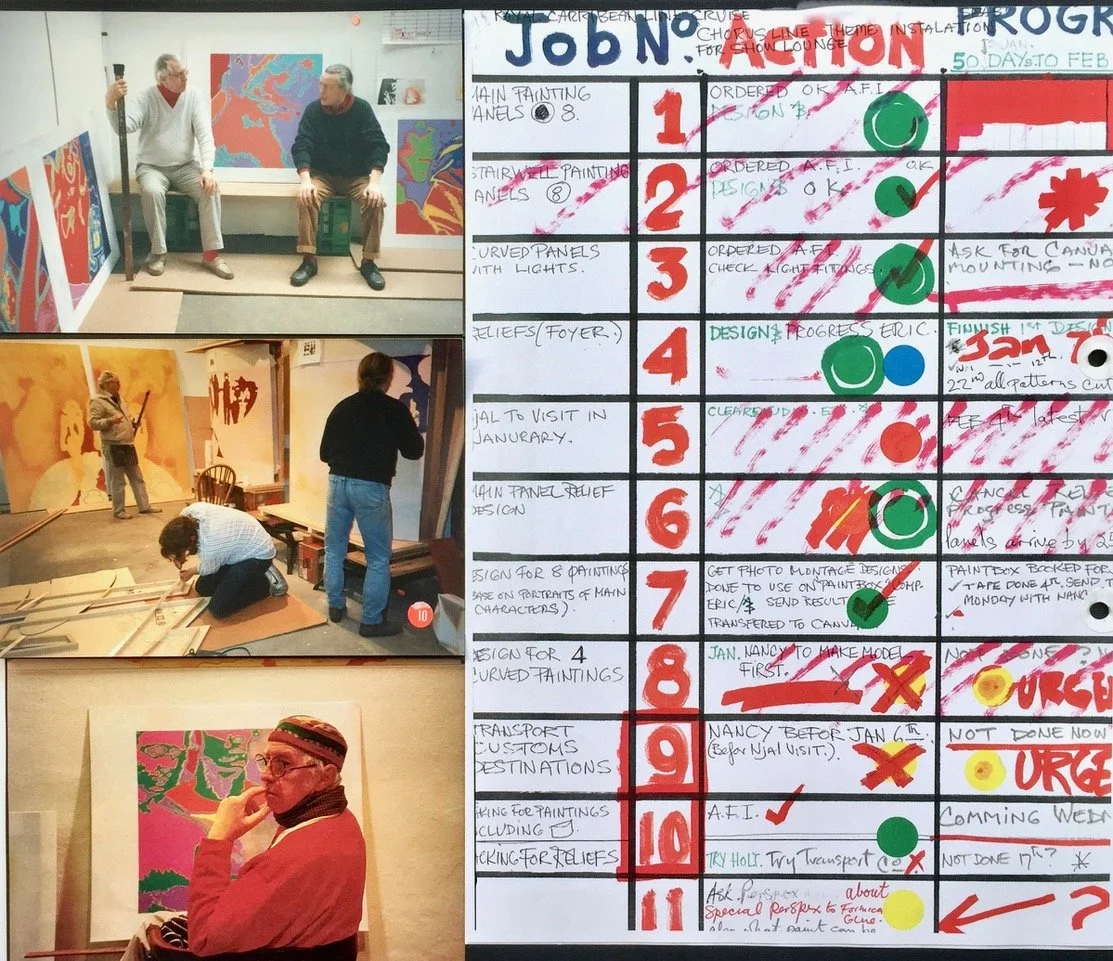
Time had started running out before the contract for the second Royal Caribbean Liner, Majesty of the Seas, had arrived and the theme was even more challenging than The Music Man… it was the 1985 musical - ‘ Chorus Line’, but it came with the proviso that the design should not be ‘too sexy’. A scale model was required immediately and the budget was tighter, so no engraved glass murals, but however unlikely the project seemed, Benjamin watched a video and came up with designs that looked okay; Nancy made a model they sent off to company headquarters in Florida, but they heard nothing until a couple of months later when they were engaged in the process of moving more permanently to Norfolk.
Fortunately there was another delay in the commissioning and by the time they had the go-ahead, Benjamin had rented a large well converted barn at Lowes Farm, near Kelling, where they had moved to. As time was short he needed more help than Nancy could provide, so he contacted an old friend, an artist/one time signwriter, he knew from his time at the Beaux Arts Gallery, Derrick Greaves, who lived a a drivable few miles away, and a new friend, Eric Smee, a photographer/ artistic jack of all trades, who lived in the cottage adjacent to Benjamin’s Cottage, to join them on the project.
INSERT PHOTOS OF AB, DERRICK, & ERIC WORKING ON ‘CHORUS LINE ‘
There was a good atmosphere in the new Lowes Farm studio and everyone worked hard, but the impending deadline was stressful and Benjamin was struck down by flu that left him wasted. Then some free standing units made in Southhampton did not arrive on time, because the delivery driver could not find the studio in the rural area and did not think to ask anyone, and took them back to Southhampton. However there were delays elsewhere and the completion time was extended sufficiently to finish well enough…but enough was enough, and that was the last Cruise Ship Commission for him, but not the end of his addiction to projects.The worst was still to come.
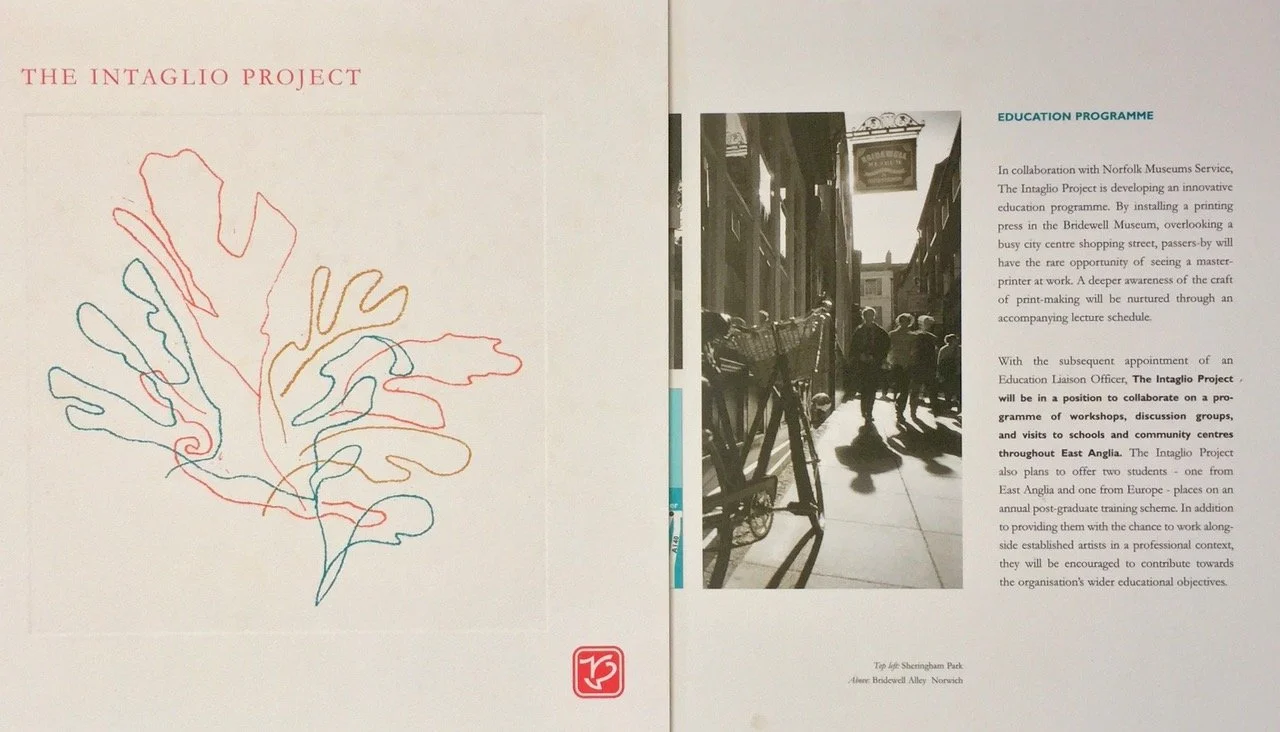
INSERT PHOTO OF INTAGLIO PROJECT BROCHURE (?) line engraving by Derick Greaves
“ THE INTAGLIO PROJECT - A European Initiative with Norwich Castle Museum” - started circa1992 … when it was finally put to sleep, circa 1996, the person who mercifully pulled the funding plug, said something to the effect that… he had never come across such a good idea, unnecessarily bogged down by so much complication and red tape… and he was right. Although it had been Benjamin, who launched the idea, he was quietly relieved that it was finally finished, over and done with, after at least four years of reports and meeting at the Castle, and more reports and meetings at the Lowes Farm Studio. They were getting paid for their time, but Benjamin was on his own time… and he usually provided the drinks and snacks, and sometimes lunch as well.
The October 1994 Project Proposal stated in the “1.0 Introduction- This project proposes the setting up of a Fine Art Etching and Aquatint Intaglio Studio in Norfolk, UK in partnership with the Norwich Castle Museum. Master printers and platemakers will be recruited to work with leading European and East Anglian artist to produce high quality Limited Edition Fine Art prints. The project will create a unique collection of Modern Art … reflecting the cultural climate following the inauguration of the European Community single market. The collection will be of lasting benefit to the visiting public and the Permanent Collections of the Norwich Castle Museum and its European partners, whilt expanding the historically close ties between East Anglia and Europe by encouraging regional exchanges of artists and exhibitions.” concluding rather optimistically - “ It is anticipated that the project will be self -financing in the medium term.”
Every one seemed enthusiastic, particularly when generous Lottery Funding was granted not once, but twice. Benjamin had a good relationship with the Director, Andrew Moore and others at the Castle, as well as contacts with local, and European artists, and major cultural organisations in Germany, Holland, Belgium, Norway, Sweden and elsewhere, who were seriously interested in participating. It could have worked, but issues with the overly complicated details of accessibility, health and safety etc., piled up and wasted time… especially when the Castle added an Educational element to the proposal in order to seek more funding from other sources. This quadrupled the Red Tape; the project was taking too long and costing too much. Nothing but papers and reports had been produced, no Art…so that was that ! One positive outcome - it was the last big Project Benjamin was involved in; he was quietly relieved to be out of it and straight off, he turned his full focus back to his own Artwork!
I
ess
1970’s-1990’s, London & Europe: Prints and Projects
When travelling back and forth between North America and Britain, he produced the eight ‘TransAtlantic Suite’ screenprints; when he finally left Canada in 1973 to return to London, he made a suite of six screen print images titled ‘Pre- Packaged-Phantasies’. This was partly a reflection on modern upmarket consumerism, but also a homage to the art deco style he loved, there was always something more than might be expected in his inspiration. These beautifully images perfectly printed by Kevin Harris were an immediate success; Sheldon Williams wrote about them eloquently in 1974 as- “The Quest for Unambiguous Contact” … mentioning Fernand Leger, who Benjamin studied with in Paris: “He would have approved the interesting and competent way in which Benjamin today has discovered and tapped latent extensions of the art-deco epoch, back in public favor on a wave of nostalgia.” Interior Designer, Mary Gilliat, used the ‘Pre-Packaged’ set several times when working with Liberty’s on magazine features and show flats… one set of the six framed images was stolen from a show flat and never recovered.
However, his boundless energy and interest in cooperative activities also led him into participation in Projects that ate up his time, and while these projects often worked out brilliantly, sometimes they did not produce the intended results, even though Benjamin enjoyed the activities involved. He probably became overly interested in projects not directly involved with his artwork, because of the success he had in leading citizen groups confronting civic planning issues. The first in the early 1970s in Toronto with John Sewell (who eventually became the mayor ), when they successfully led the ‘Save Cabbagetown’ protest again Meridian, a ruthless construction company who wanted to replace the fine, but at the time slightly rundown, early 20th century properties on the margin of downtown Toronto, where we lived and are now incredibly valuable, and replace them with concrete towers… then later in London with the ‘Liverpool Road Association’, by preventing the installation of overnight refrigerated lorry parking at Highbury Corner. On each occasion he made a rousing speech to a crowd of supporters from the steps of a civic building, which probably caused a bit of an adrenalin rush.
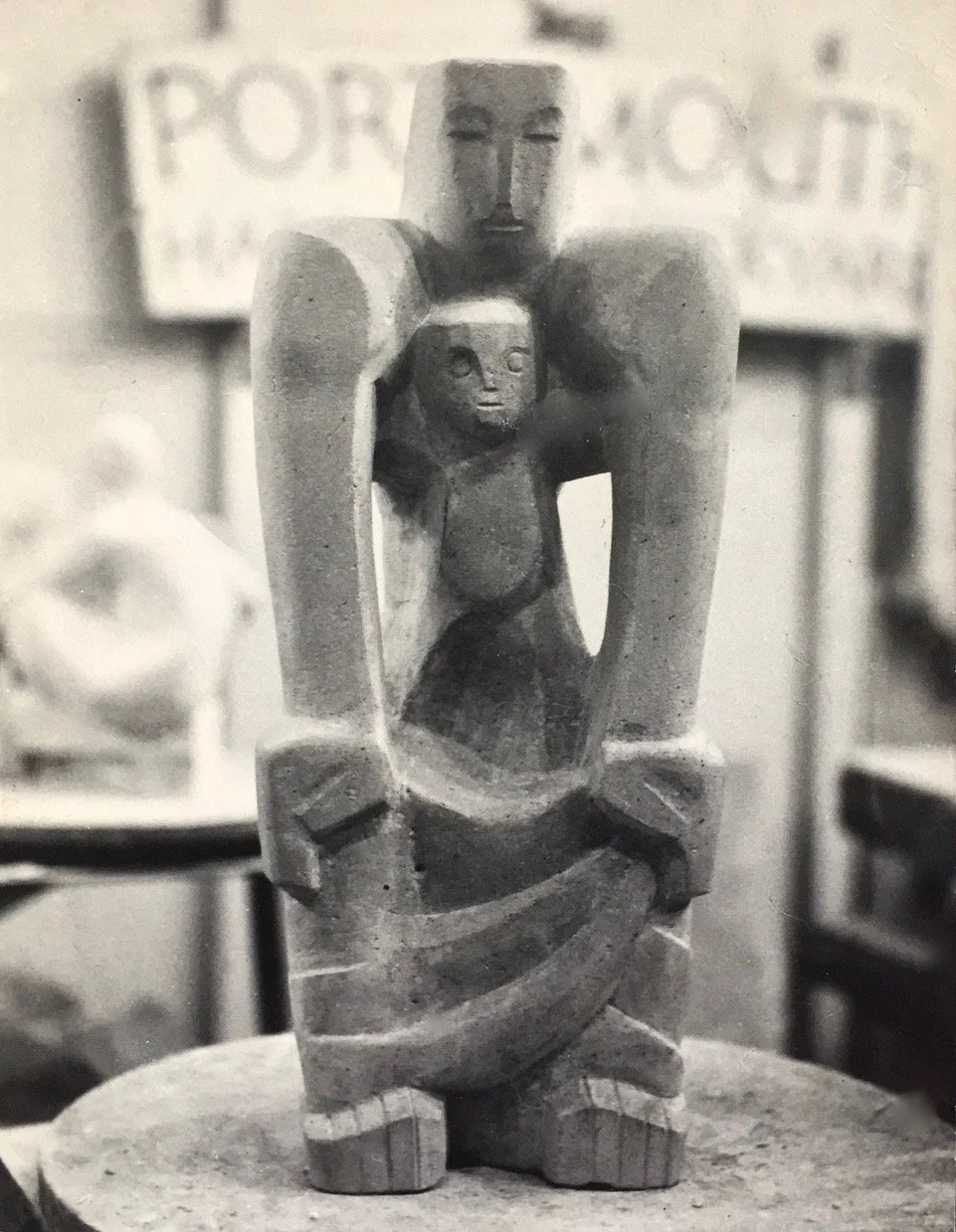
Benjamin’s original artistic intention was to learn how to carve and be a sculptor; possibly this was due to his early training in engineering and because he enjoyed making things. When studying art in the early ‘50s at the Regent Street Polytechnic he was accepted into the sculpture department where he carved a ‘Mother and Child’, with a nod in the direction of the Jacob Epstein style. The piece was ‘Highly Commended’ by Henry Moore and then purchased by the Anglo Iranian Oil Company.
However, when he used paint on a stone carving it seriously offended the instructor, and when he adamantly refused to destroy the piece, he was told to leave the department immediately. Fortunately Norman Blamey, a skilful traditional artist who taught painting and drawing at the Poly, recognised Benjamin’s talent and admired his tenacity, offered him a place in his class, for which Benjamin was forever grateful. So while his main artistic activities were painting and drawing, he also enjoyed making things and working cooperatively with technicians to produce limited edition etchings and screenprints. By the early 1970s he was exhibiting widely, and winning prizes internationally - 1970 and ‘72 Cracow Print Biennale, 1971 Tokyo Print Biennale, 1972 III Exposition Internationale Rijeka, Yugoslavia, the 1972, and 1980 Frechen Internationale Grafik Biennale, 1974 Norske Internasjonale Grafikk Biennale, Fredrikstad,1975 Albright -Knox Gallery, Buffalo, New York,1979, 9 Canadian Artists, Chicago, USA, 1979 Biennale Ljubljana, Yugoslavia, 1982 Arteder Bilbao, 1982 British International Print Biennale, Bradford 1982, X Biennal Ibizagrafi, 1983, International Print Exhibition, ROC, Taiwan and many more.
Crawford was more British, than most born in Britain folk; he rejected the change to decimalisation, so business over the bar was conducted in the ‘old pound, shilling and pence’ manner, using ancient, clanging cash registers… a bit of a challenge for newcomers on both side of the bar. Weekends were wild affairs with Khan and Peet playing to ecstatic crowds that include all manner of Islington Bohemia and people from all levels of the theatre world; Alan Clark, who lived nearby on Almeida Street, Roy Minton and David Yallop were frequent visitors. By the time “Closing time! Ladies and Gentlemen, Please!”,was called by Crawford, the place would be packed to the walls, with happy crowds flowing out onto the wide Upper Street pavement. Sometimes neighborhood noise complaints attracted the ‘cops’, who arrived to pull the speaker plugs. King’s Head mythology maintained that one night, Khan, Clark and Bronco, an Australian stunt man, had ended the evening by dancing on the bar with their underpants on their heads…and maybe they did? But even when the pub appeared to be Closed, insiders, and friends of friends, would retire to the dim backroom for more merriment.
Benjamin liked Khan’s anarchistic talent, they were like ‘blood brothers’… Khan was giving him informal guitar lessons, and he called Nancy, his ’Sister’. One evening when David Hess, an American horror film actor/director/musician, and Brian Eno, Benjamin’s former student, were at Liverpool Road for supper, soon after Eno had returned from Berlin where he had been working with David Bowie; they were all sitting on the floor in front of the fire drinking wine, when Khan burst in the door clutching his guitar and full of contagious exuberance. Catching his spirit of fun they started passing the guitar around, improvising short doggerel songs that started off with …“My ol’ friend Bowlegs, he ain’t got no legs…” the silly songs went on and on, becoming more and more outrageous, until everyone fell asleep, or passed out.
Khan had written a musical show called ‘Goose Fair’, with reference to the annual last gathering of the season of fun fairs in Britain on Forest Fields in Nottingham. He had located a venue in Birmingham, and in some other provincial towns, for a chamber version of the show, but he wanted to do the show in London as well. Somehow Benjamin managed to convince his friend Julie Lawson, to convince her boss, Sir Roland Penrose, that it might be interesting to do a couple of the 'Goose Fair’ shows at the new ICA in the Mall. Pina Bauch, the incredibly, innovative contemporary dancer was booked to do some shows at the ICA soon, but another act was needed for the first half of the evening and, by some luck, that turned out to be Mike Khan’s musical. The cast included the small ‘Manzani Family Travelling Circus’; when Nancy noticed that Benjamin had singed his eyebrows, she discovered he had been secretly practicing Fire Eating, with a member of the Manzani troop…but being conscious of his good appearance, he gave it up. The images of Fire Eaters on the poster are Self Portraits. When the clever little black cat moved from upstairs to downstairs, they named him Manzani, and he lived with them for years.
INSERT THE ‘GOOSE FAIR’ POSTER & PHOTOS
Benjamin became fully engaged with both screen printing and etching in the mid-1960 in Britain and then in Canada and the USA from 1968, which he enjoyed and provided good returns. When back in Britain in the early 1970s, working with Kevin Harris on screenprints, he also began working with dedicated intaglio printer, Hugh Stoneman, starting with the ‘Sculptor’s Garden’,and the ‘Sculptor’s Sketchbook’, series that used limited colour.
Islington Daze : Soon after moving back into 312 Liverpool Road, Benjamin become close with Mike Khan, a talented but unruly, Rocker from the Nottingham Meadows who had moved in upstairs where Brian Wall lived before he left for California. Khan, a charismatic singer/songwriter with a brilliant guitarist partner, Malcolm Peet, were the regular weekend entertainment at The King’s Head in Upper Street, Islington. This classic19th century pub had an unusually large backroom used as a boxing arena in earlier times; this long derelict space had been adapted for use as a theatrical venue in 1970 when the pub was taken over by eccentric American, Dan Crawford, and his wife, Joan, who were dedicated to promoting all manner of innovative theatre. The theatre room was used for mix of one-person performances, and scaled down previews of shows that some-times transferred to the West End. The performances were proceeded by formal Dinners at candle lit tables; occasionally Nancy helped out with service intrade for watching the show and a tasty meal.
Although he did not really need an external stimulus to get on with making art, he tended to arrange exhibitions and set deadlines that were overly optimistic …time would get tight, and he would have to call in help. He was good at this, because he was fun to work with. however, sometimes he would slide off sideways into something else, leaving his co-worker(s) wondering why they were busy working through the night; Benjamin had managed to divert Kevin Harris, ( when he was involved in printing the Pre-Packaged Phantasies in time for an exhibition at Gorner & Millard ), into printing posters for a musical show a friend was putting on. Fortunately Harris was able to finish the prints to his usual high standard, as well as the posters, but sometimes not everything Benjamin started, was finished as intended.
“ Each of the 10 etchings in the suite was composed of small plates which are then grouped in sequences, together on a sheet. Thus, within the suite, one is offered a private insight into Benjamin’s thought process instead of, as with most works of art, the preferred conclusion”. (Rosemary Simmons, Arts Review) By the time Borderline project was completed he had become totally engrossed in the intaglio process; he then produced two very different fanciful images - ‘Wish you were here’ and ‘Timepiece’, that both incorporated a very full range of plate making and colour printing technique.
INSERT PHOTOS OF BENJAMIN MAKING ETCHINGS … and ‘Wish you were here’ & ‘Timepiece’ images
Switching the use of the studio in the garden at Liverpool Road from to a place for his own art work, to a venue where other artists and technicians came to make limited edition prints, had stopped him painting. Eventually he decided to refocus himself on being an Artist, rather than a Publisher of Prints… so he handed the business, and the bulky equipment on to the dedicated printers, Simon and Pete…and transferred the balance of the stocks of Clarendon Graphics editions to the Graffiti Gallery run by Peter Leigh, a cheerful and charming young man who was already selling Clarendon publications, as well as staging exhibitions and selling art in central London, where Nancy joined him as a director of the Gallery.
INSERT PHOTO OF GRAFFITI BROCHURE
Graffiti staged a very successful show in 1978- British Graphics at Work at the ICA, in the spacious new venue in Carlton HouseTerrace, in the Mall. This had come about because of Benjamin’s friendship with Sir Roland Penrose, the director, and Julie Lawson his diligent P A, who were open to new ideas for exhibitions. Selling art to advertising agencies, corporations, architects, designers etc. was a relatively new thing in Britain at the time. Graffiti had come into the rapidly expanding niche market, more by happy accident than intention; Peter Leigh’s first partner in a gallery located on the street level of an ad-agency in Soho, had been a professional copy-writer named Richard Gordon Freeman, who was also a poet…his clients became Graffiti’s first clients, but when the business grew, Leigh moved on to a larger premises on the third floor of a 19th century building on Great Marlborough Street near Liberty’s and Oxford Circus. At that time most West End/Bond Street art dealers, were too snobby to chase the Business Clients, but after the Royal Academy opened the Business Art Gallery and Christie’s Fine Art Auction House started publishing Fine Art Limited Edition prints as Christie’s Contemporary Art, it soon became a competitive scramble.
INSERT PHOTO OF BRITISH GRAPHICS AT WORK BROCHURE
INSERT PHOTO OF GRAFFITI BROCHURE
Graffiti staged a very successful show in 1978- British Graphics at Work at the ICA, in the spacious new venue in Carlton HouseTerrace, in the Mall. This had come about because of Benjamin’s friendship with Sir Roland Penrose, the director, and Julie Lawson his diligent P A, who were open to new ideas for exhibitions. Selling art to advertising agencies, corporations, architects, designers etc. was a relatively new thing in Britain at the time. Graffiti had come into the rapidly expanding niche market, more by happy accident than intention; Peter Leigh’s first partner in a gallery located on the street level of an ad-agency in Soho, had been a professional copy-writer named Richard Gordon Freeman, who was also a poet…his clients became Graffiti’s first clients, but when the business grew, Leigh moved on to a larger premises on the third floor of a 19th century building on Great Marlborough Street near Liberty’s and Oxford Circus. At that time most West End/Bond Street art dealers, were too snobby to chase the Business Clients, but after the Royal Academy opened the Business Art Gallery and Christie’s Fine Art Auction House started publishing Fine Art Limited Edition prints as Christie’s Contemporary Art, it soon became a competitive scramble.
INSERT PHOTO OF BRITISH GRAPHICS AT WORK BROCHURE
INSERT PHOTOS OF CHRISTIE’S PUBLICATIONS and possibly a photo of the AKHENATEN Perspex and bronze sculpture?
Benjamin produced a commissioned screen print for Westinghouse with a small calendar along the lower margin, then another commissioned to produce a larger screen print that could be adapted into a poster for Rosco, a company that supplied materials for theatrical productions. A silhouette in yellow in the middle distance of two exuberant female figures running was borrowed from a painting by Picasso and placed on a spacial perspective ground with the mysterious pyramid he had used in several other prints. He maintained an enduring fascination with the rebel Pharaoh Akhenaten, represented by a variety of pyramid shapes in his prints and drawings.
INSERT PHOTO OF ‘ROSCO’ IMAGE
Benjamin became fully engaged with both screen printing and etching in the mid-1960 in Britain and then in Canada and the USA from 1968, which he enjoyed and provided good returns. When back in Britain in the early 1970s, working with Kevin Harris on screenprints, he also began working with dedicated intaglio printer, Hugh Stoneman, starting with the ‘Sculptor’s Garden’,and the ‘Sculptor’s Sketchbook’, series that used limited colour.
INSERT PHOTOS OF BENJAMIN MAKING ETCHINGS with Hugh Stoneman
His enthusiasm for etching increased and he installed a press and plate making equipment in his studio in the garden at Liverpool Road and started publishing etchings as Clarendon Graphics, working with Glenn Mingham, another fine printer. They gradually increased the use of colour using a precise, labour intensive technique referred to as-‘a la Poupee’, that involved inking with fine pointed Q Tips so the borders of the coloured areas could have sharp edges, not blended, or faded out. The printing process was further complicated in 1979 when Benjamin started working on the - ‘Borderline Images Volume 1, A portfolio of 10 assemblage etchings… Proofed and printed by Glenn Mingham …at Clarendon Graphics Studio’.
The 10 images were like an abbreviated diary of his art and life, made up of combinations of small plates, 3 inches by 4 inches, in varying groups that involved 3, 4, 6, 8 or 9 plates, in both horizontal and vertical arrangements. The images on the mini-plates were a collection of his favourite visual preoccupations- kites, cakes and deserts, smoke plumes, pyramids, a compass, details of his sculptures, and a range of other oddities. The titles included the complicated- 'Equivalence for Megalothis’- (a favored saying of his beloved Grandma), printed in bright red and blue, ‘N.Y. N.Y.’ a place of urban surprise, printed in red, blue, yellow and green, and the simple 4 plate -‘Columbus’ with a compass and a rainbow on a horizon. The images related to each other, and related to him and his work. The complex printing process required concentration and total precision from both Benjamin and Mingham but they seemed to enjoy themselves throughout. The project went well and was featured in many exhibitions, and in many public collections, including the Tate and V&A.
INSERT PHOTO OF BORDERLINE IMAGES CATALOGUE
Pleased with the Benjamin works, Geraughty commissioned wall hangings from a diverse group of artists including, Phillip Sutton, Derrick Greaves, Richard Allen, Suad Al Attar and Rima Farah. These were shown in the Berni Gallery, at the Arts Centre in Jersey, and reviewed in the Jersey Evening Post 3.12.87… “Pulling the wool over your eyes at the Arts Center…” Diane Simon- wrote enthusiastically about Benjamin’s wall hangings as -“vibrant and fresh in appearance…geometric pattern in rich beckoning colours which the onlooker feels distinctly comfortable with”.
Jersey Evening Post, 3.12.1987, Photo showing Benjamin’s Wall hangings being hung in the Berni Arts Centre, Jersey
As usual Benjamin was involved in other projects at the same time; he was working with another very skillful technician, Brad Faine at Coriander Press producing limited edition silk screen prints published in pairs by Christie’s Contemporary Art. The first - ‘Red Parallax’ and ‘Blue Parallax’ were vibrantly coloured irregular geometric forms floating above parallel lines that rushed into a distant suggestion of clouds.. The prints were a great success and the editions fairly flew out of Christie’s Gallery.
INSERT THE ‘PARALLAX’ IMAGES HERE…
bl
The prints looked fresh and energetic and Christie’s sales were very satisfactory. They commissioned further editions of larger images were irregular pyramids hovering over a converging perspective headed to some energetic rainbows springing out of the horizon. There was something optimistic and positive about the images that provoked a feeling of calm, that pleased both corporate, and private customers.
INSERT THE ‘RED MIRAGE’ AND ‘MANDRAKE’ IMAGES HERE
Benjamin had a good relationship with David Case, head of fine art publishing at Christie’s; he arranged an exhibition of Benjamin’s artwork relevant to the P&O “Royal Princess” commission at the Galerie Æblegaarden, in Holte, near Copenhagen. Benjamin was delighted to go to Denmark to the private view .
INSERT PHOTO OF THE CATALOGUE WITH THE SHOT OF THE P&O LINER LOUNGE WITH AB MURALS
Benjamin continued to work with Brad Faine and they produced a spectacular Screenprint triptych titled - Canton I, II & III. each print 1m x 80cm. The three prints work well as individual pieces, and dynamically when hung together in close proximity, leading the viewer off in a suggestion of spacial infinity with glimpses of partial rainbows, and subtly blended blue skies that contrast vibrantly with the warmth of the glowing red/orange background colour.
OR 3 PPPh
When Christie’s got into publishing limited edition prints the department was headed by a charming gentleman named David Case. He liked Benjamin’s work and went on to publish a series of his screen prints that looked good and sold very well. The vibrant images used perspectives that disappeared into cloudy spaces, with references to three-dimensional Pyramid forms on top of a perfectly blended background that Kevin Harris had skillfully printed. Benjamin’s fascination with rebel Egyptian Pharaoh, Akhenaten, and pyramids, first appeared in 1968 in a piece of sculpture featuring a polished bronze pyramid with a modified tip, and an upright faceted Perspex blade that acted as a spectrum to light. Reference to pyramid forms continued to turn up in his drawings and prints ever after.
Graffiti Svenska - Hedman was well over six feet tall, and not in the least shy, or apologetic about turning up unexpectedly and out -of-hours in the gallery…nor were the busy gallerists surprised to see him standing in the doorway grinning, as gallery hours were always very flexible. Hedman cheerfully introduced himself as a commercial photographer who had spent several years working in California, and recently returned to live in Sweden again. He accepted a large glass of Valpolicella and started looking intently at the work on the walls, while Benjamin explained the complex techniques involved in making and printing the work. The big Swede seemed absolutely fascinated and asked lots of questions, then explained that he worked with NKR, a major producer of office installations in Sweden … everything, including the design, construction, furnishings and equipment, as well as the framed art for the walls. So they all sat down and drank some more wine, and the gallery did not put the lights out and lock up until after 2 AM …then on June 3rd,1979, Graffiti Svenska ( in Hjo, nearJönköping in the south of Sweden) opened with an substantial exhibition of Anthony Benjamin’s limited edition prints… and on June 6th,1980, almost exactly a year later, another similar exhibition opened at Galleri Graffiti in Oslo. Lars Hedman was a man of action and fun, as well as a professional photographer.
INSERT 1, OR 2, NKR OFFICE PHOTOS WITH AB PRINTS ON THE WALL
In the early 1980s they became involved in - ‘Contemporary Arab Graphics’ and had a series of successful group and solo exhibitions by Arabic artists, mainly from Iraq, Egypt, Algeria and Syria, that expanded and reinforced both Benjamin’s and Nancy’s interest in Arabic culture and music. A leading artist, Suad Al- Attar had several very successful solo shows at Graffiti, also made some exquisite etchings at Clarendon Graphics, and became a close friend with Nancy.
INSERT PHOTO OF ARAB GRAPHICS BROCHURES
Mediterranean Art Holidays - Benjamin loved the Greek Islands; he had rather accidentally participated as an assistant instructor on a Art Holiday in 1979 to the small remote Greek Island of Paxos, organised by Ron Ransom, a keen, traditional artist/entrepreneur. On the last evening when the group were sitting at a restaurant on the harbour front, when a large luxury yacht arrived, tied up and lowered a walkway. Eventually the comedian Peter Sellers and his wife disembarked with the intention of dinning at one of the many restaurant. A waiter rushed out and placed a table and chairs for the couple, who sat down and started taking photos of each other. Ransome quickly recognised the actor, and approached eagerly to invite him to view the group’s exhibition nearby. Sellers graciously followed him, looked briefly at the show, but did not buy anything. He returned to quickly eat dinner with his wife, then rapidly disappeared back on board the yacht. The walkway was taken up, and they sailed away… an event that could easily have been a scene in a comedy film.
INSERT PHOTO OF PAXOS HARBOUR ?
This odd adventure planted the idea in Benjamin’s active imagination of possibly doing something similar on the larger island of Corfu, which would be easier to access from the UK, and where he could set the agenda in a more contemporary manner. Robert Renack, of Art for Industry, was enthusiastic and dove in with keen practical assistance. They did some research, drew up a programme and budget, and produced a skilfully printed, two fold, three colour brochure, featuring a slightly menacing, but friendly Minotaur, appropriately carrying a painter’s palette and brush…
INSERT PHOTO OF THE MED. ART HOLIDAY BROCHURE HERE
Fortunately the trip went very well for the lucky clients who produced some rather nice art, but needless to say the arrangements were much more complicated and time consuming, than the organisers anticipated, and not surprisingly the costs were higher budgeted for. So Benjamin returned to the UK with bills to pay and not a penny of profit. He enjoyed the trip and met some lovely people, but unfortunately it did not dampen his spirit or his enthusiasm for ‘Projects’, but having cleared his studio of the bulky parfanailia of print publication, he had stretched some large canvases, purchased a full range of new Lascaux Acrylics and turned his attention back to Painting … but along came the enterprising Robert Renack with an unusual, but intriguing proposition of producing an art installation for a new super size, luxury cruise ship being built for the P&O Line.
INSERT P&O HEADING
A Cruise Liner Commission - the ‘Royal Princess’ The 31. 7.1984 P&O press release stated, the- “new $150m, 45,000 ton cruise ship Royal Princess, due to be delivered from the Wartsila Shipyard, Helsinki,at the end of 1984 ... The Princess of Wales has indicated that she hopes to name the ship in Southampton in mid-November… Royal Princess will sail for Miami on 19 November, and will be operated out of Los Angeles by P&O’s subsidiary company Princes Cruises Inc. on voyages to Alaska, Mexico or the Caribbean.” … ” An interesting aspect of the Royal Princess furnishings is the artwork. Each piece is an original item especially commissioned for the ship. The brief did not constrain the appointed artists- they were chosen because their style was sympathetic to the brief itself. From then on they joined in the process of developing the programme by presenting items on imagery. The extent of the project was vast. Each item was considered quite separately and emerged to meet the particular requirements of the space in which it would appear. The collection is valued at around $400,00…glass and gesso murals in the International Lounge by Anthony Benjamin.”
INSERT PHOTO OF AB WITH GLASS ENGRAVING TECHNICIAN
Norwegian Architect, Njal Eide in charge of the P&O project liked Benjamin’s approach to the project and gave him the Card Room to decorate as well, which really delighted him, as he already had an interest in the familiar images of playing cards- the King, Queen and Jack in the four houses, black spades, and clubs, red hearts and diamonds, and the wild, free Joker. He had taken part in the ‘Artist’s Deck of Cards’ project devised by Andrew Jones in 1976, with his image of the four of spades, using a wide variety of graphic techniques, including frottage…this was a great opportunity to take it all further.
INSERT PHOTO AB WITH EIDE and CARD ROOM IMAGES ( more available if wanted)
David Case at Christie’s Contemporary Art was very enthusiastic about this project and arranged for Benjamin to have a comprehensive exhibition of sculpture, graphics, and preparatory work for the P&O commision at Galerie AEblgaarden, (Christie’s Danish agents) near Copenhagen in March,1985.
INSERT PHOTOS OF THE GALERIE AEBLGAARDEN BROCHURE
More Cruise Ships - The well-managed P&O project was finished in time and everyone was pleased with the results. Benjamin was well paid, and he had a great time on the ‘shakedown cruise’, so when another similar project turned up for a new ship the - Sovereign of the Seas, in the Royal Caribbean Line, he readily accepted the commission for the decor of the main lounge, even though he had just started getting into his own work again. However, this time the theme for the decor was more specific … it was ‘The Music Man’, a popular 1962 film of an American musical that Benjamin was not familiar with. Viewing it on video was a bit of a shock for him as it was not the sort of entertainment he liked much, but the final big number - ‘Seventy-six Trombones’ gave him something to focus on as he liked the refined geometric shapes of the brass instruments, and the feeling of celebration the film finished with, as well as the opportunity to make a couple of tapestries with Philip Geraghty, and Perspex relief sculptures with Nancy’s technical help.
to
INSERT PHOTOS OF WORKING ON ‘THE MUSIC MAN’
The ship was built in in France at St.Nazaire, and again it all went well and looked good. The Evening Standard Travel page commented on the launch; headline, 8. 2.1988 - “Monsters of the deep…The world’s largest cruise liner, Sovereign of the Seas…She is larger than the QE2 and as tall as the Statue of Liberty. It took twice as much steel to build her as went into the Eiffel Tower…” but the project management was not quite as smooth as it had been on the Royal Princess, and it was a wild rush to get the artwork delivered on time. This was not an unusual situation for Benjamin as he tended to assume that everything would proceed as intended, no hangups or delays were ever expected; he also had faith in his ability to charm, coerce, or gently bully anyone he knew with useful skills, when time was short and he needed help.
Time had started running out before the contract for the second Royal Caribbean Liner, Majesty of the Seas, had arrived and the theme was even more challenging than The Music Man… it was the 1985 musical - ‘ Chorus Line’, but it came with the proviso that the design should not be ‘too sexy’. A scale model was required immediately and the budget was tighter, so no engraved glass murals, but however unlikely the project seemed, Benjamin watched a video and came up with designs that looked okay; Nancy made a model they sent off to company headquarters in Florida, but they heard nothing until a couple of months later when they were engaged in the process of moving more permanently to Norfolk.
Fortunately there was another delay in the commissioning and by the time they had the go-ahead, Benjamin had rented a large well converted barn at Lowes Farm, near Kelling, where they had moved to. As time was short he needed more help than Nancy could provide, so he contacted an old friend, an artist/one time signwriter, he knew from his time at the Beaux Arts Gallery, Derrick Greaves, who lived a a drivable few miles away, and a new friend, Eric Smee, a photographer/ artistic jack of all trades, who lived in the cottage adjacent to Benjamin’s Cottage, to join them on the project.
INSERT PHOTOS OF AB, DERRICK, & ERIC WORKING ON ‘CHORUS LINE ‘
There was a good atmosphere in the new Lowes Farm studio and everyone worked hard, but the impending deadline was stressful and Benjamin was struck down by flu that left him wasted. Then some free standing units made in Southhampton did not arrive on time, because the delivery driver could not find the studio in the rural area and did not think to ask anyone, and took them back to Southhampton. However there were delays elsewhere and the completion time was extended sufficiently to finish well enough…but enough was enough, and that was the last Cruise Ship Commission for him, but not the end of his addiction to projects.The worst was still to come.
INSERT PHOTO OF INTAGLIO PROJECT BROCHURE (?) line engraving by Derick Greaves
“ THE INTAGLIO PROJECT - A European Initiative with Norwich Castle Museum” - started circa1992 … when it was finally put to sleep, circa 1996, the person who mercifully pulled the funding plug, said something to the effect that… he had never come across such a good idea, unnecessarily bogged down by so much complication and red tape… and he was right. Although it had been Benjamin, who launched the idea, he was quietly relieved that it was finally finished, over and done with, after at least four years of reports and meeting at the Castle, and more reports and meetings at the Lowes Farm Studio. They were getting paid for their time, but Benjamin was on his own time… and he usually provided the drinks and snacks, and sometimes lunch as well.
The October 1994 Project Proposal stated in the “1.0 Introduction- This project proposes the setting up of a Fine Art Etching and Aquatint Intaglio Studio in Norfolk, UK in partnership with the Norwich Castle Museum. Master printers and platemakers will be recruited to work with leading European and East Anglian artist to produce high quality Limited Edition Fine Art prints. The project will create a unique collection of Modern Art … reflecting the cultural climate following the inauguration of the European Community single market. The collection will be of lasting benefit to the visiting public and the Permanent Collections of the Norwich Castle Museum and its European partners, whilt expanding the historically close ties between East Anglia and Europe by encouraging regional exchanges of artists and exhibitions.” concluding rather optimistically - “ It is anticipated that the project will be self -financing in the medium term.”
Every one seemed enthusiastic, particularly when generous Lottery Funding was granted not once, but twice. Benjamin had a good relationship with the Director, Andrew Moore and others at the Castle, as well as contacts with local, and European artists, and major cultural organisations in Germany, Holland, Belgium, Norway, Sweden and elsewhere, who were seriously interested in participating. It could have worked, but issues with the overly complicated details of accessibility, health and safety etc., piled up and wasted time… especially when the Castle added an Educational element to the proposal in order to seek more funding from other sources. This quadrupled the Red Tape; the project was taking too long and costing too much. Nothing but papers and reports had been produced, no Art…so that was that ! One positive outcome - it was the last big Project Benjamin was involved in; he was quietly relieved to be out of it and straight off, he turned his full focus back to his own Artwork!
I
ess
“Canton I, Canton II, Canton III, Screenprints 80cm x 100cm. Limited edition of 45 sets plus AP’s - printed by Brad Faine at Coriander Studios, London, 1987
SEPARATE SECTION ON WALLHANGINGS
Baskerville Serif, Wallhanging-1986 size 2.650 x 1.850 mm. from the original limited edition 1972 screenprint
DO WE NEED THIS???
1979-89 Mediterranean Excursion 1979-89 Mediterranean Excursion
may be able to delete
THE MEDITERRANEAN OPEN STUDIO 1981 add photo of brochure
In the the spring of 1979 Benjamin had been employed as a last minute replacement for an assistant teacher on a week-long, art holiday excursion to a Greek Island called Paxos organised by an artist/ entrepreneur, named Ronald Ransome. It was not Benjamin’s kind of art, but he was a good teacher of any kind of art, including the traditional watercolour landscapes most of the folk in the group wanted to paint. He and Nancy got their transport and accommodation as payment and it had been fun, particularly the half day voyage from Corfu on an ancient steamboat to the small Island. So when back in the UK at the Graffiti Gallery in cahoots with Robert Renak( Art for Industry) they decided to have a go at something similar that might appeal to the more sophisticated artist/travellers. They did a bit of research, wrote the copy and Benjamin designed an interesting brochure that attracted just enough would-be-artists to make the project viable… maybe? When the time came off they went to Corfu and fortunately it worked well enough, but they had underestimated almost everything and returned to the UK, exhausted, with empty pockets and some bills to pay, so although it had been an interesting experience, they did not repeat it. However it was not the first time, or the last, that a time devouring project would take Benjamin over. The Liverpool Road Association of which Benjamin was the President was the next good cause, and it was even greedier than the - Save Cabbagetown had been in Toronto, but at least, back then in the early 1970s John Sewell, eventually the Mayor of Toronto, had been at the head of the movement. Unfortunately Benjamin had too much appetite for other activities, and sometimes became involved in complicated projects that overwhelmed him, ate up his time and diverted his energy from making art.
Benjamin and Baskerville Kaleidoscope Wallhanging,1987, 13’-0 long x 6’.6” high. Design - a collage of 4 Baskerville Serif 1972 Screenprints
CRUISE SHIP CARD ROOM LOTS OF PLAYING CARD DRAWINGS NEW SECTION?
1970’s-1990’s, London & Europe: Prints and Projects
When travelling back and forth between North America and Britain, he produced the eight ‘TransAtlantic Suite’ screenprints; when he finally left Canada in 1973 to return to London, he made a suite of six screen print images titled ‘Pre- Packaged-Phantasies’. This was partly a reflection on modern upmarket consumerism, but also a homage to the art deco style he loved, there was always something more than might be expected in his inspiration. These beautifully images perfectly printed by Kevin Harris were an immediate success; Sheldon Williams wrote about them eloquently in 1974 as- “The Quest for Unambiguous Contact” … mentioning Fernand Leger, who Benjamin studied with in Paris: “He would have approved the interesting and competent way in which Benjamin today has discovered and tapped latent extensions of the art-deco epoch, back in public favor on a wave of nostalgia.” Interior Designer, Mary Gilliat, used the ‘Pre-Packaged’ set several times when working with Liberty’s on magazine features and show flats… one set of the six framed images was stolen from a show flat and never recovered.
However, his boundless energy and interest in cooperative activities also led him into participation in Projects that ate up his time, and while these projects often worked out brilliantly, sometimes they did not produce the intended results, even though Benjamin enjoyed the activities involved. He probably became overly interested in projects not directly involved with his artwork, because of the success he had in leading citizen groups confronting civic planning issues. The first in the early 1970s in Toronto with John Sewell (who eventually became the mayor ), when they successfully led the ‘Save Cabbagetown’ protest again Meridian, a ruthless construction company who wanted to replace the fine, but at the time slightly rundown, early 20th century properties on the margin of downtown Toronto, where we lived and are now incredibly valuable, and replace them with concrete towers… then later in London with the ‘Liverpool Road Association’, by preventing the installation of overnight refrigerated lorry parking at Highbury Corner. On each occasion he made a rousing speech to a crowd of supporters from the steps of a civic building, which probably caused a bit of an adrenalin rush.
Benjamin’s original artistic intention was to learn how to carve and be a sculptor; possibly this was due to his early training in engineering and because he enjoyed making things. When studying art in the early ‘50s at the Regent Street Polytechnic he was accepted into the sculpture department where he carved a ‘Mother and Child’, with a nod in the direction of the Jacob Epstein style. The piece was ‘Highly Commended’ by Henry Moore and then purchased by the Anglo Iranian Oil Company.
However, when he used paint on a stone carving it seriously offended the instructor, and when he adamantly refused to destroy the piece, he was told to leave the department immediately. Fortunately Norman Blamey, a skilful traditional artist who taught painting and drawing at the Poly, recognised Benjamin’s talent and admired his tenacity, offered him a place in his class, for which Benjamin was forever grateful. So while his main artistic activities were painting and drawing, he also enjoyed making things and working cooperatively with technicians to produce limited edition etchings and screenprints. By the early 1970s he was exhibiting widely, and winning prizes internationally - 1970 and ‘72 Cracow Print Biennale, 1971 Tokyo Print Biennale, 1972 III Exposition Internationale Rijeka, Yugoslavia, the 1972, and 1980 Frechen Internationale Grafik Biennale, 1974 Norske Internasjonale Grafikk Biennale, Fredrikstad,1975 Albright -Knox Gallery, Buffalo, New York,1979, 9 Canadian Artists, Chicago, USA, 1979 Biennale Ljubljana, Yugoslavia, 1982 Arteder Bilbao, 1982 British International Print Biennale, Bradford 1982, X Biennal Ibizagrafi, 1983, International Print Exhibition, ROC, Taiwan and many more.
Although he did not really need an external stimulus to get on with making art, he tended to arrange exhibitions and set deadlines that were overly optimistic …time would get tight, and he would have to call in help. He was good at this, because he was fun to work with. however, sometimes he would slide off sideways into something else, leaving his co-worker(s) wondering why they were busy working through the night; Benjamin had managed to divert Kevin Harris, ( when he was involved in printing the Pre-Packaged Phantasies in time for an exhibition at Gorner & Millard ), into printing posters for a musical show a friend was putting on. Fortunately Harris was able to finish the prints to his usual high standard, as well as the posters, but sometimes not everything Benjamin started, was finished as intended.
Benjamin became fully engaged with both screen printing and etching in the mid-1960 in Britain and then in Canada and the USA from 1968, which he enjoyed and provided good returns. When back in Britain in the early 1970s, working with Kevin Harris on screenprints, he also began working with dedicated intaglio printer, Hugh Stoneman, starting with the ‘Sculptor’s Garden’,and the ‘Sculptor’s Sketchbook’, series that used limited colour.
“ Each of the 10 etchings in the suite was composed of small plates which are then grouped in sequences, together on a sheet. Thus, within the suite, one is offered a private insight into Benjamin’s thought process instead of, as with most works of art, the preferred conclusion”. (Rosemary Simmons, Arts Review) By the time Borderline project was completed he had become totally engrossed in the intaglio process; he then produced two very different fanciful images - ‘Wish you were here’ and ‘Timepiece’, that both incorporated a very full range of plate making and colour printing technique.
INSERT PHOTOS OF BENJAMIN MAKING ETCHINGS … and ‘Wish you were here’ & ‘Timepiece’ images
INSERT PHOTO OF GRAFFITI BROCHURE
Graffiti staged a very successful show in 1978- British Graphics at Work at the ICA, in the spacious new venue in Carlton HouseTerrace, in the Mall. This had come about because of Benjamin’s friendship with Sir Roland Penrose, the director, and Julie Lawson his diligent P A, who were open to new ideas for exhibitions. Selling art to advertising agencies, corporations, architects, designers etc. was a relatively new thing in Britain at the time. Graffiti had come into the rapidly expanding niche market, more by happy accident than intention; Peter Leigh’s first partner in a gallery located on the street level of an ad-agency in Soho, had been a professional copy-writer named Richard Gordon Freeman, who was also a poet…his clients became Graffiti’s first clients, but when the business grew, Leigh moved on to a larger premises on the third floor of a 19th century building on Great Marlborough Street near Liberty’s and Oxford Circus. At that time most West End/Bond Street art dealers, were too snobby to chase the Business Clients, but after the Royal Academy opened the Business Art Gallery and Christie’s Fine Art Auction House started publishing Fine Art Limited Edition prints as Christie’s Contemporary Art, it soon became a competitive scramble.
INSERT PHOTO OF BRITISH GRAPHICS AT WORK BROCHURE
Switching the use of the studio in the garden at Liverpool Road from to a place for his own art work, to a venue where other artists and technicians came to make limited edition prints, had stopped him painting. Eventually he decided to refocus himself on being an Artist, rather than a Publisher of Prints… so he handed the business, and the bulky equipment on to the dedicated printers, Simon and Pete…and transferred the balance of the stocks of Clarendon Graphics editions to the Graffiti Gallery run by Peter Leigh, a cheerful and charming young man who was already selling Clarendon publications, as well as staging exhibitions and selling art in central London, where Nancy joined him as a director of the Gallery.
INSERT PHOTO OF GRAFFITI BROCHURE
Graffiti staged a very successful show in 1978- British Graphics at Work at the ICA, in the spacious new venue in Carlton HouseTerrace, in the Mall. This had come about because of Benjamin’s friendship with Sir Roland Penrose, the director, and Julie Lawson his diligent P A, who were open to new ideas for exhibitions. Selling art to advertising agencies, corporations, architects, designers etc. was a relatively new thing in Britain at the time. Graffiti had come into the rapidly expanding niche market, more by happy accident than intention; Peter Leigh’s first partner in a gallery located on the street level of an ad-agency in Soho, had been a professional copy-writer named Richard Gordon Freeman, who was also a poet…his clients became Graffiti’s first clients, but when the business grew, Leigh moved on to a larger premises on the third floor of a 19th century building on Great Marlborough Street near Liberty’s and Oxford Circus. At that time most West End/Bond Street art dealers, were too snobby to chase the Business Clients, but after the Royal Academy opened the Business Art Gallery and Christie’s Fine Art Auction House started publishing Fine Art Limited Edition prints as Christie’s Contemporary Art, it soon became a competitive scramble.
INSERT PHOTO OF BRITISH GRAPHICS AT WORK BROCHURE
When Christie’s got into publishing limited edition prints the department was headed by a charming gentleman named David Case. He liked Benjamin’s work and went on to publish a series of his screen prints that looked good and sold very well. The vibrant images used perspectives that disappeared into cloudy spaces, with references to three-dimensional Pyramid forms on top of a perfectly blended background that Kevin Harris had skillfully printed. Benjamin’s fascination with rebel Egyptian Pharaoh, Akhenaten, and pyramids, first appeared in 1968 in a piece of sculpture featuring a polished bronze pyramid with a modified tip, and an upright faceted Perspex blade that acted as a spectrum to light. Reference to pyramid forms continued to turn up in his drawings and prints ever after.
INSERT PHOTOS OF CHRISTIE’S PUBLICATIONS and possibly a photo of the AKHENATEN Perspex and bronze sculpture?
Benjamin produced a commissioned screen print for Westinghouse with a small calendar along the lower margin, then another commissioned to produce a larger screen print that could be adapted into a poster for Rosco, a company that supplied materials for theatrical productions. A silhouette in yellow in the middle distance of two exuberant female figures running was borrowed from a painting by Picasso and placed on a spacial perspective ground with the mysterious pyramid he had used in several other prints. He maintained an enduring fascination with the rebel Pharaoh Akhenaten, represented by a variety of pyramid shapes in his prints and drawings.
INSERT PHOTO OF ‘ROSCO’ IMAGE
His enthusiasm for etching increased and he installed a press and plate making equipment in his studio in the garden at Liverpool Road and started publishing etchings as Clarendon Graphics, working with Glenn Mingham, another fine printer. They gradually increased the use of colour using a precise, labour intensive technique referred to as-‘a la Poupee’, that involved inking with fine pointed Q Tips so the borders of the coloured areas could have sharp edges, not blended, or faded out. The printing process was further complicated in 1979 when Benjamin started working on the - ‘Borderline Images Volume 1, A portfolio of 10 assemblage etchings… Proofed and printed by Glenn Mingham …at Clarendon Graphics Studio’.
The 10 images were like an abbreviated diary of his art and life, made up of combinations of small plates, 3 inches by 4 inches, in varying groups that involved 3, 4, 6, 8 or 9 plates, in both horizontal and vertical arrangements. The images on the mini-plates were a collection of his favourite visual preoccupations- kites, cakes and deserts, smoke plumes, pyramids, a compass, details of his sculptures, and a range of other oddities. The titles included the complicated- 'Equivalence for Megalothis’- (a favored saying of his beloved Grandma), printed in bright red and blue, ‘N.Y. N.Y.’ a place of urban surprise, printed in red, blue, yellow and green, and the simple 4 plate -‘Columbus’ with a compass and a rainbow on a horizon. The images related to each other, and related to him and his work. The complex printing process required concentration and total precision from both Benjamin and Mingham but they seemed to enjoy themselves throughout. The project went well and was featured in many exhibitions, and in many public collections, including the Tate and V&A.
The Graffiti Gallery - Late one evening in early 1979, the unusual, upstairs Gallery was discovered by a visiting Swede named Lars Hedman. He had noticed the bright lights shining out of the big windows on the third floor of the seedy old building, while the rest of the building and most of Great Marlborough Street was very quiet and almost dark. Graffiti did not have a street presence; the nameplate on the door was less than three inches long, and so tarnished as to be invisible, but as the main clientele were corporate customers and a few keen collectors, it did not matter. The Times Critic, Geraldine Norman, had recently written an enthusiastic piece about the gallery - “… a highly enjoyable place to browse, get one’s eye in, and weigh up the visual images of the Seventies. Drawer upon drawer of unframed prints carries one from highly detailed figurative work, through misty surreal images, to bright abstracts in primary colours…Graffiti was started by Peter Leigh in 1972 … and now has a new partner, Nancy Patterson, a Canadian who used to run Clarendon Graphics…It becomes clear that you are moving into another world as you reach the third floor (no lift) where scruffy lino stops and carpeting begins. The gallery itself is a light large room with colourful carpets and quantities of potted plants. The partners do their business in a comfortably relaxed manner encouraging purchasers, large and small, to stay as long as they like looking through the prints.”
The adventurous Swede found the heavy wooden street door open, and a distant sound of jazz drifting from above so he climbed the creaky carpeted stairs toward the light and music coming from the bright white space where Nancy Patterson, Peter Leigh, her gallery business partner, Robert Renack, the AFI consultant, and Anthony Benjamin, the artist, and sometimes publisher of limited editions, were occupied with hanging a show of the portfolio of his etchings named - ‘Borderline Images’.
INSERT PHOTOS OF THE 2 RELEVANT POSTERS & PHOTO OF THE GALLERY WITH BORDERLINE IMAGES ON THE WALL, HERE ? OR BELOW NEXT TEXT ?
OTO
Pleased with the Benjamin works, Geraughty commissioned wall hangings from a diverse group of artists including, Phillip Sutton, Derrick Greaves, Richard Allen, Suad Al Attar and Rima Farah. These were shown in the Berni Gallery, at the Arts Centre in Jersey, and reviewed in the Jersey Evening Post 3.12.87… “Pulling the wool over your eyes at the Arts Center…” Diane Simon- wrote enthusiastically about Benjamin’s wall hangings as -“vibrant and fresh in appearance…geometric pattern in rich beckoning colours which the onlooker feels distinctly comfortable with”.
Jersey Evening Post, 3.12.1987, Photo showing Benjamin’s Wall hangings being hung in the Berni Arts Centre, Jersey
Graffiti Svenska - Hedman was well over six feet tall, and not in the least shy, or apologetic about turning up unexpectedly and out -of-hours in the gallery…nor were the busy gallerists surprised to see him standing in the doorway grinning, as gallery hours were always very flexible. Hedman cheerfully introduced himself as a commercial photographer who had spent several years working in California, and recently returned to live in Sweden again. He accepted a large glass of Valpolicella and started looking intently at the work on the walls, while Benjamin explained the complex techniques involved in making and printing the work. The big Swede seemed absolutely fascinated and asked lots of questions, then explained that he worked with NKR, a major producer of office installations in Sweden … everything, including the design, construction, furnishings and equipment, as well as the framed art for the walls. So they all sat down and drank some more wine, and the gallery did not put the lights out and lock up until after 2 AM …then on June 3rd,1979, Graffiti Svenska ( in Hjo, nearJönköping in the south of Sweden) opened with an substantial exhibition of Anthony Benjamin’s limited edition prints… and on June 6th,1980, almost exactly a year later, another similar exhibition opened at Galleri Graffiti in Oslo. Lars Hedman was a man of action and fun, as well as a professional photographer.
INSERT 1, OR 2, NKR OFFICE PHOTOS WITH AB PRINTS ON THE WALL
In the early 1980s they became involved in - ‘Contemporary Arab Graphics’ and had a series of successful group and solo exhibitions by Arabic artists, mainly from Iraq, Egypt, Algeria and Syria, that expanded and reinforced both Benjamin’s and Nancy’s interest in Arabic culture and music. A leading artist, Suad Al- Attar had several very successful solo shows at Graffiti, also made some exquisite etchings at Clarendon Graphics, and became a close friend with Nancy.
INSERT PHOTO OF ARAB GRAPHICS BROCHURES
Mediterranean Art Holidays - Benjamin loved the Greek Islands; he had rather accidentally participated as an assistant instructor on a Art Holiday in 1979 to the small remote Greek Island of Paxos, organised by Ron Ransom, a keen, traditional artist/entrepreneur. On the last evening when the group were sitting at a restaurant on the harbour front, when a large luxury yacht arrived, tied up and lowered a walkway. Eventually the comedian Peter Sellers and his wife disembarked with the intention of dinning at one of the many restaurant. A waiter rushed out and placed a table and chairs for the couple, who sat down and started taking photos of each other. Ransome quickly recognised the actor, and approached eagerly to invite him to view the group’s exhibition nearby. Sellers graciously followed him, looked briefly at the show, but did not buy anything. He returned to quickly eat dinner with his wife, then rapidly disappeared back on board the yacht. The walkway was taken up, and they sailed away… an event that could easily have been a scene in a comedy film.
INSERT PHOTO OF PAXOS HARBOUR ?
This odd adventure planted the idea in Benjamin’s active imagination of possibly doing something similar on the larger island of Corfu, which would be easier to access from the UK, and where he could set the agenda in a more contemporary manner. Robert Renack, of Art for Industry, was enthusiastic and dove in with keen practical assistance. They did some research, drew up a programme and budget, and produced a skilfully printed, two fold, three colour brochure, featuring a slightly menacing, but friendly Minotaur, appropriately carrying a painter’s palette and brush…
INSERT PHOTO OF THE MED. ART HOLIDAY BROCHURE HERE
Fortunately the trip went very well for the lucky clients who produced some rather nice art, but needless to say the arrangements were much more complicated and time consuming, than the organisers anticipated, and not surprisingly the costs were higher budgeted for. So Benjamin returned to the UK with bills to pay and not a penny of profit. He enjoyed the trip and met some lovely people, but unfortunately it did not dampen his spirit or his enthusiasm for ‘Projects’, but having cleared his studio of the bulky parfanailia of print publication, he had stretched some large canvases, purchased a full range of new Lascaux Acrylics and turned his attention back to Painting … but along came the enterprising Robert Renack with an unusual, but intriguing proposition of producing an art installation for a new super size, luxury cruise ship being built for the P&O Line.
INSERT P&O HEADING
A Cruise Liner Commission - the ‘Royal Princess’ The 31. 7.1984 P&O press release stated, the- “new $150m, 45,000 ton cruise ship Royal Princess, due to be delivered from the Wartsila Shipyard, Helsinki,at the end of 1984 ... The Princess of Wales has indicated that she hopes to name the ship in Southampton in mid-November… Royal Princess will sail for Miami on 19 November, and will be operated out of Los Angeles by P&O’s subsidiary company Princes Cruises Inc. on voyages to Alaska, Mexico or the Caribbean.” … ” An interesting aspect of the Royal Princess furnishings is the artwork. Each piece is an original item especially commissioned for the ship. The brief did not constrain the appointed artists- they were chosen because their style was sympathetic to the brief itself. From then on they joined in the process of developing the programme by presenting items on imagery. The extent of the project was vast. Each item was considered quite separately and emerged to meet the particular requirements of the space in which it would appear. The collection is valued at around $400,00…glass and gesso murals in the International Lounge by Anthony Benjamin.”
INSERT PHOTO OF AB WITH GLASS ENGRAVING TECHNICIAN
Norwegian Architect, Njal Eide in charge of the P&O project liked Benjamin’s approach to the project and gave him the Card Room to decorate as well, which really delighted him, as he already had an interest in the familiar images of playing cards- the King, Queen and Jack in the four houses, black spades, and clubs, red hearts and diamonds, and the wild, free Joker. He had taken part in the ‘Artist’s Deck of Cards’ project devised by Andrew Jones in 1976, with his image of the four of spades, using a wide variety of graphic techniques, including frottage…this was a great opportunity to take it all further.
INSERT PHOTO AB WITH EIDE and CARD ROOM IMAGES ( more available if wanted)
David Case at Christie’s Contemporary Art was very enthusiastic about this project and arranged for Benjamin to have a comprehensive exhibition of sculpture, graphics, and preparatory work for the P&O commision at Galerie AEblgaarden, (Christie’s Danish agents) near Copenhagen in March,1985.
INSERT PHOTOS OF THE GALERIE AEBLGAARDEN BROCHURE
More Cruise Ships - The well-managed P&O project was finished in time and everyone was pleased with the results. Benjamin was well paid, and he had a great time on the ‘shakedown cruise’, so when another similar project turned up for a new ship the - Sovereign of the Seas, in the Royal Caribbean Line, he readily accepted the commission for the decor of the main lounge, even though he had just started getting into his own work again. However, this time the theme for the decor was more specific … it was ‘The Music Man’, a popular 1962 film of an American musical that Benjamin was not familiar with. Viewing it on video was a bit of a shock for him as it was not the sort of entertainment he liked much, but the final big number - ‘Seventy-six Trombones’ gave him something to focus on as he liked the refined geometric shapes of the brass instruments, and the feeling of celebration the film finished with, as well as the opportunity to make a couple of tapestries with Philip Geraghty, and Perspex relief sculptures with Nancy’s technical help.
to
INSERT PHOTOS OF WORKING ON ‘THE MUSIC MAN’
The ship was built in in France at St.Nazaire, and again it all went well and looked good. The Evening Standard Travel page commented on the launch; headline, 8. 2.1988 - “Monsters of the deep…The world’s largest cruise liner, Sovereign of the Seas…She is larger than the QE2 and as tall as the Statue of Liberty. It took twice as much steel to build her as went into the Eiffel Tower…” but the project management was not quite as smooth as it had been on the Royal Princess, and it was a wild rush to get the artwork delivered on time. This was not an unusual situation for Benjamin as he tended to assume that everything would proceed as intended, no hangups or delays were ever expected; he also had faith in his ability to charm, coerce, or gently bully anyone he knew with useful skills, when time was short and he needed help.
Time had started running out before the contract for the second Royal Caribbean Liner, Majesty of the Seas, had arrived and the theme was even more challenging than The Music Man… it was the 1985 musical - ‘ Chorus Line’, but it came with the proviso that the design should not be ‘too sexy’. A scale model was required immediately and the budget was tighter, so no engraved glass murals, but however unlikely the project seemed, Benjamin watched a video and came up with designs that looked okay; Nancy made a model they sent off to company headquarters in Florida, but they heard nothing until a couple of months later when they were engaged in the process of moving more permanently to Norfolk.
Fortunately there was another delay in the commissioning and by the time they had the go-ahead, Benjamin had rented a large well converted barn at Lowes Farm, near Kelling, where they had moved to. As time was short he needed more help than Nancy could provide, so he contacted an old friend, an artist/one time signwriter, he knew from his time at the Beaux Arts Gallery, Derrick Greaves, who lived a a drivable few miles away, and a new friend, Eric Smee, a photographer/ artistic jack of all trades, who lived in the cottage adjacent to Benjamin’s Cottage, to join them on the project.
INSERT PHOTOS OF AB, DERRICK, & ERIC WORKING ON ‘CHORUS LINE ‘
There was a good atmosphere in the new Lowes Farm studio and everyone worked hard, but the impending deadline was stressful and Benjamin was struck down by flu that left him wasted. Then some free standing units made in Southhampton did not arrive on time, because the delivery driver could not find the studio in the rural area and did not think to ask anyone, and took them back to Southhampton. However there were delays elsewhere and the completion time was extended sufficiently to finish well enough…but enough was enough, and that was the last Cruise Ship Commission for him, but not the end of his addiction to projects.The worst was still to come.
INSERT PHOTO OF INTAGLIO PROJECT BROCHURE (?) line engraving by Derick Greaves
“ THE INTAGLIO PROJECT - A European Initiative with Norwich Castle Museum” - started circa1992 … when it was finally put to sleep, circa 1996, the person who mercifully pulled the funding plug, said something to the effect that… he had never come across such a good idea, unnecessarily bogged down by so much complication and red tape… and he was right. Although it had been Benjamin, who launched the idea, he was quietly relieved that it was finally finished, over and done with, after at least four years of reports and meeting at the Castle, and more reports and meetings at the Lowes Farm Studio. They were getting paid for their time, but Benjamin was on his own time… and he usually provided the drinks and snacks, and sometimes lunch as well.
The October 1994 Project Proposal stated in the “1.0 Introduction- This project proposes the setting up of a Fine Art Etching and Aquatint Intaglio Studio in Norfolk, UK in partnership with the Norwich Castle Museum. Master printers and platemakers will be recruited to work with leading European and East Anglian artist to produce high quality Limited Edition Fine Art prints. The project will create a unique collection of Modern Art … reflecting the cultural climate following the inauguration of the European Community single market. The collection will be of lasting benefit to the visiting public and the Permanent Collections of the Norwich Castle Museum and its European partners, whilt expanding the historically close ties between East Anglia and Europe by encouraging regional exchanges of artists and exhibitions.” concluding rather optimistically - “ It is anticipated that the project will be self -financing in the medium term.”
Every one seemed enthusiastic, particularly when generous Lottery Funding was granted not once, but twice. Benjamin had a good relationship with the Director, Andrew Moore and others at the Castle, as well as contacts with local, and European artists, and major cultural organisations in Germany, Holland, Belgium, Norway, Sweden and elsewhere, who were seriously interested in participating. It could have worked, but issues with the overly complicated details of accessibility, health and safety etc., piled up and wasted time… especially when the Castle added an Educational element to the proposal in order to seek more funding from other sources. This quadrupled the Red Tape; the project was taking too long and costing too much. Nothing but papers and reports had been produced, no Art…so that was that ! One positive outcome - it was the last big Project Benjamin was involved in; he was quietly relieved to be out of it and straight off, he turned his full focus back to his own Artwork!
I
ess
As usual Benjamin was involved in other projects at the same time; he was working with another very skillful technician, Brad Faine at Coriander Press producing limited edition silk screen prints published in pairs by Christie’s Contemporary Art. The first - ‘Red Parallax’ and ‘Blue Parallax’ were vibrantly coloured irregular geometric forms floating above parallel lines that rushed into a distant suggestion of clouds.. The prints were a great success and the editions fairly flew out of Christie’s Gallery.
INSERT THE ‘PARALLAX’ IMAGES HERE…
bl
The prints looked fresh and energetic and Christie’s sales were very satisfactory. They commissioned further editions of larger images were irregular pyramids hovering over a converging perspective headed to some energetic rainbows springing out of the horizon. There was something optimistic and positive about the images that provoked a feeling of calm, that pleased both corporate, and private customers.
INSERT THE ‘RED MIRAGE’ AND ‘MANDRAKE’ IMAGES HERE
Benjamin had a good relationship with David Case, head of fine art publishing at Christie’s; he arranged an exhibition of Benjamin’s artwork relevant to the P&O “Royal Princess” commission at the Galerie Æblegaarden, in Holte, near Copenhagen. Benjamin was delighted to go to Denmark to the private view .
INSERT PHOTO OF THE CATALOGUE WITH THE SHOT OF THE P&O LINER LOUNGE WITH AB MURALS
Benjamin continued to work with Brad Faine and they produced a spectacular Screenprint triptych titled - Canton I, II & III. each print 1m x 80cm. The three prints work well as individual pieces, and dynamically when hung together in close proximity, leading the viewer off in a suggestion of spacial infinity with glimpses of partial rainbows, and subtly blended blue skies that contrast vibrantly with the warmth of the glowing red/orange background colour.
OR 3 PPPh
“Canton I, Canton II, Canton III, Screenprints 80cm x 100cm. Limited edition of 45 sets plus AP’s - printed by Brad Faine at Coriander Studios, London, 1987
Baskerville Serif, Wallhanging-1986 size 2.650 x 1.850 mm. from the original limited edition 1972 screenprint
DO WE NEED THIS???
1979-89 Mediterranean Excursion 1979-89 Mediterranean Excursion
may be able to delete
THE MEDITERRANEAN OPEN STUDIO 1981 add photo of brochure
In the the spring of 1979 Benjamin had been employed as a last minute replacement for an assistant teacher on a week-long, art holiday excursion to a Greek Island called Paxos organised by an artist/ entrepreneur, named Ronald Ransome. It was not Benjamin’s kind of art, but he was a good teacher of any kind of art, including the traditional watercolour landscapes most of the folk in the group wanted to paint. He and Nancy got their transport and accommodation as payment and it had been fun, particularly the half day voyage from Corfu on an ancient steamboat to the small Island. So when back in the UK at the Graffiti Gallery in cahoots with Robert Renak( Art for Industry) they decided to have a go at something similar that might appeal to the more sophisticated artist/travellers. They did a bit of research, wrote the copy and Benjamin designed an interesting brochure that attracted just enough would-be-artists to make the project viable… maybe? When the time came off they went to Corfu and fortunately it worked well enough, but they had underestimated almost everything and returned to the UK, exhausted, with empty pockets and some bills to pay, so although it had been an interesting experience, they did not repeat it. However it was not the first time, or the last, that a time devouring project would take Benjamin over. The Liverpool Road Association of which Benjamin was the President was the next good cause, and it was even greedier than the - Save Cabbagetown had been in Toronto, but at least, back then in the early 1970s John Sewell, eventually the Mayor of Toronto, had been at the head of the movement. Unfortunately Benjamin had too much appetite for other activities, and sometimes became involved in complicated projects that overwhelmed him, ate up his time and diverted his energy from making art.
Benjamin and Baskerville Kaleidoscope Wallhanging,1987, 13’-0 long x 6’.6” high. Design - a collage of 4 Baskerville Serif 1972 Screenprints
Islington Daze : Soon after moving back into 312 Liverpool Road, Benjamin become close with Mike Khan, a talented but unruly, Rocker from the Nottingham Meadows who had moved in upstairs where Brian Wall lived before he left for California. Khan, a charismatic singer/songwriter with a brilliant guitarist partner, Malcolm Peet, were the regular weekend entertainment at The King’s Head in Upper Street, Islington. This classic19th century pub had an unusually large backroom used as a boxing arena in earlier times; this long derelict space had been adapted for use as a theatrical venue in 1970 when the pub was taken over by eccentric American, Dan Crawford, and his wife, Joan, who were dedicated to promoting all manner of innovative theatre. The theatre room was used for mix of one-person performances, and scaled down previews of shows that some-times transferred to the West End. The performances were proceeded by formal Dinners at candle lit tables; occasionally Nancy helped out with service intrade for watching the show and a tasty meal.
Islington Daze : Soon after moving back into 312 Liverpool Road, Benjamin become close with Mike Khan, a talented but unruly, Rocker from the Nottingham Meadows who had moved in upstairs where Brian Wall lived before he left for California. Khan, a charismatic singer/songwriter with a brilliant guitarist partner, Malcolm Peet, were the regular weekend entertainment at The King’s Head in Upper Street, Islington. This classic19th century pub had an unusually large backroom used as a boxing arena in earlier times; this long derelict space had been adapted for use as a theatrical venue in 1970 when the pub was taken over by eccentric American, Dan Crawford, and his wife, Joan, who were dedicated to promoting all manner of innovative theatre. The theatre room was used for mix of one-person performances, and scaled down previews of shows that some-times transferred to the West End. The performances were proceeded by formal Dinners at candle lit tables; occasionally Nancy helped out with service intrade for watching the show and a tasty meal.
Khan had written a musical show called ‘Goose Fair’, with reference to the annual last gathering of the season of fun fairs in Britain on Forest Fields in Nottingham. He had located a venue in Birmingham, and in some other provincial towns, for a chamber version of the show, but he wanted to do the show in London as well. Somehow Benjamin managed to convince his friend Julie Lawson, to convince her boss, Sir Roland Penrose, that it might be interesting to do a couple of the 'Goose Fair’ shows at the new ICA in the Mall. Pina Bauch, the incredibly, innovative contemporary dancer was booked to do some shows at the ICA soon, but another act was needed for the first half of the evening and, by some luck, that turned out to be Mike Khan’s musical. The cast included the small ‘Manzani Family Travelling Circus’; when Nancy noticed that Benjamin had singed his eyebrows, she discovered he had been secretly practicing Fire Eating, with a member of the Manzani troop…but being conscious of his good appearance, he gave it up. The images of Fire Eaters on the poster are Self Portraits. When the clever little black cat moved from upstairs to downstairs, they named him Manzani, and he lived with them for years.